Gear Decisions05 October 2026
Dog Water Toys: Choose for Safer Water Play
Choose dog water toys by water conditions, your dog's play style, toy fit, a clear exit, and supervision—not as a swimming lesson.
TextPetzette Editorial
Read5 Min
Evidence status
Source-backed editorial
- Evidence record
- 3 claim cards linked to 6 documented sources.
- Independent expert review
- Not commissioned. Petzette Editorial is responsible for the published wording.
- Source record checked
- 15 July 2026
- Scope
- General guidance. Individual animals and circumstances can differ.
Dog water toys can make a familiar game easier to organize, but they do not teach swimming or make a risky place safe. The useful first decision is not which shape floats longest. It is whether this dog, this water, and this toy fit together for a short, supervised game with an easy way back out.
PDSA’s water-safety guidance starts with a limit that matters for new owners: not every dog enjoys or copes equally well with swimming. Breed labels and enthusiasm are not proof of skill. Let the dog choose, start in shallow suitable water, show the exit, assess the conditions, and supervise even a confident swimmer.
Start With the Water, Not the Toy
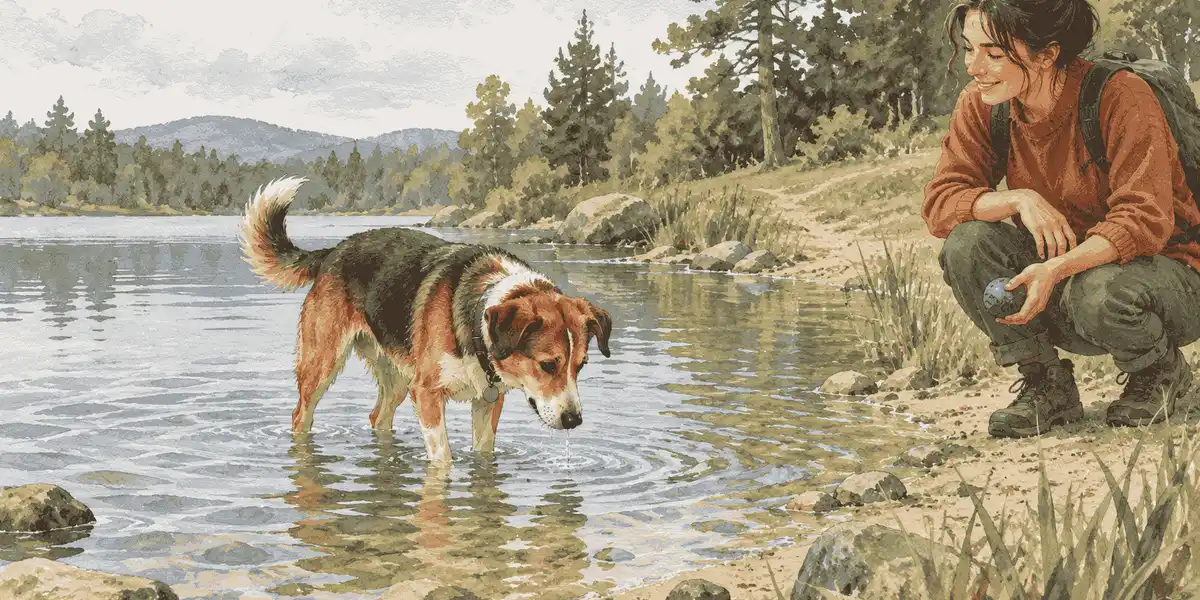
Before you pack a water toy, look at the setting. A calm, shallow edge with a visible route back to dry ground creates a different decision from fast-flowing water, rough sea, a reservoir, hidden debris, or water that may be contaminated. If you cannot describe where the dog will get out, the toy is not the missing part of the plan.
Introduce the water in small steps. Let the dog investigate the edge and choose whether to put in a paw. Keep your own route and the dog’s route out clear. Do not throw a toy beyond the dog’s comfortable depth to test swimming, force a frightened dog into the water, or assume that a dog associated with water needs no teaching. A retrieval game should preserve choice, not turn the toy into a reason to follow you farther than the dog can safely return.
The same principle applies on a walk: equipment should support the setting rather than create pressure. Our dog-leash guide covers how to match walking equipment to the job and keep room for sniffing and choice.
Match the Water Toy to the Dog in Front of You
Once the water and exit work, apply the ordinary toy checks. Blue Cross play guidance recommends matching a toy to the individual dog’s preferred game—chasing, retrieving, tugging, or searching—rather than treating a label as a safety guarantee.
Before each session, ask:
- Is the toy too large for this dog to swallow whole, while still practical for the game?
- Are its seams, handles, and attachments sound, with no loose, split, cracked, or missing pieces?
- Does this dog carry and release it, or try to shred and swallow parts?
- Can you supervise continuously for as long as the dog has access to it?
Water play does not make a damaged toy acceptable. A 2022 multicentre study in Animals described toys, balls, and fragments among objects recovered from 72 dogs treated for gastrointestinal foreign bodies. That clinical series does not tell you the odds of a particular toy causing trouble, but it supports a simple prevention habit: inspect the toy, retire it when its shape or condition changes, and treat a missing piece as useful veterinary history.
There is no universally indestructible water toy. If the dog dismantles an object quickly or tries to swallow pieces, the safer choice may be a different activity on dry ground rather than a tougher promise on the packaging.
Teach the Exit Before the Retrieve
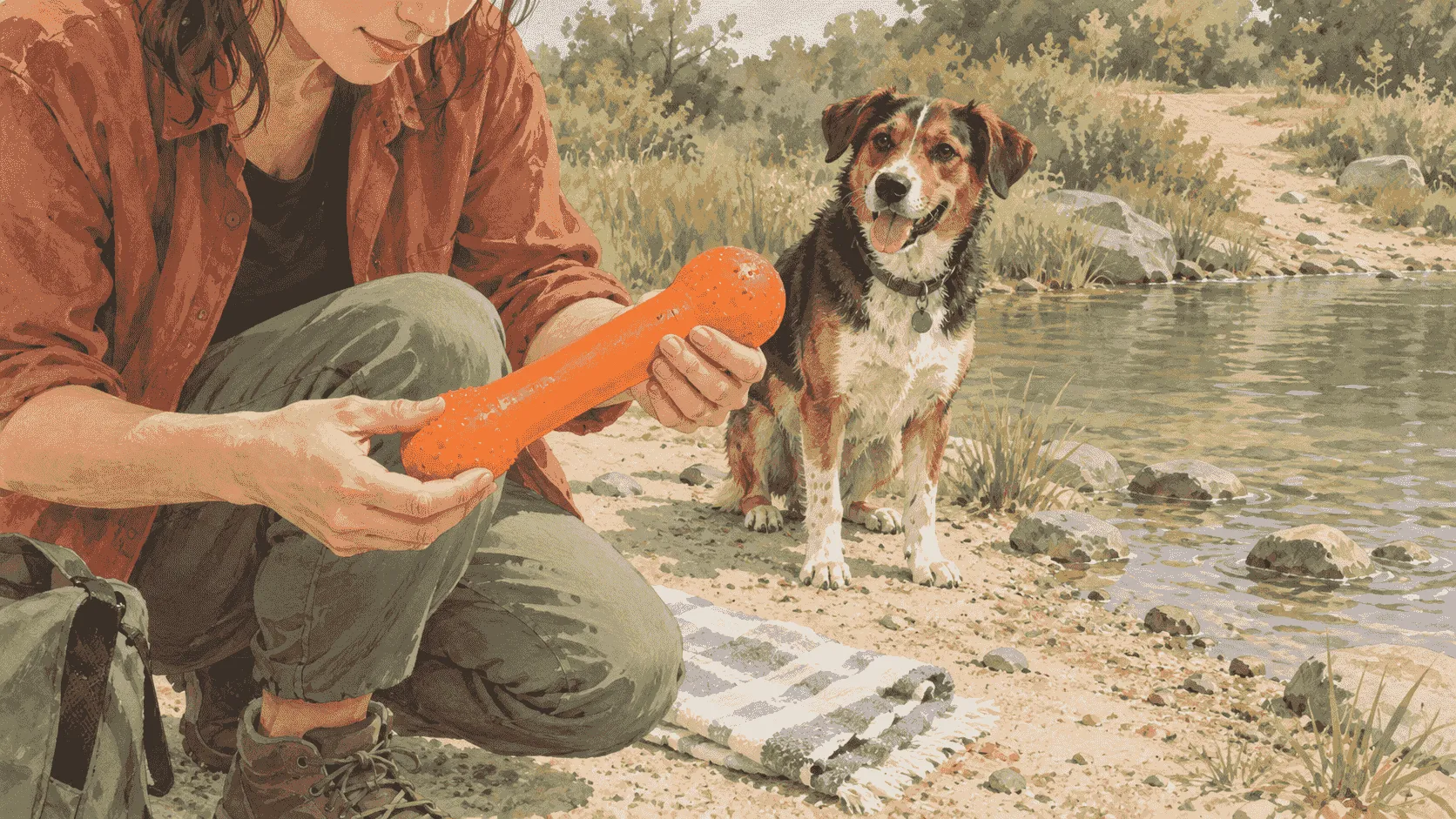
The first water game can be much smaller than a full fetch. Let the dog move at the shallow edge, turn back, and leave the water without being hurried. Keep the toy close enough that the dog can return through the same visible route. If the dog stops choosing the water, cannot find the exit, or needs to be pulled toward shore, end the game rather than adding excitement.
This is also why a water toy should not be used to lure a dog into deeper or faster water. The toy can be interesting while the conditions remain unsuitable. PDSA specifically separates gradual, choice-based introduction from rough seas, reservoirs, fast-flowing water, and other hazards. In an emergency, do not enter dangerous water after a dog; call for professional help.
For a new dog who is still learning how to move through the world, a dry-land version may be the better first win. The broader dog-toy safety guide covers size, condition, chewing habits, and simple search games without asking water to be part of the lesson.
Keep the Game Short, Visible, and Varied
Blue Cross recommends varying play and matching the activity to the individual dog. In water, that can mean a brief retrieve near shore rather than repeated long launches. Let the toy land before the dog sets off instead of building the game around high airborne catches; the lower-demand version gives you more time to watch the whole dog and the route back.
Supervision is an active check, not a person standing somewhere nearby. Keep the dog in view, notice whether the toy remains intact, and watch whether the dog can pause, turn, and exit. Stop if the water changes, the toy is damaged, the dog begins trying to ingest pieces, or you can no longer supervise the session.
Water toys are only one kind of enrichment. Blue Cross describes enrichment as safe opportunities for natural behavior such as searching, scent work, food foraging, problem solving, and calm environmental choice. If swimming is not a good fit today, a sniff walk, simple search, or easy dry-land game can still give the dog a useful job. Enrichment does not replace ordinary exercise, reward-based training, veterinary care, or behavior support, and it is not a treatment for anxiety.
Use a Simple Go, Pause, or Stop Check
Before the next outing, sort the plan into one of three lanes:
- Go: the water is suitable, the dog chooses a shallow entry, the exit is visible, the toy is appropriately sized and intact, and you can supervise continuously.
- Pause: the dog is unfamiliar with the setting, the exit is unclear, the conditions have changed, or the toy needs inspection. Stay on dry ground or simplify the game.
- Stop and call: there is a water emergency, possible swallowed material, or a missing toy piece. Keep the details and the toy if safe to do so, and ask your veterinarian for direction.
If possible ingestion is followed by vomiting, appetite loss, abdominal pain, diarrhea, dehydration, or lethargy, Cornell’s veterinary guidance supports prompt assessment. Do not wait for a missing piece to prove that it has caused an obstruction, induce vomiting, or rely on a home remedy.
The practical choice is therefore modest: make the water and exit safe first, choose a sound toy that suits this dog, and keep the game close enough to supervise. A water toy can support play; it cannot replace swimming skill, a clear route out, or your attention.
Sources
Petzette's claim cards for this article point to the following scientific, veterinary, or animal-welfare sources.
- PDSA Dog Water Safety: Veterinary-welfare water safety guidance
- Gastrointestinal Foreign Bodies In 72 Dogs: Peer-reviewed multicentre retrospective clinical study
Di Palma C, et al. *Animals*. 2022;12(11):1376. doi:10.3390/ani12111376.
- Blue Cross: How To Play With Your Dog: Animal-welfare and behavior guidance
- Cornell: Gastrointestinal Foreign-Body Obstruction In Dogs: Veterinary-school clinical education
- Dog Nosework Positive Judgment Bias 2019: Peer-reviewed animal behaviour paper with Purdue Canine Welfare Science summary
- Blue Cross Dog Enrichment: Animal welfare charity guidance / dog enrichment advice