Nutrition15 July 2026
How Much to Feed a Puppy: Start, Measure, Recheck
How much to feed a puppy depends on the food and the puppy. Use the label as a starting point, count extras, then recheck growth.
TextPetzette Editorial
Read4 Min

Evidence status
Source-backed editorial
- Evidence record
- 6 claim cards linked to 4 documented sources.
- Independent expert review
- Not commissioned. Petzette Editorial is responsible for the published wording.
- Source record checked
- 11 July 2026
- Scope
- General information, not an individual diagnosis or treatment plan.
How much to feed a puppy cannot be answered safely with one universal scoop. The useful starting amount depends on the food’s energy density and feeding directions, plus the puppy’s life stage, size, growth, body condition, activity, and health. Start with the current food’s label, measure one daily plan consistently, then recheck the puppy rather than defending the first number forever.
If the current food has not been screened for growth, begin with our guide to choosing puppy food for healthy growth. Portion planning works only after the nutritional foundation makes sense.
Start With the Current Food’s Feeding Guide
In the United States, first find the nutritional adequacy or intended-use statement. For a generally healthy puppy, look for a complete and balanced food made for dogs in the growth life stage. A treat, topper, or product labeled for intermittent or supplemental feeding cannot carry the main nutritional work of growth.
Next, find that food’s feeding directions. AAFCO label guidance describes these directions as guidelines that may need adjustment for the individual animal. The 2021 American Animal Hospital Association nutrition guidelines similarly treat the package amount as a starting point, followed by individual assessment and monitoring.
Use the directions for the food actually in the bowl. The same volume of a different food may deliver a different intake, so carrying an old scoop amount into a new bag is not a reliable comparison.
Why a Puppy Feeding Chart Cannot Give One Final Number
A puppy feeding chart by age or weight can organize a manufacturer’s starting guidance, but age or kilograms alone do not finish the decision. The safe amount also depends on the particular food, its energy density, the puppy’s body and muscle condition, growth pattern, activity, and health history.
That is why two healthy puppies of the same age may not stay on an identical portion. It is also why a hungry-looking expression does not settle the question by itself. The uncertainty is real: a general article cannot see the puppy, assess growth, or know the full diet.
Do not translate an online chart into a homemade calorie target, or add cups from two different foods as if they were interchangeable. When a mixed-food plan becomes hard to reconcile, ask your veterinarian to help set the starting total.
Make One Measured Daily Plan
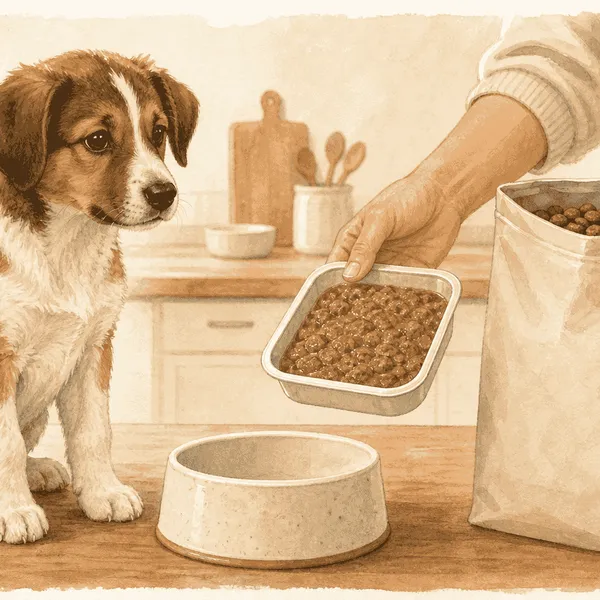
Write down the food, the label’s starting amount, and every other source of food in the day. Measure the main food the same way each time and make sure everyone in the household is working from the same daily plan. This is more useful than several people topping up the bowl from memory.

Count training rewards, toppers, table bites, and chews rather than treating them as invisible. For generally healthy pets, AAHA recommends that complete and balanced food provide at least 90 percent of total calories, with extras limited to 10 percent or less. Ten percent is a ceiling, not a promise that every extra is suitable. Our everyday dog-treat guide explains how to keep rewards in their supporting role.
The plan may be divided into the meal pattern chosen for the puppy, but dividing food does not increase the daily total. If a veterinarian has given a therapeutic or growth-specific plan, follow that individual direction instead of this general framework.
Recheck the Puppy, Not Just the Scoop
AAHA recommends reassessing nutrition with weight, growth, body condition, muscle condition, activity, and health in view. A scale supplies one useful number, but it is not the whole assessment. WSAVA body-condition tools help veterinary teams assess fat stores through body shape, while muscle condition is considered separately.
Body condition is a shape check, not a shame check. Ask your veterinary team to show you what they are assessing rather than guessing from a photo or comparing your puppy with another dog online. Keep a simple record of the food, measured amount, weight, appetite, digestion, and any advice you receive. That turns a vague impression into a history the team can review.
For a puppy expected to become large or giant, portion review matters alongside food choice. AAHA guidance supports steady growth and a lean body condition while avoiding excessive calcium. Check that the food is suitable for large-breed growth, and do not add calcium unless your veterinarian recommends it.
Know When the Starting Plan Needs Professional Help
Contact your veterinarian if growth seems off, appetite changes, body condition shifts quickly, or vomiting, diarrhea, low energy, pain, or other illness signs appear. Those changes need assessment; they are not a cue to keep adjusting the scoop by trial and error. Puppies with disease, persistent digestive signs, a suspected food reaction, or a therapeutic need require an individual nutrition plan.
Your useful next step is concrete: photograph the current food’s adequacy statement and feeding directions, record everything the puppy receives in one day, and bring both to the next veterinary check. The label supplies the beginning. The puppy’s growth and health decide what needs to change.
Sources
Petzette's claim cards for this article point to the following scientific, veterinary, or animal-welfare sources.
- AAHA Nutrition And Weight Management Guidelines 2021: Peer-reviewed veterinary clinical guideline
Cline MG, Burns KM, Coe JB, et al. 2021 AAHA Nutrition and Weight Management Guidelines for Dogs and Cats. Journal of the American Animal Hospital Association. 2021;57:153-178.
- AAFCO Pet Food Labels And Nutritional Adequacy: US feed-control association consumer and regulatory guidance
- WSAVA Body Condition Score Tools: Veterinary association nutrition toolkit
- WSAVA Selecting Pet Food Toolkit 2021: Global veterinary nutrition toolkit / food-selection guidance