Nutrition04 September 2026
Senior Dog Food vs Adult Food: How to Check the Fit
Senior dog food is not one universal prescription. Compare the full label with your dog's body, appetite, activity, and health before changing.
TextPetzette Editorial
Read6 Min

Evidence status
Source-backed editorial
- Evidence record
- 10 claim cards linked to 7 documented sources.
- Independent expert review
- Not commissioned. Petzette Editorial is responsible for the published wording.
- Source record checked
- 04 September 2026
- Scope
- General information, not an individual diagnosis or treatment plan.
Senior dog food versus adult food is not a decision settled by the word on the front of a bag. For an older dog that is doing well on a complete and balanced adult-maintenance food, age alone does not require an automatic switch. The American Animal Hospital Association (AAHA) says there is no universal AAFCO nutrition standard for senior dogs, and manufacturers do not share one consistent definition of a senior diet.
That does not make senior-labelled food pointless. It means the useful question is narrower: what does this dog need the food to do, and what evidence will tell you whether the current plan still fits? The dog’s body condition, muscle, appetite, activity, history, and health matter more than a single age label.
“Senior” Is Not a Universal Nutrition Standard
AAHA’s nutrition guidance explains that AAFCO does not set specific nutritional requirements for mature, senior, or geriatric pets. AAFCO’s recognized life stage language includes categories such as growth, maintenance, and all life stages; “senior” is not one universal nutritional adequacy category shared by every manufacturer.
So when you see senior dog food, treat the word as a reason to read further, not as proof that the food is automatically lower calorie, higher protein, or better for every older dog. The label may reflect a manufacturer’s own recipe and marketing choices. It does not, by itself, tell you whether the food fits a dog who is lean, gaining weight, losing muscle, managing a condition, or simply eating well.
Age still provides useful context. AAHA’s canine life-stage framework places a dog’s senior stage in the last 25% of its estimated lifespan, rather than at one fixed birthday. The life-stage framework for senior dogs explains why that estimate starts a care conversation but does not prescribe a food change.
Start With the Whole Label
Use the package as a screening tool. First find the nutritional adequacy statement and intended use. Check that the food is for dogs and is complete and balanced for the life stage it claims to support. A product intended only for intermittent or supplemental feeding is not the same decision as the main food in an ordinary feeding plan.
Then read the feeding directions and energy information for the food you are actually serving. Package directions are starting points, not prescriptions for an unseen dog. The amount may need to be reconsidered with activity, weight, body condition, muscle condition, and health in view. Do not carry the same cup amount from one food to another and assume that the dog’s intake stayed the same.
AAFCO develops model nutrient profiles, feeding protocols, and label standards, but it does not approve, certify, test, or endorse individual food brands. That means an AAFCO adequacy statement can help you understand the claim being made; it is not a product award.
The ingredient list is also only one piece. WSAVA food-selection guidance points to questions about who formulates the diet, whether the finished food is analysed, what quality controls are used, and whether the manufacturer can answer nutrient questions. Words such as “premium,” “natural,” or “senior” do not settle those questions, and the first ingredient does not measure the finished food’s complete nutritional performance.
Compare the Food With the Dog in Front of You
Before changing a stable plan, make a short observation record. You are not trying to diagnose the dog at home; you are making the next discussion more specific.
- Body condition and muscle: Has the dog’s shape or muscle appearance changed gradually or quickly? Body condition is a shape check, not a shame check, and muscle condition is a separate observation. One photograph or weigh-in cannot explain why a change happened.
- Appetite and acceptance: Is the dog eating the ordinary food willingly, leaving meals, seeking extras, or finding the texture harder to manage? A change in appetite can be a reason for veterinary advice, not an invitation to cycle through foods until one seems appealing.
- Activity and routine: Is the dog moving and resting as usual? A change in activity can alter the feeding context, but it does not tell you which diet or portion to prescribe. Record the pattern and ask the veterinary team.
- Health and history: Note known conditions, previous food changes, current veterinary instructions, and any persistent vomiting, diarrhoea, pain, or other illness sign. A senior-labelled maintenance food is not a substitute for a therapeutic plan when disease is part of the decision.
For a generally healthy dog, keep complete and balanced food as the nutritional foundation. AAHA recommends at least 90% of calories from that foundation, with treats and other extras at 10% or less; that is a ceiling, not a promise that every extra is suitable for every dog.
What About Small, Large, Wet, or Dry Senior Food?
Searches for “senior dog food small breed,” “senior dog food large breed,” or the best senior wet dog food can make the choice look like a format or size contest. Size, activity, food texture, and the dog’s ability to eat can all be relevant context, but none creates a universal winner.
For a small or large older dog, begin with the same questions: what is the adequacy statement, what is the current body and muscle pattern, what does the dog actually eat, and what does the veterinarian want monitored? Do not assume that a small-breed or large-breed senior label resolves those questions.
For wet versus dry food, compare the complete-food claim and the dog’s response rather than treating one format as automatically superior. If appetite, chewing, swallowing, or food acceptance has changed, bring that change to the veterinary team. The format may be part of a practical plan, but it does not explain the reason for a symptom.
If You Decide to Change the Food
When an otherwise stable dog needs a routine food change, introduce it gradually enough to monitor acceptance, stool, and tolerance. Keep the rest of the feeding plan steady when practical, so you can tell which change you are observing. Read the new food’s directions rather than copying the old portion.
Do not use a generic transition schedule to manage active or repeated vomiting, diarrhoea, appetite loss, pain, lethargy, blood, suspected toxin or foreign object exposure, or a veterinarian-directed therapeutic diet. Those situations belong with veterinary advice. If this is sudden or severe, ask a veterinarian rather than adjusting the bowl at home.
When the “Best” Food Question Becomes a Vet Question
Ask your veterinarian before changing a prescribed food, and make an appointment when weight or muscle is changing, appetite is persistently different, or the dog has vomiting, diarrhoea, pain, low energy, or another concerning sign. A nutrition checklist cannot diagnose the cause or choose a therapeutic diet.
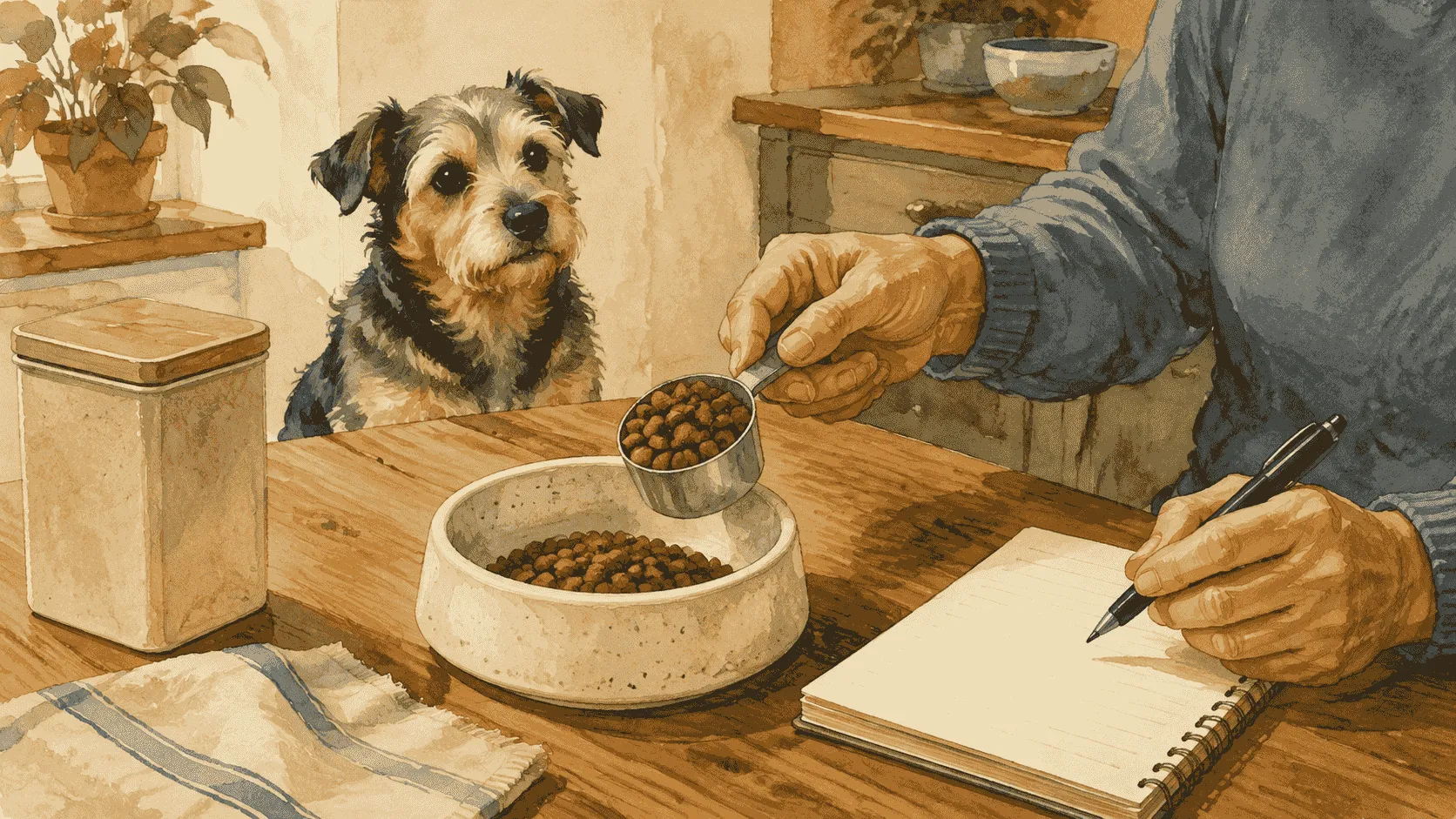
Your next step is concrete: photograph the current food’s adequacy statement and feeding directions, write down what the dog receives in an ordinary day, and note appetite, stool, activity, body condition, and muscle observations. Bring that record—and the label—to the veterinary team. The measured adult-dog feeding plan can help you organize the ordinary-day record, while the senior-food decision stays anchored to this individual dog rather than a universal package promise.
Sources
Petzette's claim cards for this article point to the following scientific, veterinary, or animal-welfare sources.
- AAHA Senior Dog Food Decision Guidance: Veterinary nutrition and senior-care guidance
- AAFCO Pet Food Labels And Nutritional Adequacy: US feed-control association consumer and regulatory guidance
- AAHA Nutrition And Weight Management Guidelines 2021: Peer-reviewed veterinary clinical guideline
Cline MG, Burns KM, Coe JB, et al. 2021 AAHA Nutrition and Weight Management Guidelines for Dogs and Cats. Journal of the American Animal Hospital Association. 2021;57:153-178.
- WSAVA Selecting Pet Food Toolkit 2021: Global veterinary nutrition toolkit / food-selection guidance
- WSAVA Principles Of Wellness 2025: Global veterinary-association wellness guidance
- Cornell Dog Diarrhea Guidance: Veterinary-school clinical owner guidance
- WSAVA Body Condition Score Tools: Veterinary association nutrition toolkit