Published 11 July 2026Breeds

Magazine
Breeds10 July 2026
Smartest dog breeds lists compress many skills into one score. Here is what breed studies can—and cannot—tell you about an individual dog.
TextPetzette Editorial
Read4 Min

Search for the smartest dog breeds, and the phrase invites a tidy ladder of the most intelligent dog breeds. But dog intelligence is not one ability with one winner. A dog can perform strongly on one kind of task and differently on another, while dogs of the same breed can still vary widely as individuals.
That does not make breed irrelevant. It makes the usual ranking too blunt. The better question is not simply, “Which breed is smartest?” It is, “Smart at which task—and what does that tell us about this particular dog?”
Researchers can examine specific abilities and behaviors: following a human gesture, controlling an immediate response, working through a spatial problem, using short-term memory, or responding when a problem cannot be solved. Those are different questions, not interchangeable versions of a universal intelligence test.
This matters because a broad label such as “smart” hides what was actually measured. A dog that performs well when reading a human gesture has shown something about that task. The result does not automatically place the dog above another dog in every kind of learning or problem-solving.
For a closer example of a particular social behavior, see why dogs look to people when they are unsure. Naming the behavior makes the explanation more useful than treating every interesting response as evidence of a single intelligence score.
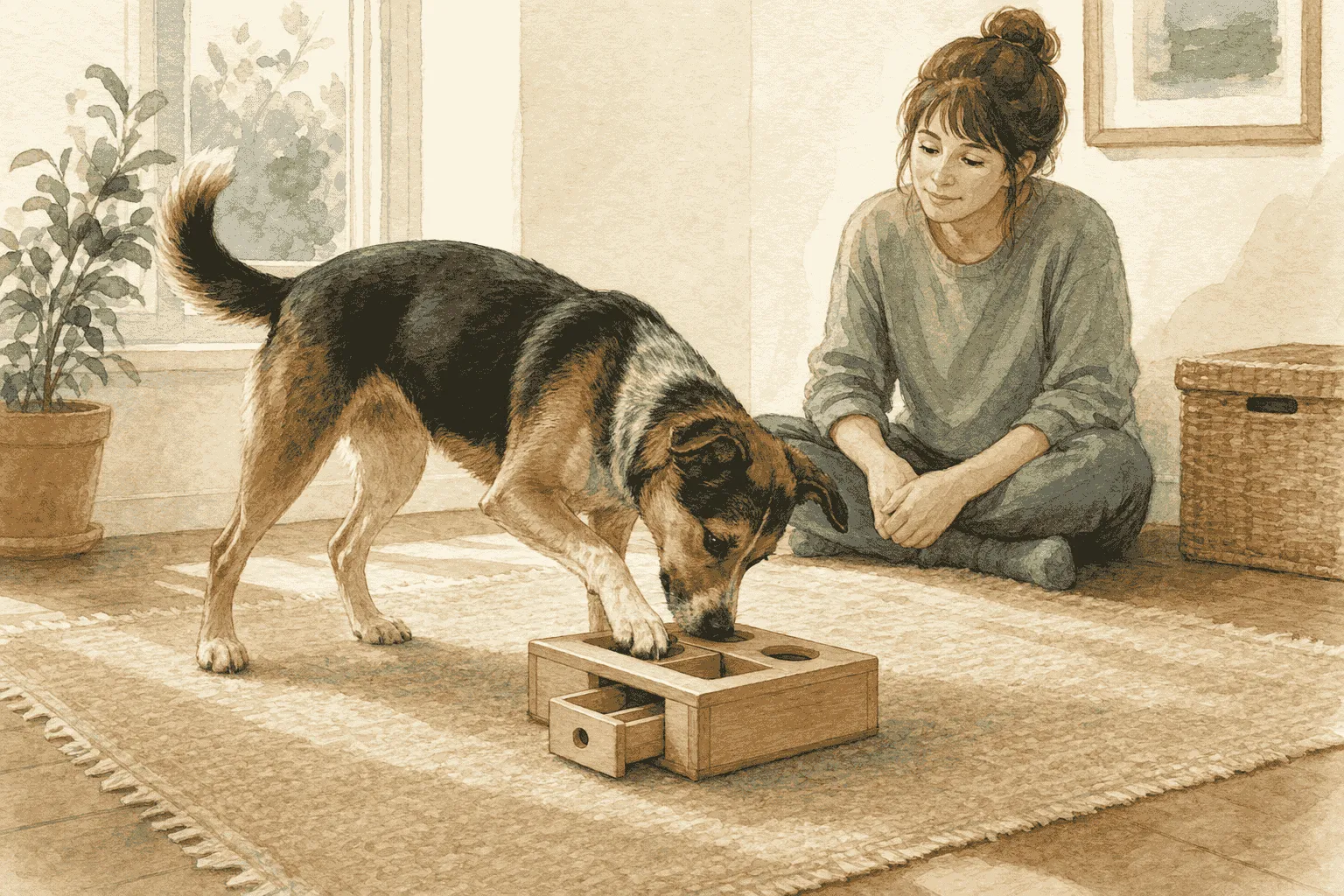
A 2022 study led by researchers at the University of Helsinki and published in Scientific Reports tested 1,002 Finnish dogs using a cognitive test battery. The analysis covered 13 breeds, each represented by at least 40 tested dogs.
The researchers found breed differences in several specific tests, including inhibitory control, understanding human gestures, spatial problem-solving, activity level, greeting an unfamiliar person, exploration in a new environment, and behavior during an unsolvable problem. They did not find breed differences in the logical-reasoning or short-term-memory tasks used in the study.
That pattern is the point: performance varied by the measure. The study did not establish one breed as the universal winner, and its 13-breed sample cannot stand in for all dogs. The University of Helsinki’s own summary cautioned against extending results from specific problem situations to the general behavior of an individual dog.
Another 2022 paper, by Morrill and colleagues in Science, looked at a much larger set of dogs from the Darwin’s Ark research project. The work drew on surveys covering more than 18,000 dogs and genetic data from more than 2,000.
In that study, breed explained only a small share of the behavioral variation among individual dogs. Some broad tendencies still had a genetic component, but a breed label was a weak guide to the full behavior of one dog.
The careful takeaway sits between two extremes. Breed is not meaningless, and it is not a personality guarantee. It may offer a hint about some tendencies, while individual history, environment, training, age, sex, and immediate context also matter. A breed label can hint, but it cannot introduce the individual dog.
Popular rankings often blur responsiveness in human-led training with intelligence as a whole. Yet the research separates human-gesture reading, inhibitory control, memory, reasoning, and problem-solving into different measures. Folding them into one score removes the very distinctions the tests were designed to examine.
That distinction also changes how we talk about an individual dog. Quick responses to a familiar cue describe one part of performance. Spatial problem-solving describes another. Behavior during an unsolvable task describes something else again. None of these results, alone, can tell you how a particular dog will learn across situations.
Before accepting a ranking, ask a few concrete questions:
A useful account should answer at least some of those questions. If it only presents a numbered list, it may be offering a clean headline instead of a clear measure.
Breed can be one piece of context. It is not the whole portrait, and the same research that finds some breed differences also warns against overgeneralizing them.
So when someone names the smartest dog breeds, pause before accepting the order. Ask what the dogs were asked to do, what the study actually measured, and how much individual variation remains. “Smart at what?” is not a dodge. It is the question that makes dog intelligence meaningful.
Petzette's claim cards for this article point to the following scientific, veterinary, or animal-welfare sources.