BehaviorUpdated 12 July 2026
Why Cats Knead: What Making Biscuits Can—and Can't—Tell You
Why do cats knead? The kitten origin is clear, but adult meaning depends on the individual cat, the setting, and the rest of the body.
TextPetzette Editorial
Read3 Min
Evidence status
Source-backed editorial
- Evidence record
- 2 claim cards linked to 2 documented sources.
- Independent expert review
- Not commissioned. Petzette Editorial is responsible for the published wording.
- Source record checked
- 12 July 2026
- Scope
- General guidance. Individual animals and circumstances can differ.
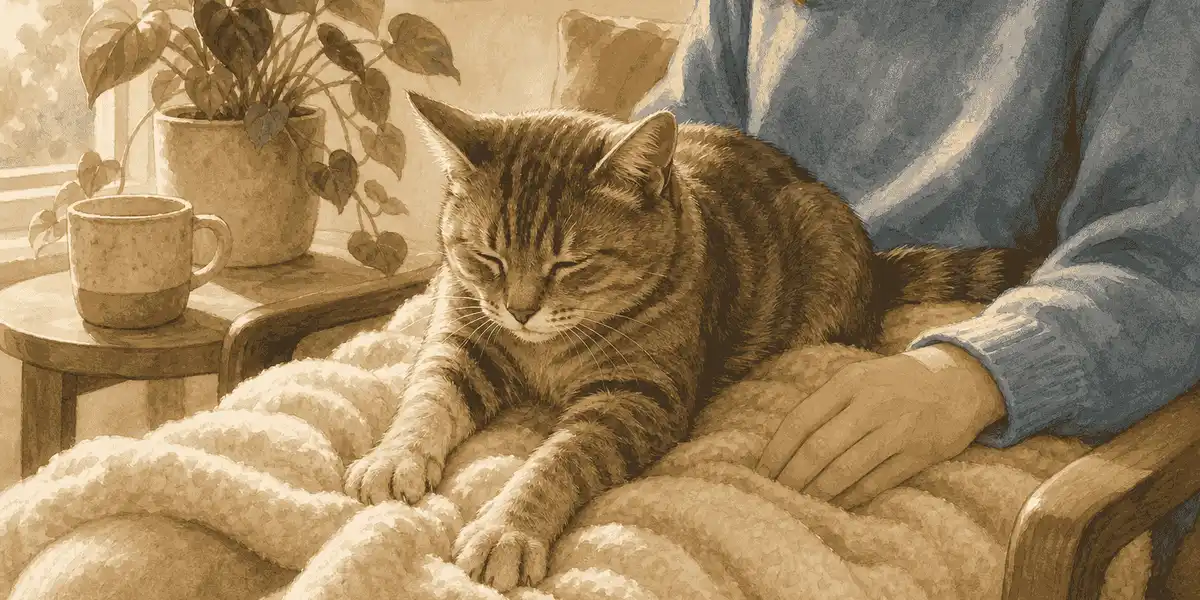
Why do cats knead? The movement nicknamed “making biscuits”—alternating front paws pressed into a blanket, bed, or lap—looks wonderfully purposeful. The honest answer is split in two: its kitten context is clear, while its adult meaning remains an open question.
That distinction matters. A familiar behavior can be delightful without becoming a secret emotional code. The paws give you an observation; the individual cat, setting, and rest of the body provide the context.
The known part begins with nursing
Kittens knead around the mother’s teats while nursing, in connection with milk flow. Some cats continue a similar alternating forepaw movement into adulthood. Cats Protection’s behavior guidance draws a careful line here: the kitten function is observable, but why some adults keep doing it is not known.
Comfort, automatic response, and preparation of a resting place are commonly repeated explanations. They are plausible hypotheses, not three proven jobs performed by every kneading cat. The available evidence also does not let us infer that a cat was weaned early, is remembering its mother, or is releasing a particular “happy hormone.”
Read the whole cat, not only the paws
A 2022 review in Animals examined domestic-cat sociality and human-cat interaction research. In some interaction studies summarized by the review, kneading appeared among several affiliative or positively valenced behaviors. Crucially, it was one part of a wider pattern, and cats varied substantially in how they responded to people and touch.
So a cat kneading a familiar blanket with a loose posture, ordinary ears and tail, and its usual settling routine may fit a relaxed moment. That still does not make kneading proof of contentment, affection, trust, or ownership. A cat that does not knead is not less bonded, either.
The surface is context too. A blanket, bed, another animal, and a person’s lap are different situations, even when the paws make the same motion. Treat each event as a small scene rather than evidence for a universal personality trait.
This is the same useful restraint that applies when asking why cats purr: one behavior can appear in more than one context. Look at what happened before, what the cat does next, and whether the whole pattern is normal for that individual.
When claws get involved
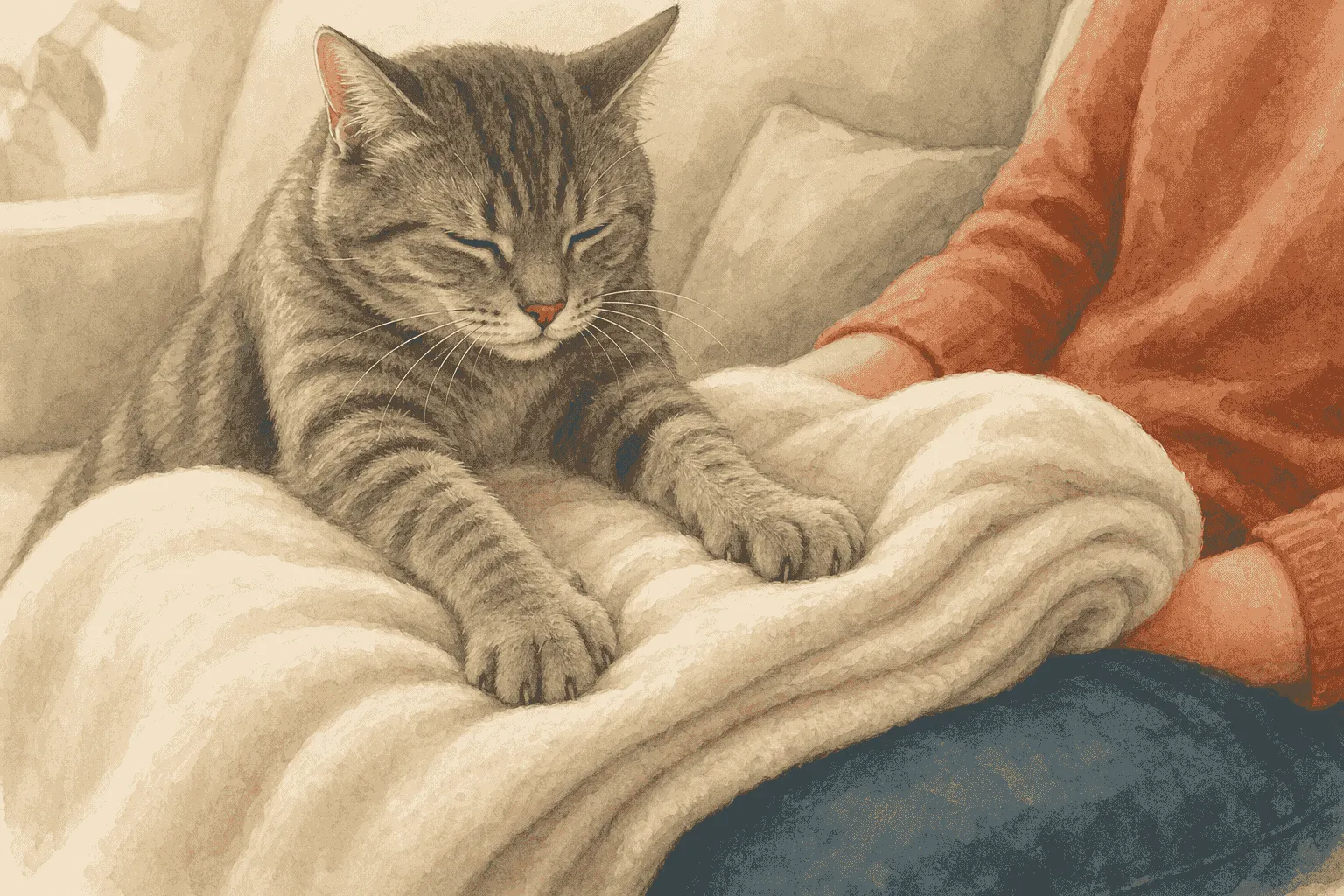
Kneading can extend the claws, making a soft ritual unexpectedly sharp. You do not need to assign a motive or punish the cat. Protect skin and fabric by changing the surface calmly:
- Keep a thick folded blanket within reach and place it between paws and lap.
- Invite the cat toward another soft surface rather than shouting or pushing.
- Let the cat leave; do not hold it in place to continue an interaction.
If claw care itself is difficult, ask a veterinary professional to show you a cat-appropriate approach. Avoid turning a quiet kneading moment into forced handling.
A change matters more than a theory
The safest question is not “What does kneading always mean?” It is “Is this my cat’s ordinary pattern?” Notice changes in frequency, location, posture, appetite, activity, hiding, vocalizing, and tolerance of touch. Do not use kneading alone to diagnose pain or stress, and do not use it to dismiss other concerning signs.
If kneading changes suddenly and persistently, or arrives alongside reduced appetite or activity, unusual hiding, sensitivity to handling, or another health change, ask your veterinarian. A short note or video showing the wider context may be more useful than an interpretation.
For an otherwise familiar scene, enjoy the motion without translating it too confidently. The most evidence-friendly answer is also the most feline: adult kneading can sit inside a comfortable routine, but the paws do not tell the whole story.
Sources
Petzette's claim cards for this article point to the following scientific, veterinary, or animal-welfare sources.
- Cats Protection Cat Kneading Explainer: National cat-welfare charity behavior explainer
- Finka Domestic Cat Sociality Review 2022: Peer-reviewed scientific review
Finka LR. Conspecific and Human Sociality in the Domestic Cat: Consideration of Proximate Mechanisms, Human Selection and Implications for Cat Welfare. Animals. 2022;12(3):298. doi:10.3390/ani12030298.