Breeds12 October 2026
Best Family Dog? Start With a Household Fit Checklist
Looking for the best family dog? Use a practical checklist for time, training, activity, grooming, supervision, and the individual dog's history.
TextPetzette Editorial
Read5 Min

Evidence status
Source-backed editorial
- Evidence record
- 6 claim cards linked to 10 documented sources.
- Independent expert review
- Not commissioned. Petzette Editorial is responsible for the published wording.
- Source record checked
- 13 July 2026
- Scope
- General guidance. Individual animals and circumstances can differ.
The best family dog is not a prize you find at the top of a breed list. It is an individual dog whose daily needs, history, and support plan fit the life your household can actually provide. That makes “best” a useful question only after you define what your family can do.
Merck Veterinary Manual guidance puts size, activity level, temperament, and coat type on the selection checklist. Blue Cross adds time, exercise, grooming, training, socialisation, cost, health care, and safe housing. Together, those checks turn a vague search into a decision you can test.
Treat “Best” as a Fit Question
Start by replacing the ranking question with a household question: Which dog’s needs can we meet consistently, including on busy weeks?
This is not an argument that breed information is useless. Breed history can suggest questions about likely care patterns, coat work, activity, or training. It is a prompt for research, not a personality guarantee or a substitute for the dog’s current life experience.
The distinction matters because a family may have children, visitors, school runs, work shifts, other animals, or limited time for grooming and training. A dog that looks appealing in a photo may still be a poor match if its ordinary care needs do not fit the household. For the wider selection process, use this guide alongside a general dog-breed fit checklist, which explains how to read breed labels without treating them as predictions.
Map Your Actual Family Week
Before comparing breeds or meeting dogs, write down an ordinary week rather than an ideal weekend. Mark the parts of care that need a person, a predictable routine, or a backup plan:
- walks and other exercise that suit the individual dog’s capacity;
- meals, water, toileting, play, and quiet rest;
- short training and enrichment sessions;
- grooming, handling, transport, and veterinary visits;
- time at home and gradual practice for being alone; and
- who takes responsibility when school, work, travel, or illness changes the plan.
Dogs Trust’s readiness guidance asks whether prospective owners have enough time for daily walks, games, training, and routine. It also describes alone time as something to build gradually within the individual dog’s comfort. That is different from assigning one universal hour limit or assuming a crate solves a difficult transition.
RSPCA puppy-selection guidance similarly asks families to consider space, outdoor access, exercise, training, play, company, grooming, health issues, and responsible sourcing. If you are preparing for a puppy, the first-month puppy checklist can turn those broad commitments into a week-by-week plan. If the plan works only when one adult is never delayed, add support before you choose.
Translate Breed Ideas Into Care Work
Use a breed profile to make a short list of questions, then answer those questions with the individual dog in mind:
- Activity: What movement, play, and mental work does this dog appear to need, and who will provide it?
- Care: What coat care, handling, transport, and health information are realistic for the household?
- Training: Which skills are already established, and what calm, reward-based practice will continue?
- Home: Is there room for feeding, resting, play, and a quiet retreat without constant traffic?
- History: What is known about the dog’s previous homes, experiences, handling, and responses to change?
The MSD Veterinary Manual notes that size does not reliably predict activity level: some small dogs need substantial exercise, while some larger adults may be relatively low-activity. Do not use a small body as shorthand for “easy,” or a large body as shorthand for “too much.” Match the care work to the individual dog and your real resources.
A 2022 study in Science surveyed more than 18,000 dogs and genotyped more than 2,000. In that study, breed explained only a small share of individual behavioral variation. The useful takeaway is not that breed never matters. It is that a breed name cannot answer the family-fit question by itself.
Design Child-and-Dog Safety Before the First Meeting
If children live with or regularly visit the dog, safety needs to be a routine owned by adults, not a label attached to a breed. Oklahoma State University veterinary extension guidance says any dog of any breed can bite, and that young children should not be left alone with a dog. It also emphasizes the dog’s individual history and behavior.
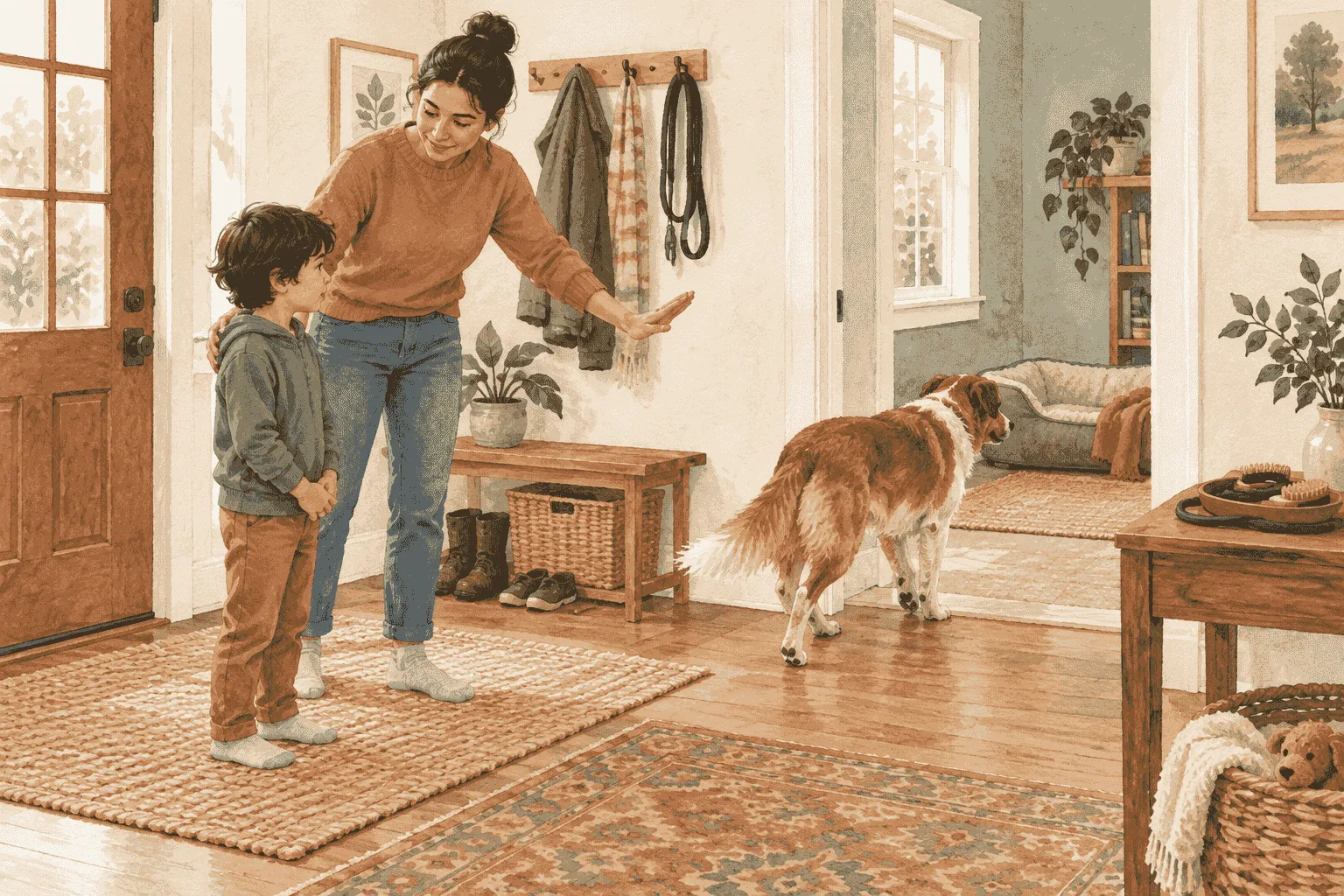
Blue Cross describes active supervision as consciously watching both child and dog. When the adult’s attention moves elsewhere, use positive separation. Children should not approach a dog that is sleeping, eating, chewing, unwell, hiding, retreating, or trying to move away. A bed or safe area needs to remain an undisturbed exit, not a play zone.
Before you choose, agree on the household rules:
- an adult manages every child-and-dog interaction;
- the dog can move away without being followed;
- children learn to leave rest, food, toys, and retreat spaces alone; and
- adults pause the interaction when either child or dog becomes overexcited, worried, tired, or difficult to supervise.
“Family-friendly” may describe a reputation, but it cannot make supervision optional. If a child’s age, the dog’s history, or the home’s layout makes those rules difficult to carry out, change the plan or seek qualified guidance before committing.
Ask for Evidence About the Individual Dog
Ask a breeder, rescue, foster caregiver, or current owner for observations rather than one-word assurances:
- What does this dog’s normal day look like, including activity and rest?
- How does the dog respond to children, visitors, handling, food, toys, and being interrupted?
- What training, grooming, health, or behavior support is already in place?
- Which parts of the history are unknown?
- What does the caregiver do when the dog needs space?
Unknown information is not automatically a reason to reject a dog. It is a reason to leave more room in the plan, arrange support, and avoid promising that a breed label will fill the gaps. A single meeting is one moment; repeated observations and honest records are more useful.
Make the Decision With the Limits Visible
Choose the dog only when you can name the routine, supervision plan, backup care, and unanswered questions. A family fit can change as a dog grows, a child develops, or the household schedule shifts, so build in a way to review the plan rather than expecting one choice to settle everything.
If the dog has marked fear, aggression, pain signs, illness, or a complicated history, ask the responsible caregiver what veterinary or qualified behavior support is involved. This checklist helps with observation and planning; it cannot diagnose a problem or replace professional assessment.
The next step is simple: write the family week, assign the care work, and ask about the individual dog before you compare another “best family dog” list. The strongest match is the one your household can support with time, training, supervision, and honest room for uncertainty.
Sources
Petzette's claim cards for this article point to the following scientific, veterinary, or animal-welfare sources.
- Blue Cross Choosing The Right Dog: Animal welfare organisation guidance
- Merck Veterinary Manual Selecting A Dog 2025: Veterinary education / owner guidance
- Dogs Trust Dog Ready And Breed Fit: Animal welfare charity guidance / dog-readiness and breed-fit advice
- MSD Veterinary Manual Selecting A Dog: Veterinary education / pet-owner guidance
- RSPCA Choosing The Right Puppy: Animal welfare charity guidance / puppy-selection advice
- Dog Breed Behavior Science 2022: Peer-reviewed genetics and behavior study with institutional summaries
- PDSA PetWise Choosing A Pet: Animal welfare charity guidance / pet-selection checklist
- Oklahoma State Canine Bite Prevention 2018: Veterinary college / cooperative extension public safety fact sheet
- Blue Cross Children And Dogs Supervision: Animal welfare charity guidance / child-dog safety advice
- Blue Cross: Being Safe Around Dogs: Animal-welfare caregiver guidance