Gear Decisions19 July 2026
Dog Teething Toys: A Puppy Safety Checklist
Dog teething toys need the right give, size, and supervision. Use this product-neutral checklist for safer puppy chewing and redirection.
TextPetzette Editorial
Read3 Min

Evidence status
Source-backed editorial
- Evidence record
- 5 claim cards linked to 10 documented sources.
- Independent expert review
- Not commissioned. Petzette Editorial is responsible for the published wording.
- Source record checked
- 19 July 2026
- Scope
- General guidance. Individual animals and circumstances can differ.
Dog teething toys are most useful when they pass three ordinary checks: they have some give, they cannot fit completely in your puppy’s mouth, and they stay intact during supervised chewing. The word “teething” on a label cannot make an object suitable for every puppy.
Start with one chew-specific toy and watch what your puppy actually does with it. A gentle chewer and a puppy determined to pull off pieces may need different setups. Your next decision should follow the dog in front of you, not a promise on the package.
Puppy Teething Is a Window, Not a Deadline
Puppies replace a deciduous set of baby teeth with a permanent set. The MSD Veterinary Manual says permanent teeth usually begin appearing at around four to five months, with the permanent set generally present by seven months. Those ages are context, not a home diagnosis or an exact timetable for every puppy.
Chewing can happen during this transition, but chewing alone does not confirm that the mouth is developing normally. Dogs also chew in several other contexts. A 2025 review in Frontiers in Veterinary Science describes chewing as a behavior with multiple possible functions, so a damaged chair leg does not identify one motive—and it is not evidence of spite.
How to Choose Dog Teething Toys
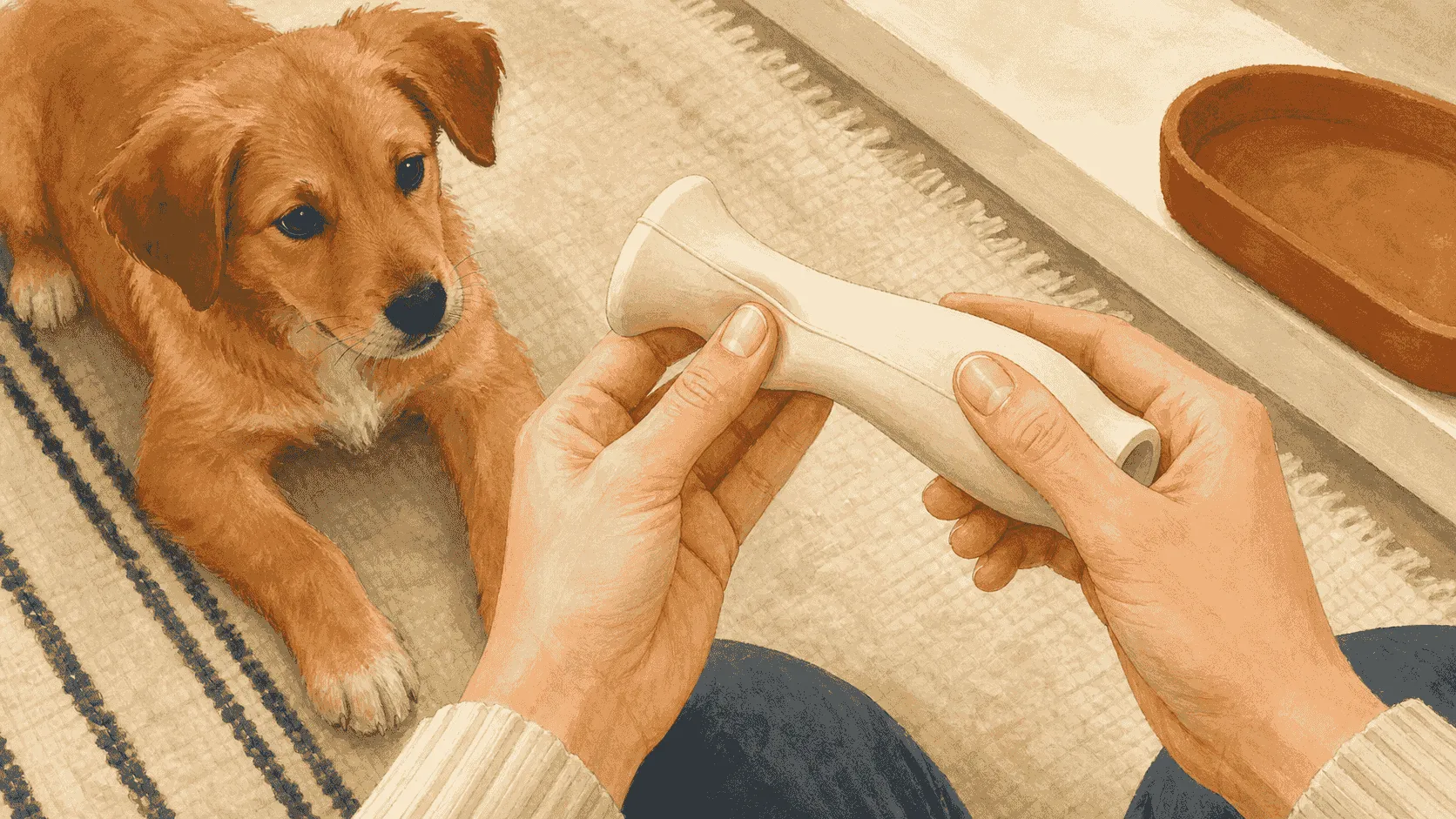
PDSA’s veterinarian-authored guidance offers a practical product-neutral starting point. Choose an item designed for chewing, with enough give that you can make an indent with a fingernail. Skip very hard objects that do not yield. Then check the whole size: the toy should not fit completely inside your puppy’s mouth.
Run this checklist before the first chew:
- Purpose: Is it designed to be chewed, rather than only carried, tugged, or thrown?
- Give: Can you make a small fingernail indent instead of meeting a rigid surface?
- Size: Is the whole object too large to fit completely in this puppy’s mouth?
- Construction: Are seams, edges, stuffing, and attachments easy to see and currently intact?
None of these features guarantees safety. Size needs to change as a puppy grows, and material that begins with some give can still split, shed, or become swallowable.
Make the After-Chew Check Part of the Toy
Offer the toy when you can watch how it is used. Look for attempts to swallow it whole, tear off pieces, strip fibers, or open seams. When the session ends, compare the toy with how it looked before. Retire it if the shape has changed, a seam has split, stuffing or fibers are exposed, or any piece is missing.
Do not leave a damaged toy available for one more session. A missing piece belongs in the history you give your veterinarian, even if your puppy seems comfortable at first. For a broader approach to size, condition, play style, and enrichment, use our safer dog-toy guide.
Redirect Puppy Chewing Without Punishment
A useful toy also gives you a planned “yes.” Keep it close before predictable busy periods. If your puppy mouths a hand, sleeve, or household object, make the moving target still, pause the interaction calmly, and offer the suitable chew. Reward calm engagement with the right object rather than chasing, shouting, or turning the swap into a wrestling match.
Dogs Trust guidance recommends anticipating common mouthing moments, preparing an age-appropriate supervised outlet, and briefly stepping away when teeth keep contacting people. The goal is not to make all chewing disappear. It is to teach where chewing can happen while keeping hazards out of reach.
If hands and clothing are the main target, the calm puppy-biting plan explains how to combine redirection, short pauses, rest, and professional boundaries.
Know When a Toy Is Not the Answer
A chew toy cannot diagnose teething, treat mouth pain, or solve distress. Contact your veterinarian if you notice a broken or oddly positioned tooth, oral bleeding, facial swelling, drooling, repeated food dropping, reduced appetite, difficulty eating, or a sudden change in chewing. Do not force open a sore mouth to look for proof.
Possible choking or ingestion, or a toy piece that has gone missing, also needs prompt professional direction. Tell the clinic what the object was, what seems to be missing, and what you have observed.
The useful next step is deliberately small: choose one chew-specific toy with some give, confirm that it cannot fit completely in your puppy’s mouth, supervise one session, and inspect it again. Let that before-and-after check—not a marketing label—decide whether the toy returns tomorrow.
Sources
Petzette's claim cards for this article point to the following scientific, veterinary, or animal-welfare sources.
- MSD Veterinary Manual: Dental Development Of Dogs: Veterinary reference manual
- Blue Cross: How To Play With Your Dog: Animal-welfare and behavior guidance
- Cornell: Gastrointestinal Foreign-Body Obstruction In Dogs: Veterinary-school clinical education
- PDSA: Dog Chewing And Chew-Toy Safety: Veterinary-authored animal-welfare guidance
- AVSAB Humane Dog Training 2021: Veterinary behavior society position statement
- Dogs Trust Puppy Mouthing And Biting Guidance: Animal-welfare organization guidance
- Dog Chewing Function And Welfare Review 2025: Peer-reviewed narrative review
- RSPCA Dog Home And Chewing Outlets: Animal-welfare organization guidance
- AAHA Dental Care Guidelines 2019: Veterinary practice guideline
- AVMA Pet Dental Care: Veterinary association client-education brochure