Behavior21 July 2026
How to Get a Puppy to Stop Biting the Leash
Learn how to get a puppy to stop biting the leash with a calm pause, an easier practice route, safe redirection, and clear help boundaries.
TextPetzette Editorial
Read4 Min

Evidence status
Source-backed editorial
- Evidence record
- 5 claim cards linked to 6 documented sources.
- Independent expert review
- Not commissioned. Petzette Editorial is responsible for the published wording.
- Source record checked
- 14 July 2026
- Scope
- General guidance. Individual animals and circumstances can differ.
Learning how to get a puppy to stop biting the leash starts with a safer goal than winning a tug-of-war. Pause the moving target, check what was happening around the puppy, and make the next few steps easier to get right. You are teaching a walking skill, not trying to prove why one bite happened.
That distinction matters because puppies commonly explore and play with their mouths, but mouth contact can also appear with frustration, fear, overwhelm, pain, or other needs. The leash in the puppy’s mouth does not identify one cause. Your first decision is whether this is a calm training moment or a reason to stop the outing and get help.
Stop Puppy Leash Biting Without a Pulling Contest
When teeth catch the leash, stop adding exciting movement. Keep your hands and clothing still, pause forward travel, and avoid jerking the leash or wrestling it away. Dogs Trust guidance on puppy mouthing recommends stillness and a brief pause rather than raised voices or physical punishment. Its loose-leash guidance likewise advises stopping calmly when the line tightens instead of jerking the dog back.
Safety comes first. If you are near traffic, another animal, or a place where the handler could fall, move to the safest manageable position before trying to train. Keep hold of the puppy; a pause does not mean dropping the leash. If you cannot create a workable training space, end the practice calmly and try again in an easier setting.
Use a Four-Part Pause, Reset, and Rehearse Plan
Use the same short sequence each time so the puppy gets a clear alternative:
- Pause. Stop walking and make the leash as uninteresting as you can without pulling against the puppy.
- Read the moment. Notice what happened just before the bite: faster movement, a busy corner, another dog, handling, or a longer stretch of walking. Also read the whole body rather than one tail, ear, or sound.
- Reset. When it is safe, offer an age-appropriate supervised toy or chew during a calm break. If teeth keep returning, create a brief pause in interaction rather than escalating the game.
- Rehearse the wanted step. In a quieter spot, reward the puppy for being beside you with the leash slack. Take only a few steps, reward again, and stop while the puppy can still succeed.
This is not a promise that one toy or one pause ends the behavior. It is a way to prevent a lively moment from becoming a repeated pulling game while you teach what continues the walk. The 2021 American Veterinary Society of Animal Behavior position statement supports reward-based teaching rather than methods built on fear, pain, intimidation, or discomfort.
Practice Loose-Leash Walking Before the Route Gets Hard
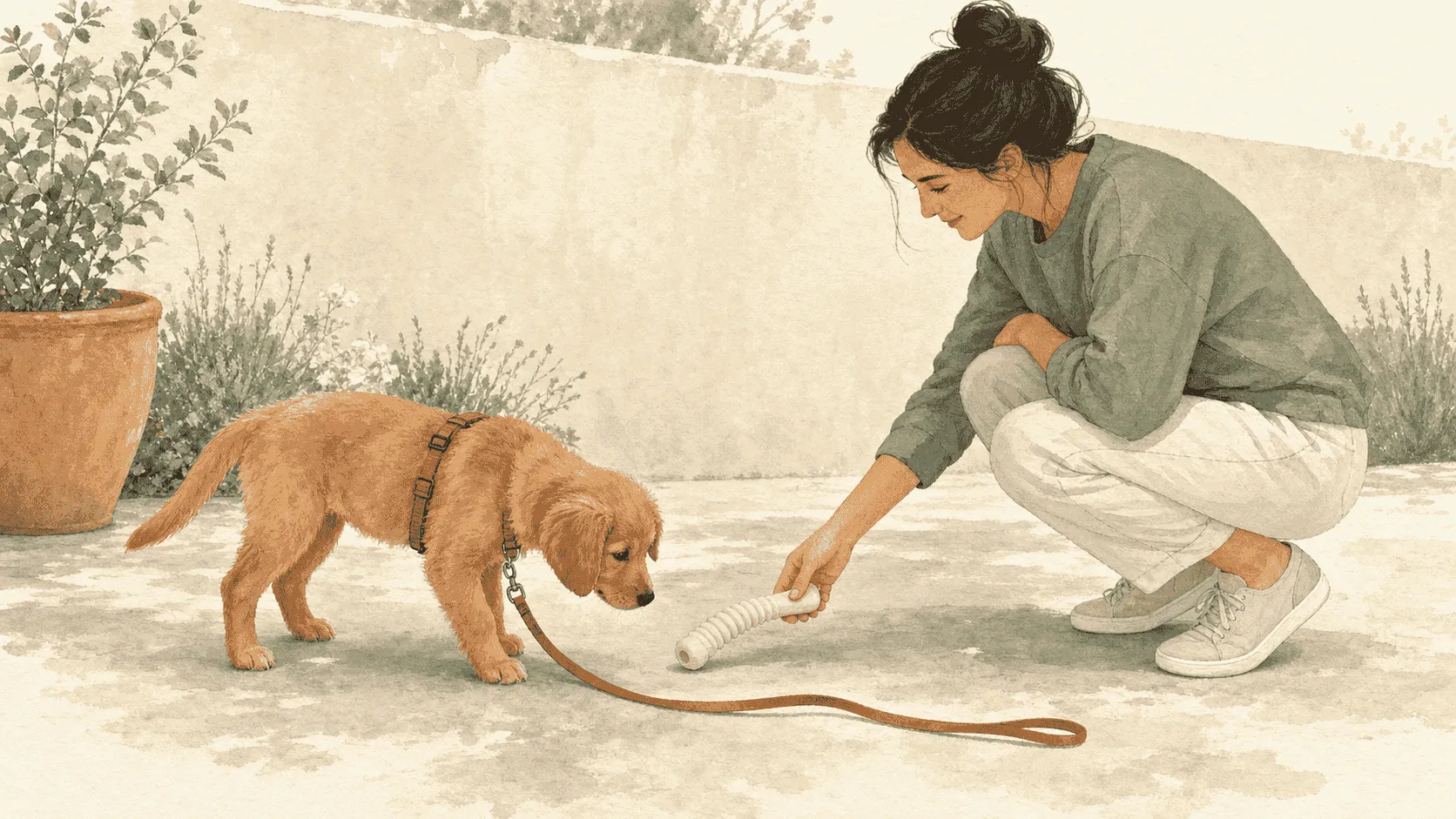
Do the first rehearsal somewhere the puppy can think: a quiet room, enclosed yard, or calm stretch of path that you can manage safely. Dogs Trust recommends rewarding proximity first, adding movement in small pieces, and increasing distractions gradually. Our dog leash guide explains how slack, setting, and supervised reach fit together; this plan focuses on what to do when puppy teeth interrupt that lesson.
Keep a simple note for several outings: where the biting began, what happened immediately before it, how long the outing had lasted, and whether an easier reset worked. A pattern can help you change the setup earlier next time. It cannot diagnose teething, fear, pain, or frustration.
If the leash grab tends to arrive after a predictable burst of activity, prepare the supervised outlet before that moment and shorten the training slice. The broader calm puppy-biting plan covers mouthing aimed at hands and clothing, household consistency, and child-safety boundaries.
Give Chewing a Safe Place, Not a Job It Cannot Do
A suitable chew or toy can provide a planned “yes,” but it is not a treatment for every reason a puppy might grab a leash. A 2025 review in Frontiers in Veterinary Science describes dog chewing across several functional contexts and emphasizes individual safety assessment. Choose an outlet for the puppy’s size and chewing style, supervise it, and check its condition.
The puppy teething-toy checklist can help with give, whole size, and damage checks. Chewing the leash alone does not confirm teething, and a product label cannot make an object suitable for this puppy.
Know When to Stop Training and Ask for Help
Create distance and seek professional help if biting is hard or repeated, causes injury, comes with a tense or fearful body, is difficult to interrupt, or makes anyone feel unsafe. A sudden increase or other clear behavior change belongs with a veterinarian because pain or illness can influence mouth contact; the behavior alone cannot diagnose either one. A qualified reward-based trainer or behavior professional can watch the full pattern and help design a safer setup.
For the next outing, make the assignment small: choose a quiet practice place, prepare one safe supervised outlet, reward three slack-leash steps, and finish before the route becomes difficult. If the leash enters the puppy’s mouth, pause, reset, and rehearse—then let the pattern, not frustration, guide the next plan.
Sources
Petzette's claim cards for this article point to the following scientific, veterinary, or animal-welfare sources.
- Dogs Trust Body Language Context Guidance: Welfare organization dog body-language guidance
- Dogs Trust Puppy Mouthing And Biting Guidance: Animal-welfare organization guidance
- AVSAB Humane Dog Training 2021: Veterinary behavior society position statement
- Dogs Trust Leash Training And Long-Line Guidance: Animal welfare charity guidance / loose-leash walking and long-line recall advice
- Dog Chewing Function And Welfare Review 2025: Peer-reviewed narrative review
- RSPCA Dog Home And Chewing Outlets: Animal-welfare organization guidance