Gear Decisions23 August 2026
Dog Travel Crate: A Safer First-Ride Setup Plan
Use a dog travel crate as part of a suitable car setup, then build comfort while parked before adding engine noise and short trips.
TextPetzette Editorial
Read4 Min
Evidence status
Source-backed editorial
- Evidence record
- 6 claim cards linked to 4 documented sources.
- Independent expert review
- Not commissioned. Petzette Editorial is responsible for the published wording.
- Source record checked
- 16 July 2026
- Scope
- General guidance. Individual animals and circumstances can differ.
A dog travel crate can be part of a safer first car ride, but putting a dog in a box and closing the door is not a complete travel plan. The useful decision is whether the crate, dog, and vehicle can work together as a suitable restraint—and whether the dog can learn the setup gradually. This guide narrows in on the crate-in-car question. For a broader comparison of vehicle restraints and first-ride practice, see the dog car harness first-ride plan.
Decide What the Crate Is Supposed to Do
UK Highway Code Rule 57 says animals should be suitably restrained in a vehicle so they cannot distract the driver or injure themselves or occupants during a sudden stop. It lists a seat-belt harness, carrier, cage, or dog guard as possible approaches. That is a safety purpose, not an endorsement of one product or proof that a particular crate has a certain test performance.
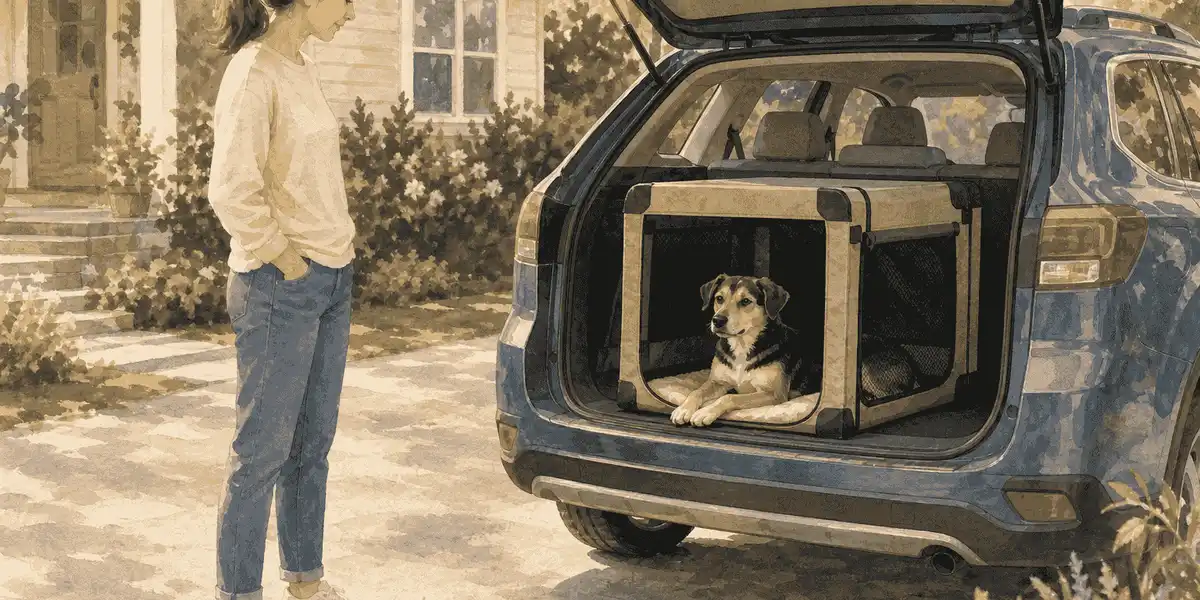
Start with the actual dog and car. Check the crate’s intended travel use and instructions, the available space, how it will remain in the planned position, and whether the dog can enter without being pushed. A home crate is not automatically suitable for vehicle travel. The home dog crate setup guide covers ordinary fit and choice-based training; travel has an additional restraint and vehicle-safety boundary.
Do not make a loose box, a lap, or an improvised attachment your plan. If the vehicle or crate instructions leave the setup unclear, pause and confirm the arrangement before the journey rather than testing it with a moving car.
Check the Crate Against the Dog, Not a Size Label
RSPCA crate guidance uses four ordinary movements as the home-fit check: the dog should be able to stand at full height, turn around, lie down, and stretch comfortably. Those observations are still useful when you are preparing a travel crate, but they do not create a universal travel-size chart. Airline transport, veterinary recovery, emergency evacuation, and vehicle travel can each have different requirements.
Watch the individual dog inside the stationary crate. Can they change position without squeezing? Can they settle without being forced into one posture? Can they enter and leave during early practice? Recheck as a puppy grows or if the dog’s coat, body, or travel setup changes. A crate that fits at home may also be awkward in a particular vehicle, so confirm the whole arrangement before the first trip.
Teach the Crate Before the Car Moves
The first travel lesson should happen while the car is parked. Dogs Trust guidance suggests building from calm proximity to the car, then calm exploration inside with the engine off, then engine sound, and only later a short, smooth journey. Use the crate during those steps so the moving trip does not introduce every new element at once.
Begin with the crate open and allow the dog to investigate by choice. Reward one easy step—looking toward it, approaching, placing paws inside, or resting there—then allow an exit. Increase difficulty in small pieces while the dog remains comfortable. The RSPCA’s crate-training sequence also warns that panting, excessive barking, cowering, or aggression can mean the step became too hard; make the next repetition easier instead of holding the dog in place.
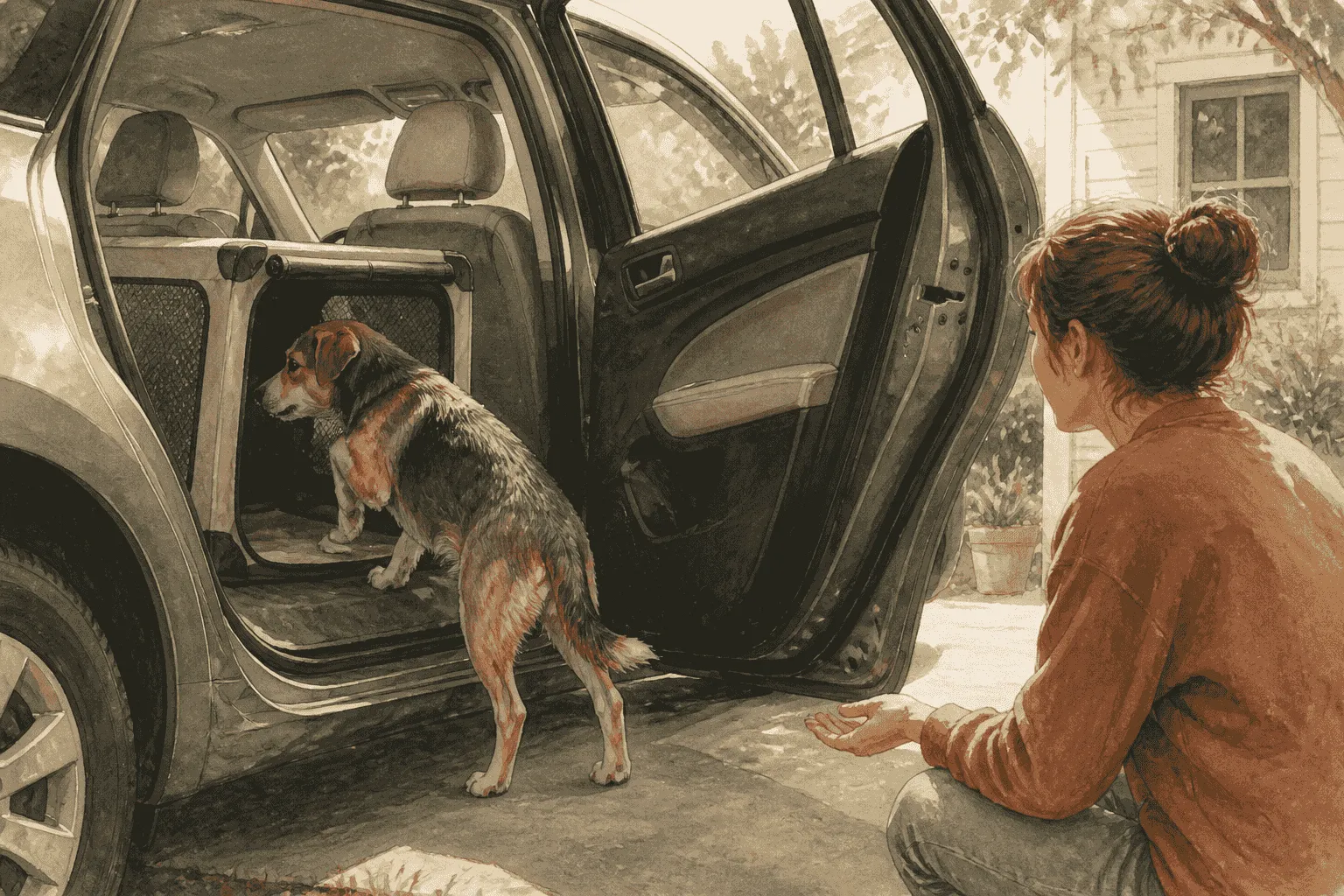
Do not use the crate to push through fear, solve separation distress, or make a frightened dog endure a long drive. A crate is a short, planned travel tool or resting option, not a substitute for exercise, toileting, veterinary care, or behavior support.
Plan Stops Before You Plan Distance
Keep the first moving journey short enough to observe the dog rather than make them endure a difficult trip. There is no universal number of minutes or rides that makes travel settled. A calm arrival and an easy exit give you better information for the next step than a long necessary trip.
Plan the waiting part before the keys turn. RSPCA guidance is clear that shade and a cracked window do not make a warm parked car a safe waiting place. Use a dog-safe alternative: take the dog with you only where that is genuinely suitable, arrange another person, or leave the dog at home. A travel crate does not change the temperature risk.
Repeated vomiting, severe drooling, panic, persistent distress, or a marked change in how the dog moves or settles is a reason to stop the training plan and ask your veterinarian. Established travel fear also deserves qualified behavior support. These signs do not identify one cause from home, but they do tell you that a longer drive is not the next experiment.
A Pre-Drive Travel-Crate Check
Before the first trip, and again as the dog grows, ask:
- Does the dog have room to stand, turn, lie down, and stretch comfortably?
- Is the crate and vehicle arrangement suitable for preventing driver distraction and movement during a sudden stop?
- Has the dog practiced the crate beside a parked car, inside with the engine off, and with engine sound before moving?
- Is the first journey short, smooth, and followed by a calm exit?
- Is there a safe plan for warm stops that does not depend on shade or an open window?
If one answer is no, keep the car parked and simplify that step. The aim is not to make a dog tolerate a travel crate on a deadline. It is to build a vehicle routine that respects restraint, comfort, temperature safety, and the individual dog in front of you.
Sources
Petzette's claim cards for this article point to the following scientific, veterinary, or animal-welfare sources.
- GOV.UK Highway Code Rule 57: Animals In Vehicles: UK government road-safety guidance
- Dogs Trust Car-Travel Training: Animal-welfare training guidance
- RSPCA Dogs In Hot Cars Guidance: Animal-welfare safety guidance
- RSPCA Playpen And Crate Training: Established animal-welfare guidance for low-risk home setup and training boundaries