Nutrition19 July 2026
Homemade Puppy Food: Build a Complete Growth Plan
Homemade puppy food needs specialist formulation, exact preparation, growth monitoring, and a clear veterinary follow-up plan.
TextPetzette Editorial
Read4 Min

Evidence status
Source-backed editorial
- Evidence record
- 6 claim cards linked to 3 documented sources.
- Independent expert review
- Not commissioned. Petzette Editorial is responsible for the published wording.
- Source record checked
- 11 July 2026
- Scope
- General information, not an individual diagnosis or treatment plan.
Homemade puppy food can feel more personal and transparent than opening a package. But the useful first decision is not which ingredients look wholesome. It is whether you have a complete growth formula designed for your puppy, plus a plan to prepare it exactly and reassess it as the puppy develops.
The 2021 American Animal Hospital Association nutrition guidelines report that most home-prepared recipes assessed from books and websites did not provide complete and balanced nutrition. AAHA recommends consulting a board-certified veterinary nutritionist and following the resulting recipe exactly. That makes homemade feeding a specialist-formulation project, not a flexible online recipe.
Why a Homemade Puppy Food Recipe Needs a Specialist
Puppies are building a body, so their main diet needs to be complete and balanced for dogs in the growth life stage. A list of appealing meats, vegetables, and supplements cannot show by appearance whether the finished diet meets that standard.
Begin with your veterinarian. They can assess the puppy in front of them and help you seek a board-certified veterinary nutritionist for an individualized recipe. Share the puppy’s current food, age, expected adult size, weight and body-condition history, activity, health concerns, medications, treats, and every extra that enters the bowl.
Once the formula is provided, treat the ingredient list, amounts, supplements, and preparation directions as one plan. Do not improvise substitutions or add a general multivitamin to “cover the gaps.” The relevant uncertainty cannot be solved by an article: only the professional who formulated the diet can say whether a proposed change still fits the puppy.
If you are still comparing the broader options, start with our guide to choosing puppy food for healthy growth. A complete growth-stage food remains the nutritional baseline while you arrange individual advice.
Build the Homemade Dog Food Plan Before You Cook
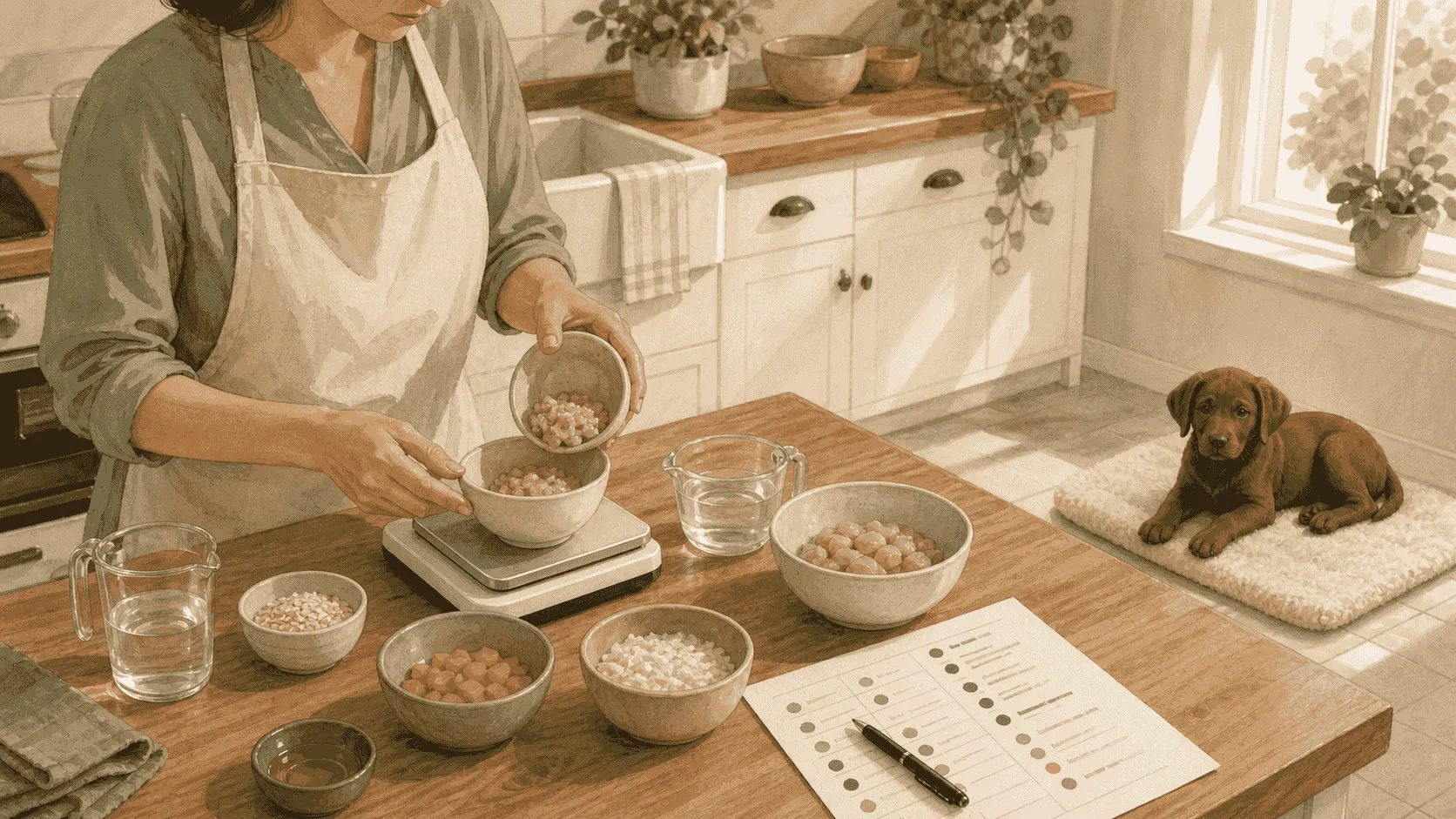
A workable home-prepared plan needs more than a recipe page. Before changing the bowl, make sure you can answer these questions:
- Who formulated the diet, and are they a board-certified veterinary nutritionist?
- Is the recipe designed for this puppy’s growth stage and expected adult size?
- Can you obtain and measure every specified ingredient and supplement consistently?
- Who will answer questions before you make a substitution?
- When will weight, growth, body condition, muscle condition, intake, and health be rechecked?
For a puppy expected to become large or giant, formulation deserves an extra size-specific check. AAHA guidance says these puppies need growth diets suited to their size and should avoid excessive calcium. Do not add calcium by guesswork or assume more will build stronger bones; ask the veterinarian and nutritionist to account for it within the complete formula.
Count Treats, Toppers, and Training Rewards
The recipe is not the whole day if food also arrives during training, from the table, or as a topper. For generally healthy pets, AAHA recommends that complete and balanced food provide at least 90 percent of total calories, with treats and other extras at 10 percent or less. That limit is a ceiling, not a promise that any particular extra is suitable.
Record every extra and bring the list to the nutrition consultation. Rewards can still have a role, but they should not quietly displace the formulated diet. Our everyday dog-treat guide offers a practical way to keep training food in its supporting role.
Recheck the Puppy, Not Just the Recipe
Even a carefully formulated starting plan needs follow-up. Feeding guidance should be reassessed with growth, weight, body condition, muscle condition, activity, and health in view. Measure consistently, keep a simple intake and weight record, and use the review schedule set by the veterinary team.
Do not adjust the recipe from a generic puppy feeding chart or copy another dog’s portions. If the puppy’s body condition, growth, or appetite changes, take the record back to the professionals who know the formula. The same principle applies to portions generally: start with a measured plan and recheck the puppy.
Contact your veterinarian if growth seems off or if there is poor appetite, repeated vomiting or diarrhea, low energy, pain, or another health change. Those signs need assessment rather than another online recipe or an improvised supplement. A puppy with a medical or therapeutic nutrition need requires individual direction.
Your next step is concrete: pause the recipe search, write down everything your puppy currently eats, and ask your veterinarian for a nutrition assessment and specialist referral. Homemade puppy food can be a deliberate choice, but the safe decision starts with a complete formula and continues with exact preparation and follow-up.
Sources
Petzette's claim cards for this article point to the following scientific, veterinary, or animal-welfare sources.
- AAHA Nutrition And Weight Management Guidelines 2021: Peer-reviewed veterinary clinical guideline
Cline MG, Burns KM, Coe JB, et al. 2021 AAHA Nutrition and Weight Management Guidelines for Dogs and Cats. Journal of the American Animal Hospital Association. 2021;57:153-178.
- AAFCO Pet Food Labels And Nutritional Adequacy: US feed-control association consumer and regulatory guidance
- WSAVA Selecting Pet Food Toolkit 2021: Global veterinary nutrition toolkit / food-selection guidance