Nutrition16 July 2026
How Much to Feed a Kitten: A Measured Daily Plan
How much to feed a kitten starts with the food label, then changes with growth, body condition, extras, and veterinary guidance.
TextPetzette Editorial
Read4 Min
Evidence status
Source-backed editorial
- Evidence record
- 6 claim cards linked to 4 documented sources.
- Independent expert review
- Not commissioned. Petzette Editorial is responsible for the published wording.
- Source record checked
- 14 July 2026
- Scope
- General information, not an individual diagnosis or treatment plan.
How much to feed a kitten is not one universal number of cans, cups, or grams. A useful starting amount depends on the exact food, its feeding directions, and the kitten’s age, growth, body condition, activity, and health. Begin with the current label, combine everything into one measured daily plan, then recheck the kitten rather than treating the first portion as permanent.
If the main food has not yet been screened for growth, use our kitten-food label checklist first. Portion planning works only when the nutritional foundation fits a growing cat.
Start With the Exact Food’s Feeding Guide
In the United States, find the nutritional adequacy or intended-use statement. For a generally healthy kitten, look for a food described as complete and balanced for cats in the growth life stage. A treat, topper, or food labeled for intermittent or supplemental feeding cannot do the main nutritional work.
Next, read the feeding directions on that same product. AAFCO label guidance describes these directions as guidelines that may need individual adjustment. The 2021 American Animal Hospital Association nutrition guidelines likewise recommend assessing intake alongside growth, weight, body condition, muscle condition, activity, and health.
This is why a generic kitten feeding chart cannot provide a final portion. Foods differ in energy density, and a two-month-old kitten and a six-month-old kitten are not interchangeable. Start from the age and weight band on the current label, but do not turn that printed range into a diagnosis or a homemade calorie prescription.
Make Wet and Dry Food One Daily Total
Write down every complete food offered during one ordinary day. If you use both formats, do not serve the full wet-food allowance and the full dry-food allowance as though each were the entire diet. Put them into one plan. Our guide to combining kitten wet and dry food explains the format decision in more detail.
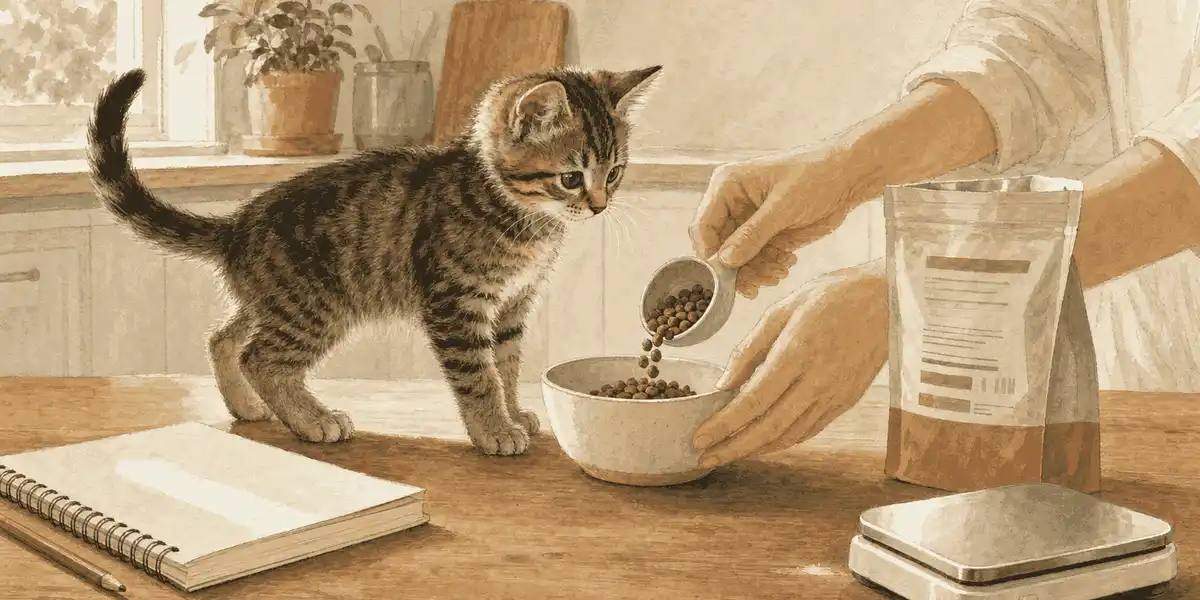
Measure consistently and record what is offered and what remains. A kitchen scale or household measure may help you repeat the label’s starting amount, but the tool does not decide the correct intake by itself. When the two labels are difficult to reconcile, ask your veterinarian to help set a starting total for the actual products and kitten.
Count treats, toppers, table bites, and food used for training. AAHA recommends that complete and balanced food provide at least 90 percent of total calories for generally healthy pets, leaving extras at 10 percent or less. That limit is a ceiling, not a promise that every extra is safe or suitable.
Divide the Allowance, Not Add to It
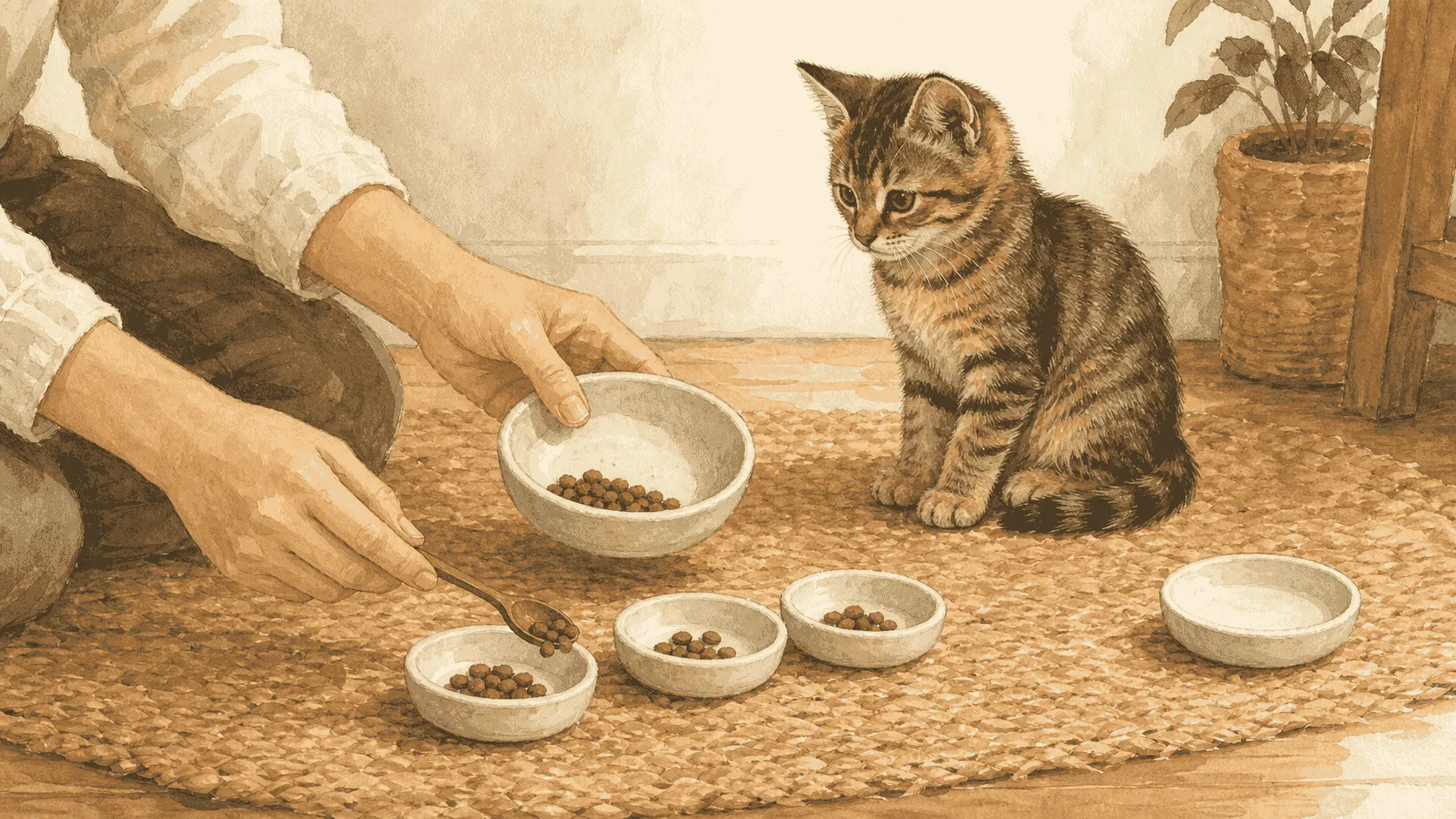
The 2018 American Association of Feline Practitioners consensus statement supports dividing a cat’s normal daily allowance into multiple small feeding opportunities. Smaller meals change the pattern, not the daily total.
You can portion the day’s measured food into several dishes or feeding times that suit the household and kitten. In a multi-cat home, separate locations and visual privacy may help prevent one shared bowl from becoming the only option. Do not assume eating side by side means both cats are comfortable, and check that one cat is not quietly taking the other’s share.
Recheck Growth and Body Condition
The label starts the plan; the kitten’s development tells you whether it needs review. Keep a simple record of the food, measured daily amount, appetite, weight, digestion, and any veterinary advice. Look for trends rather than reacting to one unfinished meal or one hungry-looking expression.
WSAVA’s body-condition tools help veterinary teams assess fat stores through body shape, not body weight alone. Muscle condition is assessed separately. Body condition is a shape check, not a shame check, and a general photo cannot safely tell you to feed more or less. Ask your veterinary team to show you what they are assessing during routine visits.
How Long to Feed Kitten Food
Kittens generally need growth-appropriate nutrition until skeletal maturity. AAHA notes that cats often transition near one year, but that is an approximate guide rather than a universal birthday deadline. Review growth, body condition, health, and the specific food before changing to an adult diet.
Know When Portion Tweaks Are Not Enough
Contact your veterinarian if growth seems off, appetite changes, weight or body condition shifts quickly, or vomiting, diarrhea, low energy, pain, or other illness signs appear. Those changes need assessment; they are not a reason to keep changing the bowl by trial and error. A kitten with disease, persistent digestive signs, a therapeutic diet, or another individual need requires a case-specific feeding plan.
Your next step is practical: photograph the current food’s adequacy statement and feeding directions, record every food and extra offered in one day, and bring that record to the next veterinary check. The answer to how much food a kitten should eat begins on the label and stays open to revision as the kitten grows.
Sources
Petzette's claim cards for this article point to the following scientific, veterinary, or animal-welfare sources.
- AAHA Nutrition And Weight Management Guidelines 2021: Peer-reviewed veterinary clinical guideline
Cline MG, Burns KM, Coe JB, et al. 2021 AAHA Nutrition and Weight Management Guidelines for Dogs and Cats. Journal of the American Animal Hospital Association. 2021;57:153-178.
- AAFCO Pet Food Labels And Nutritional Adequacy: US feed-control association consumer and regulatory guidance
- WSAVA Body Condition Score Tools: Veterinary association nutrition toolkit
- AAFP Consensus Statement On Feline Feeding Programs: Veterinary consensus statement