Health Signals20 July 2026
New Kitten Has Diarrhea: What to Do Next
A new kitten has diarrhea? Learn what to record, which accompanying changes need prompt veterinary advice, and why food guessing can wait.
TextPetzette Editorial
Read3 Min

Evidence status
Source-backed editorial
- Evidence record
- 6 claim cards linked to 8 documented sources.
- Independent expert review
- Not commissioned. Petzette Editorial is responsible for the published wording.
- Source record checked
- 20 July 2026
- Scope
- General information, not an individual diagnosis or treatment plan.
A new kitten has diarrhea—and the first useful decision is not which food to buy. Diarrhea is a sign with many possible explanations, so look at the whole kitten, record the pattern, and use the accompanying changes to decide how promptly your veterinary clinic needs to hear from you.
A soft or watery stool cannot identify infection, parasites, food intolerance, stress, a swallowed object, or another cause at home. The safer first step is to gather a clear history without turning one litter-box visit into a diagnosis.
New Kitten Diarrhea: Check the Whole Pattern
Start with what is happening alongside the stool change. Contact your veterinarian promptly when diarrhea is persistent, repeated, or severe, or when you notice blood, apparent pain, reduced appetite, lower energy, or a concern about dehydration. Possible access to a toxin, medication, string, or another swallowable object also needs professional direction rather than food troubleshooting.
Make the call more urgent if the kitten is weak, collapses, struggles to breathe, repeatedly vomits, or cannot keep food or water down. Age matters too, so tell the clinic how old the kitten is and when you first noticed the change. The veterinary team can decide how quickly the kitten should be examined from the complete picture.
If appetite has dropped, use the more specific new-kitten appetite plan as you call. A new home may change a routine, but it does not explain the cause of appetite loss or diarrhea.
Build a Useful Diarrhea Record
The MSD Veterinary Manual’s April 2026 overview describes diarrhea as one of several overlapping digestive signs. Dietary factors are only one category among infectious, parasitic, toxic, obstructive, inflammatory, congenital, and wider health possibilities. That list is not a menu for home diagnosis; it explains why the history matters.
Write down:
- When the diarrhea began and whether it has repeated
- What the kitten currently eats, including treats, toppers, and unfamiliar extras
- Any recent food change and what the kitten was eating before arrival
- Appetite, energy, drinking, urination, vomiting, apparent discomfort, and behavior
- Possible access to plants, rubbish, human medication, chemicals, string, or small objects
Keep the record factual. Stool color or texture alone does not name the cause, and the words “sensitive stomach” do not settle it either. Bring the pattern, not a guess, to the veterinarian.
Keep Food and Water Easy to Observe
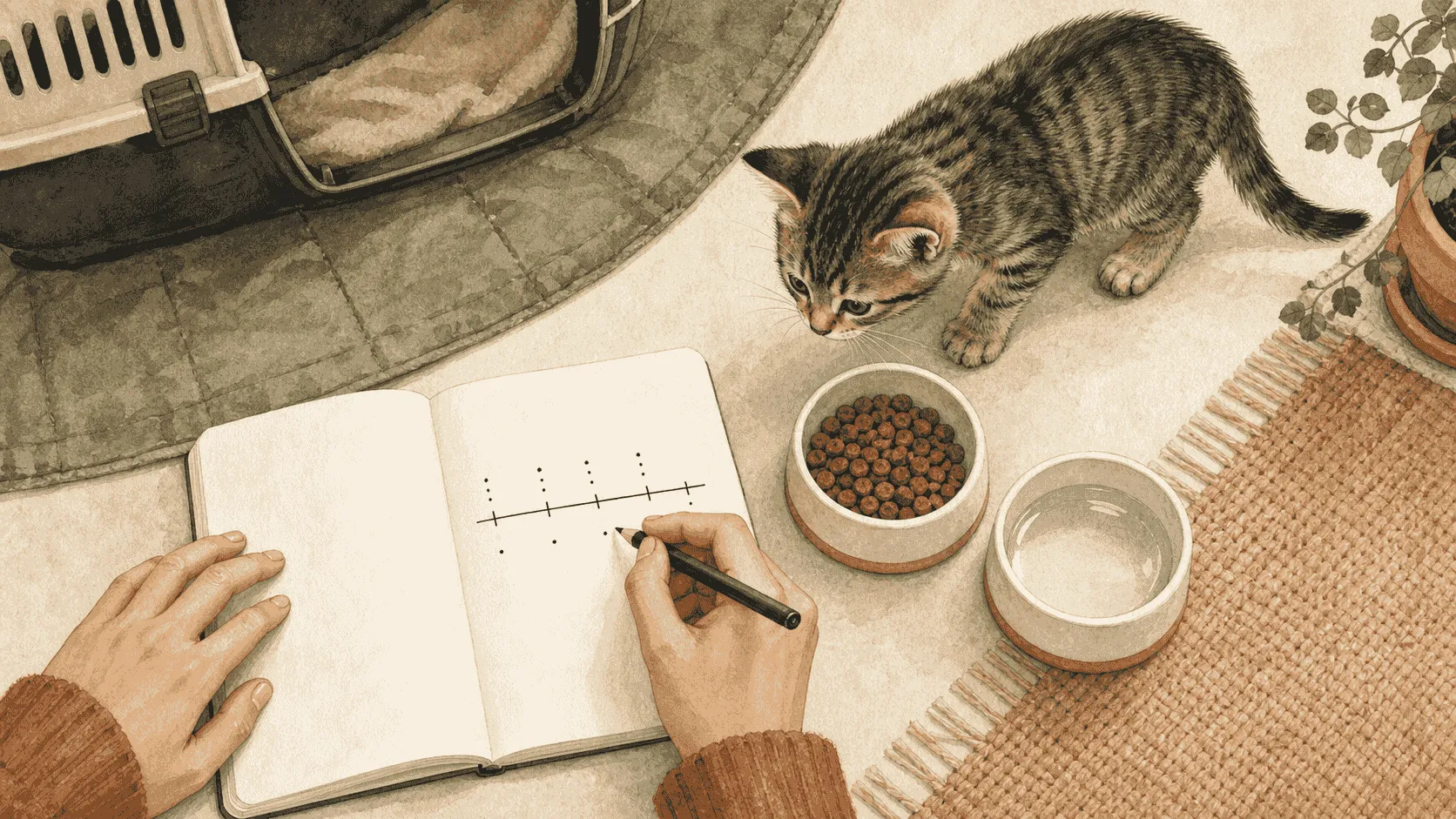
Cornell Feline Health Center guidance for a newly arrived cat recommends preserving access to familiar food in a clean, quiet location. Offer the food the kitten was eating before the move when it is available, place it away from the litter box and other animals, and record what is actually eaten. This setup makes intake easier to observe; it does not treat diarrhea or rule out illness.
Offer fresh water in quiet, easy-to-reach places. More than one location can be useful, especially when another cat might control access. Do not assume a fountain, bowl material, or room change resolves a health concern. A sudden change in drinking or urination belongs in the veterinary conversation.
Do Not Turn Active Diarrhea Into a Food Trial
For an otherwise well kitten making a routine diet change, World Small Animal Veterinary Association guidance supports a gradual introduction so acceptance, stool, and tolerance can be monitored. Active or repeated diarrhea is a different situation. It is not a reason to rotate rapidly through several foods until one appears to work.
If the veterinarian decides a routine transition is appropriate, keep the rest of the feeding plan steady enough to read the response. If signs persist, repeat, or stack up, follow the veterinary plan rather than a generic switching schedule. The sensitive-stomach kitten food guide explains that boundary between a label decision and a health question.
Let the Next Step Match the Kitten
There is no honest stool-only shortcut. A veterinarian may use the kitten’s age, diet, history, exposures, physical examination, and sometimes testing to narrow the possibilities. Your job is to make that assessment easier: notice the whole pattern, keep food and water access observable, and avoid assigning a cause from appearance alone.
If vomiting is part of the pattern, the cat-vomiting observation guide can help you describe the event without trying to diagnose it. The practical next move remains the same: escalate concerning combinations promptly, and let professional advice—not a guessed ingredient or a dramatic litter-box clue—set the plan.
Sources
Petzette's claim cards for this article point to the following scientific, veterinary, or animal-welfare sources.
- MSD Cat Digestive Disorders: Veterinary manual / clinical owner guidance
- Cornell New-Cat Appetite And Feeding Guidance: Veterinary-school feline health and new-cat care guidance
- WSAVA Principles Of Wellness 2025: Global veterinary-association wellness guidance
- AAFP ISFM Cat Friendly Veterinary Environment Guidelines 2022: Peer-reviewed feline veterinary-environment guideline
- Cat Water Intake From Still And Flowing Sources: Peer-reviewed crossover study
Robbins MT et al. *Journal of Feline Medicine and Surgery*. 2019;21(8):683-690. doi:10.1177/1098612X18803753.
- Cat Friendly Homes: Enhancing Water Intake: Veterinary-association caregiver guidance
- Feline Vomiting Evidence Review 2013: Peer-reviewed evidence-based clinical literature review
Batchelor DJ, Devauchelle P, Elliott J, et al. Mechanisms, causes, investigation and management of vomiting disorders in cats: a literature review. Journal of Feline Medicine and Surgery. 2013;15(4):237-265.
- Cornell Feline Vomiting And Household Hazards: Veterinary-school clinical and poison-safety guidance