Gear Decisions16 July 2026
Puppy Supplies: What You Need for the First Week
Use this puppy supplies guide to set up safe rest, growth-stage meals, reward-based training, play, and walking gear for week one.
TextPetzette Editorial
Read4 Min
Evidence status
Source-backed editorial
- Evidence record
- 9 claim cards linked to 11 documented sources.
- Independent expert review
- Not commissioned. Petzette Editorial is responsible for the published wording.
- Source record checked
- 12 July 2026
- Scope
- General guidance. Individual animals and circumstances can differ.
Puppy supplies can fill a cart long before they make the first week easier. Start with five jobs: comfortable rest, suitable food, kind training, safer play, and secure walking equipment. You can add extras after learning what fits your puppy, your home, and your routine. For the wider schedule around those objects, use the new puppy checklist for the first 30 days.
What supplies do I need for a puppy?
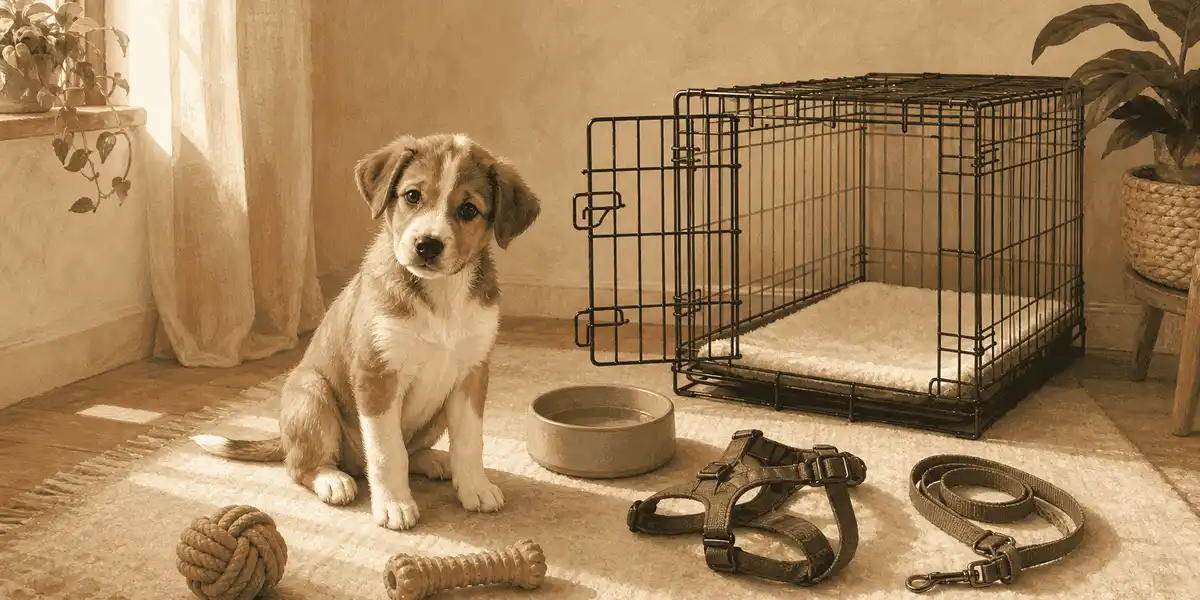
Build a short working list rather than a showroom:
- a bed or washable mat in a quiet, accessible rest area;
- an optional home crate or pen, sized and introduced for this puppy;
- complete and balanced puppy food, simple feeding equipment, and a way to record growth;
- small food or toy rewards for short training sessions;
- a few dog-appropriate toys or chews that can be inspected easily; and
- a secure, adjustable harness and leash for situations your veterinarian considers appropriate.
This is a starting setup, not a universal shopping prescription. Coat, body shape, chewing style, health, household layout, and local disease risk can change what is useful.
Set up rest before you think about containment
Dogs Trust guidance describes a safe space as comfortable, freely accessible, and protected by a household do-not-disturb rule. A mat or bed can do that job when the puppy controls entry and exit. Put it away from the busiest walkway, then make sure family members and visitors leave the puppy alone there.
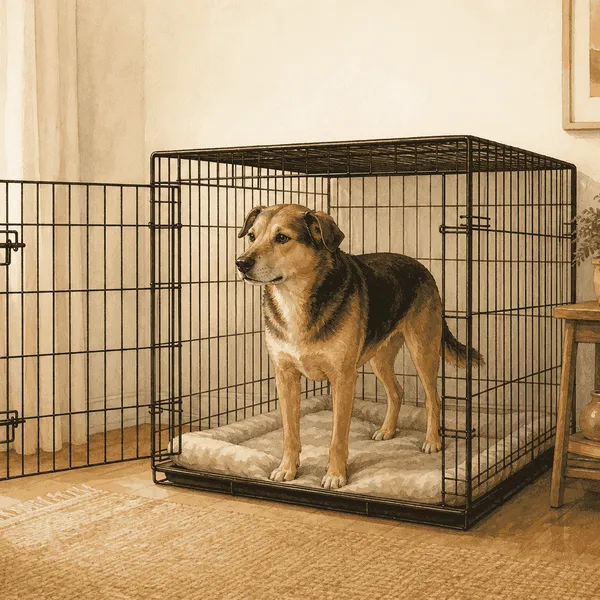
A crate is optional, and it has a different job from an always-open retreat when its door is closed. RSPCA guidance says a home crate should let the puppy stand at full height, turn without squeezing, lie comfortably, and stretch. Puppies grow quickly, so check those postures again rather than trusting the label indefinitely.
Introduce the crate with the door secured open and let the puppy investigate by choice. Closed-door practice should grow in small steps only while the puppy remains comfortable. Panting, cowering, excessive barking, or escalating distress means the step became too difficult. The gentle crate setup guide covers that process in detail.
Choose growth food before feeding accessories
The useful question is not which bowl looks most complete. In the United States, AAFCO label guidance makes the nutritional adequacy statement a practical first check: look for a complete and balanced food intended for dogs in the growth life stage. That statement is not a product endorsement or a guarantee that one food suits an individual puppy.
Package feeding directions are a starting point. The 2021 AAHA nutrition guidelines recommend reassessing intake with the puppy’s growth, weight, body condition, activity, and health. Use a consistent measuring method and keep a simple record instead of buying a gadget that promises a universal portion. If growth, appetite, vomiting, diarrhea, or another health concern is unusual or persistent, ask your veterinarian before changing the plan repeatedly.
Keep the training kit simple
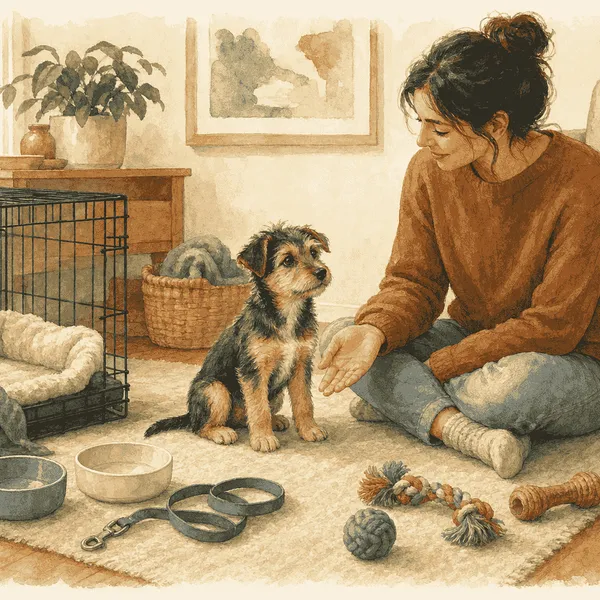
The American Veterinary Society of Animal Behavior recommends reward-based methods for everyday training. That can be as compact as a small portion of suitable food rewards, one toy the puppy enjoys, and a mat where calm choices can be noticed and rewarded. The equipment does not teach by itself; your timing and an achievable setup do the work.
Avoid gear that depends on fear, pain, intimidation, or discomfort. Serious fear, aggression, separation distress, or bite risk is not a shopping problem. It needs veterinary and appropriately qualified behavior support.
Inspect toys and chews before play
Blue Cross guidance recommends matching toys to the individual dog’s size and play style, checking for damage, and supervising when pieces might be swallowed. Choose objects too large to swallow whole, examine seams and loose parts, and retire anything split or missing a piece. The dog toy safety guide offers a fuller pre-play check.
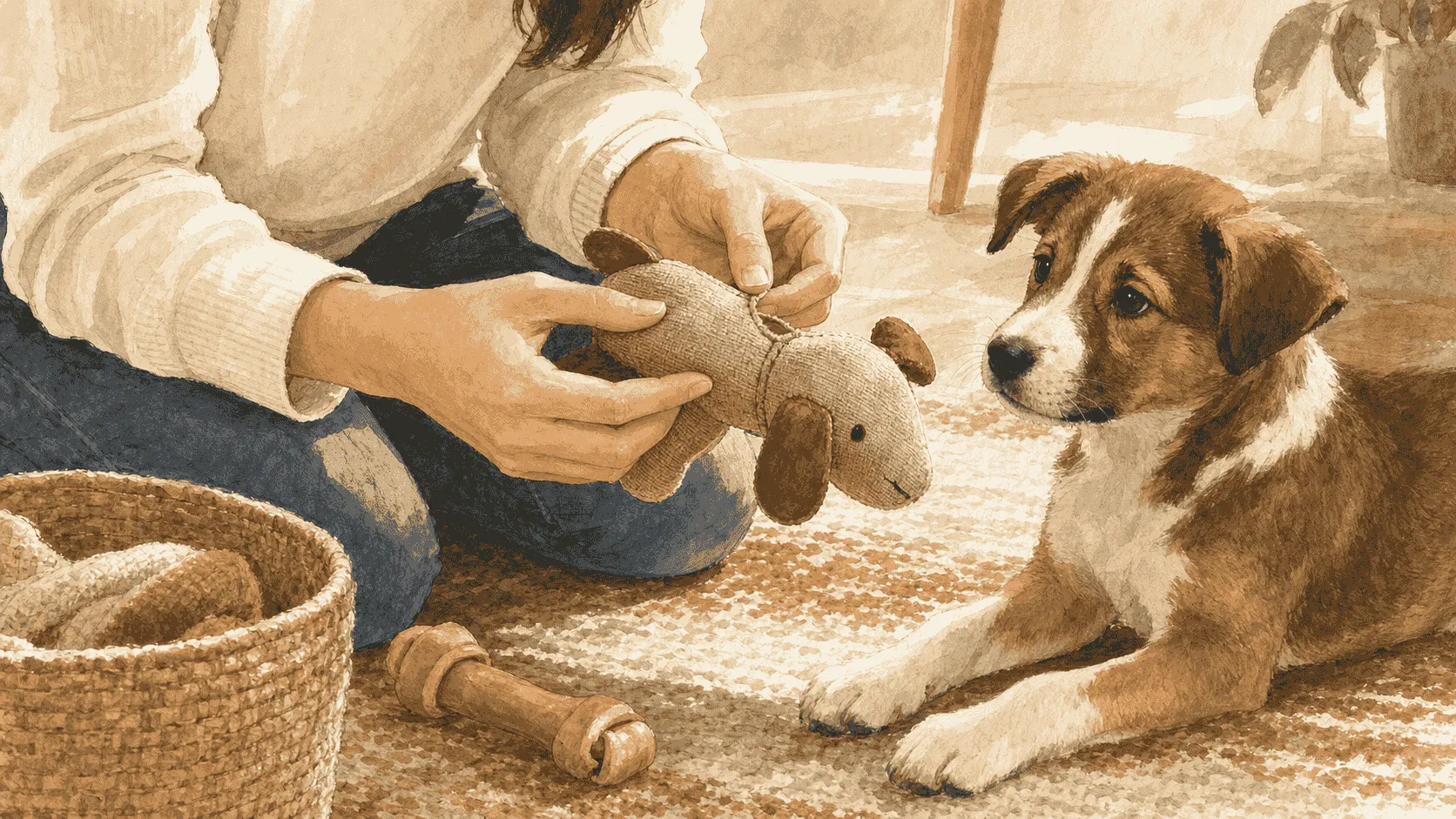
A 2025 veterinary review describes chewing as a behavior with several possible functions, not a single message. Offer a dog-appropriate outlet and manage access to household hazards, but do not expect one chew to fix distress, pain, pica, or destructive behavior. If a toy piece may have been swallowed, or the puppy develops vomiting, appetite loss, abdominal pain, diarrhea, dehydration, or lethargy, contact a veterinarian promptly.
Fit walking gear to the puppy in front of you
A 2026 review in Frontiers in Veterinary Science found that the limited harness research does not identify one universally best shape. Choose for the intended task and the individual puppy. Check that the harness stays secure without rubbing, watch normal movement, and reassess the fit as the puppy grows or changes shape.
Ask your veterinarian when it is appropriate for your puppy to walk in public areas. Pain, lameness, skin injury, breathing difficulty, or unusual movement also calls for professional advice rather than another equipment guess.
Make the first-week setup usable today
Put the rest area in place, find the growth statement on the food label, measure the current harness against the puppy, inspect each toy, and place rewards where short practice will happen. That 15-minute check is more useful than collecting puppy supplies without a plan. Add the next item only when an observed need—not a generic list—makes its job clear.
Sources
Petzette's claim cards for this article point to the following scientific, veterinary, or animal-welfare sources.
- Dogs Trust Safe Space For Dogs: Animal-welfare home-environment guidance
- RSPCA Playpen And Crate Training: Established animal-welfare guidance for low-risk home setup and training boundaries
- AAHA Nutrition And Weight Management Guidelines 2021: Peer-reviewed veterinary clinical guideline
Cline MG, Burns KM, Coe JB, et al. 2021 AAHA Nutrition and Weight Management Guidelines for Dogs and Cats. Journal of the American Animal Hospital Association. 2021;57:153-178.
- AAFCO Pet Food Labels And Nutritional Adequacy: US feed-control association consumer and regulatory guidance
- AVSAB Humane Dog Training 2021: Veterinary behavior society position statement
- Gastrointestinal Foreign Bodies In 72 Dogs: Peer-reviewed multicentre retrospective clinical study
Di Palma C, et al. *Animals*. 2022;12(11):1376. doi:10.3390/ani12111376.
- Blue Cross: How To Play With Your Dog: Animal-welfare and behavior guidance
- Cornell: Gastrointestinal Foreign-Body Obstruction In Dogs: Veterinary-school clinical education
- Dog Chewing Function And Welfare Review 2025: Peer-reviewed narrative review
- RSPCA Dog Home And Chewing Outlets: Animal-welfare organization guidance
- Dog-Worn Equipment Health Review 2026: Peer-reviewed narrative review of physical risks and evidence gaps
Ridgway M. Health implications of dog-worn equipment: a review of known and alleged physical risks. Frontiers in Veterinary Science. 2026;13:1711781.