Breeds10 August 2026
Small Cat Breeds: Size, Welfare, and Home Fit
Considering small cat breeds? Use adult-size references carefully, separate dwarf-cat welfare questions, and plan around the individual cat.
TextPetzette Editorial
Read3 Min

Evidence status
Source-backed editorial
- Evidence record
- 5 claim cards linked to 6 documented sources.
- Independent expert review
- Not commissioned. Petzette Editorial is responsible for the published wording.
- Source record checked
- 10 August 2026
- Scope
- General guidance. Individual animals and circumstances can differ.
Small cat breeds can sound like a simple space-saving choice. But a size label answers only one planning question: what adult range might you need to allow for? It cannot tell you whether one cat will be comfortable in your home, easy to handle, healthy, or a match for your household.
The useful decision is not to find the tiniest name on a list. It is to learn what is known about the individual cat, keep dwarf-cat welfare questions separate from ordinary small size, and build a first-year plan that gives the cat room for normal choices.
Use a Small-Breed Reference, Not a Promise
Registry profiles can offer a useful starting point. The International Cat Association describes the Singapura as small to medium and lists adult females at 4–6 pounds and adult males at 6–8 pounds. That is a reference for one named breed, not a forecast for a kitten or a medical assessment.
Treat a range as a prompt for better questions. What is this cat’s current age, size, and known history? Is there a veterinary record or growth information? What does the current caregiver observe during play, rest, grooming, transport, and gentle handling? If the answers are vague, pause rather than filling the gaps with a breed chart.
Small does not automatically mean low-energy, low-maintenance, or suited to every apartment. A cat’s socialization, experience, age, health, and individual needs still matter. Our guide to what cat-breed lists can and cannot tell you explains why a label is background, not a personality script.
Dwarf Cat Breeds Need a Different Question
The phrase “dwarf cat breeds” belongs in a different conversation from an ordinarily small adult cat. Cats Protection describes dwarfism, including the short-legged Munchkin breed, as an extreme physical trait that can bring individual bone, joint, spine, mobility, grooming, and quality-of-life concerns.
That does not diagnose pain or predict a particular cat’s future from a photograph. It does mean that a short-legged appearance should not be treated as a cute size preference alone. If you are considering a cat with dwarfism, ask the current caregiver what is known about mobility, comfort, veterinary history, and the daily setup. If you already share a home with one, ask your veterinarian about questions involving movement, comfort, or care rather than trying to solve them from a breed profile.
Plan for Routes and Choices, Not Miniature Gear
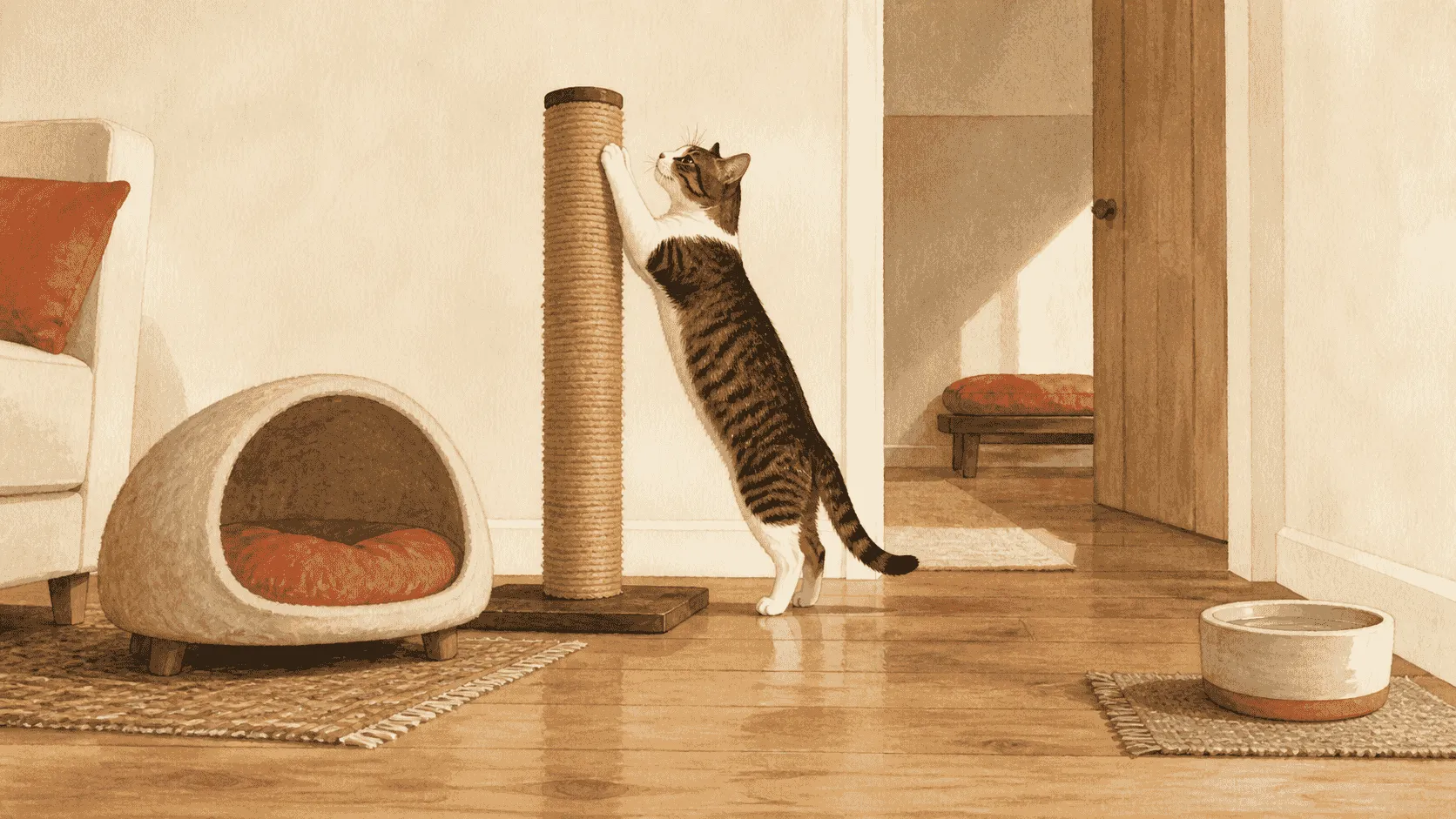
Avoid turning a small-breed label into a shopping list. A smaller cat does not automatically need a tiny carrier, litter box, bed, or scratching post. The practical check is whether this individual cat can reach, enter, turn, stretch, rest, and leave comfortably.
The AAFP/ISFM feline environmental-needs guidelines organize a cat-friendly home around safe places, separated key resources, play opportunities, predictable positive interaction, and respect for scent. In practice, that means the cat should have more than one usable route and more than one place to rest, scratch, play, eat, drink, and toilet without everything competing in a single corner.
Watch the cat you actually have or meet. A cautious cat may value a low, sheltered resting choice; another may seek a higher vantage point. Offer choice, then notice how the cat moves through the room. For stable surfaces, workable placement, and a full-body stretch, use the cat-tree setup guide rather than choosing by a size label alone.
Make the First-Year Fit Check Concrete
Before you bring a cat home, write down the decisions that remain open:
- What is known about this cat’s current size, age, mobility, health, and daily routine?
- Can the home provide separated food, water, toileting, scratching, play, and rest choices?
- Is the household ready for the cat’s actual grooming, handling, enrichment, and veterinary needs?
- If a dwarf-cat label is involved, what individual welfare information needs a veterinarian’s input before you decide?
PDSA’s pet-choice guidance starts with place, exercise, time, spending, and knowledge. Those questions are more useful than a “smallest cat breed” ranking because they turn a label into a welfare plan.
The next step is modest: meet the individual cat, ask for current information, sketch the room’s usable routes, and leave room to adjust. If growth, mobility, body condition, or comfort is uncertain, ask your veterinarian. A good fit is not a small cat in a small space; it is a cat whose needs your household can meet over time.
Sources
Petzette's claim cards for this article point to the following scientific, veterinary, or animal-welfare sources.
- TICA Singapura Breed Profile: Adult-Size Reference: Cat-registry breed profile / descriptive size reference
- The International Cat Association. *Singapura.* Breed profile and characteristics page, direct original page reviewed 2026-08-10.
- Cats Protection Dwarfism In Cats: Welfare Boundary: Animal-welfare charity guidance / extreme-trait welfare boundary
- Cats Protection. *Dwarfism in cats.* Extreme-traits welfare guidance, direct original page reviewed 2026-08-10.
- Cat Breed Behaviour Scientific Reports 2019: Peer-reviewed feline behavior and quantitative-genetics study
Salonen M, Vapalahti K, Tiira K, Maki-Tanila A, Lohi H. Breed differences of heritable behaviour traits in cats. Scientific Reports. 2019;9:7949.
- Cats Protection Choosing A Cat: Animal welfare charity guidance / cat-selection advice
- PDSA PetWise Choosing A Pet: Animal welfare charity guidance / pet-selection checklist
- AAFP/ISFM Feline Environmental Needs Guidelines 2013: Peer-reviewed veterinary guidelines plus client-facing practice resource