Nutrition13 October 2026
What Vegetables Can Cats Eat? A Plain-Treat Check
What vegetables can cats eat? Use source-named plain options as optional extras, keep complete cat food first, and know when to ask your veterinarian.
TextPetzette Editorial
Read3 Min
Evidence status
Source-backed editorial
- Evidence record
- 6 claim cards linked to 7 documented sources.
- Independent expert review
- Not commissioned. Petzette Editorial is responsible for the published wording.
- Source record checked
- 13 October 2026
- Scope
- General information, not an individual diagnosis or treatment plan.
What vegetables can cats eat? The useful answer is shorter than a produce aisle. Current Cats Protection and VCA guidance names a few vegetables that may work as optional extras for some cats, but neither source turns vegetables into a required part of a cat’s diet. Keep complete, balanced cat food as the foundation, and treat a vegetable as a small decision on the side—not a second meal or a home nutrition project.
Vegetables Are Optional, Not the Main Diet
Cats Protection says cats do not need vegetables added to their diet and names carrots, peas, corn, broccoli, and spinach as examples a cat may eat if interested. VCA’s cat-specific training guidance also names zucchini, green beans, and carrots among whole-food treat examples.
That list is useful because it is bounded. It is not a promise that every cat will enjoy or tolerate every item, and it is not a universal list of vegetables that can be offered in any form. A cat’s ordinary complete food still does the nutritional work. For a kitten, start with the life-stage food plan; the kitten-food label checklist keeps that decision separate from optional treats.
There is no prize for making a cat eat a vegetable. If your cat is uninterested, leave the experiment alone. The goal is a readable, optional treat decision—not a new feeding rule.
Use the Source-Named Choices as a Short List
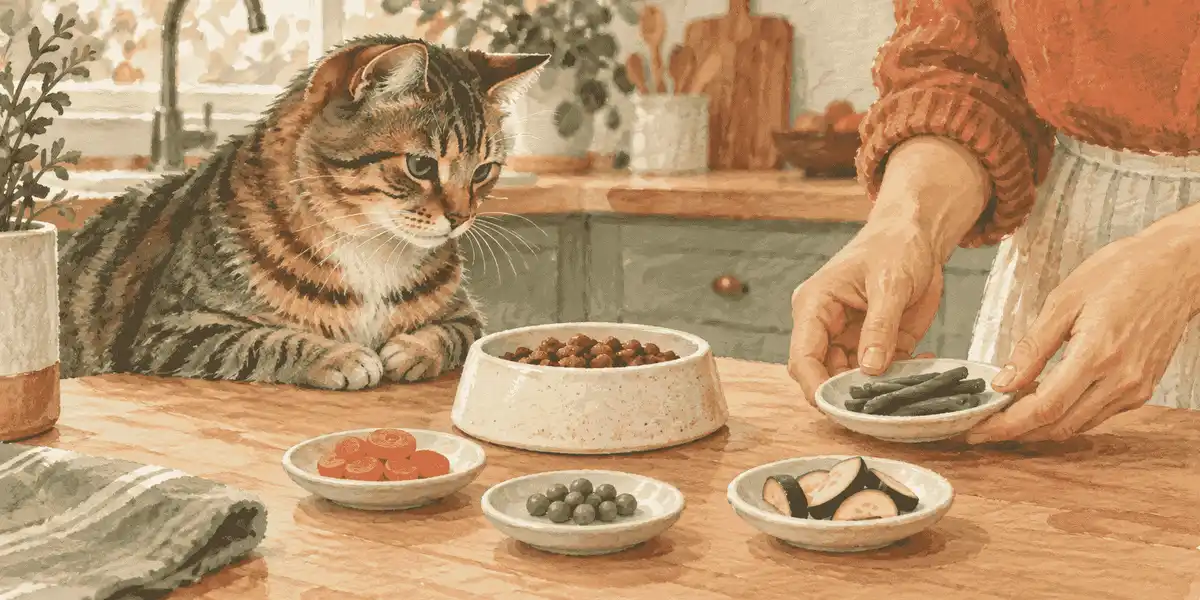
If you want to test an extra, choose one item from the named examples rather than building a mixed produce bowl. Carrot, pea, corn, broccoli, spinach, zucchini, and green bean are the useful starting names from the guidance reviewed here.
Keep the question specific:
- Is this one of the source-named vegetables, rather than an unfamiliar plant or prepared dish?
- Is it plain and unseasoned?
- Is it still an optional extra within the cat’s ordinary feeding plan?
- Does your cat have a health condition, food reaction, weight concern, or prescribed diet that changes the answer?
The last question matters more than the label on the vegetable. VCA notes that a cat with a diagnosed condition may need different treat choices. Ask your veterinarian before adding a new extra when the feeding plan is not straightforward.
Keep Preparation Boring
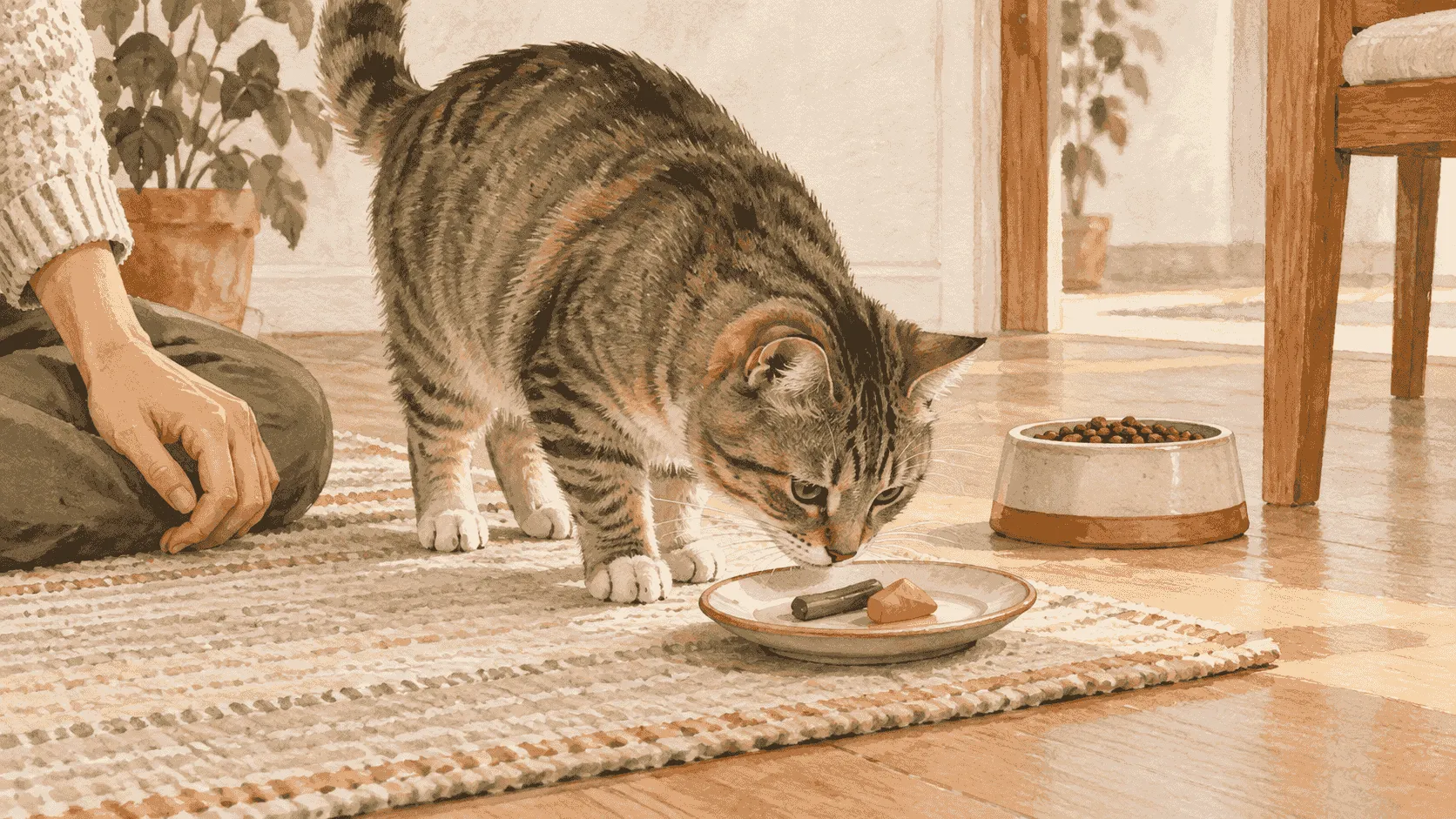
Plain means plain. Do not turn a named vegetable into a casserole, sauce, seasoned leftover, salty snack, or mixed dish and then borrow the same answer. Seasonings and co-ingredients can change the food question.
Onion and garlic stay out of food offered to cats. They are not harmless flavorings to overlook in a sauce or seasoning blend. If the possible food includes onion, garlic, or another ingredient you cannot identify, stop treating it as a routine snack and keep the package, recipe, or label details.
The broader human-food safety check for cats covers mixed recipes, raw foods, bones, and other household-food boundaries. This page stays narrower: a source-named vegetable as an optional, plain extra.
Count the Extra Without Turning It Into a Target
Complete, balanced food should supply most of a generally healthy cat’s intake. AAHA’s feeding-plan framework keeps treats and other extras at 10 percent or less, but that figure is a ceiling—not a guarantee that an ingredient suits an individual cat or that every cat should use the full allowance.
Count a vegetable alongside treats, toppers, and food used for training. Do not use it to replace the cat’s complete food, and do not assume that “natural,” “fresh,” or “plain” makes it nutritionally necessary. The cat fruit treat check explains the same optional-extra boundary for fruit without turning a list into a daily menu.
If Your Cat Already Ate Something Unclear
A vegetable you are considering and a food your cat may already have eaten are different decisions. If the food was seasoned, mixed, contained onion or garlic, or is otherwise uncertain, keep the label or recipe and note what may have been eaten, when, and how much you can honestly identify.
Contact your veterinarian or an animal poison-control service for direction. Do not induce vomiting, give medication, or wait for signs before calling. A public food list cannot create a safe exposure threshold for an individual cat.
The practical answer to “what vegetables can cats eat?” is therefore modest: use a short source-named list, keep the choice plain and optional, keep complete cat food first, and ask your veterinarian before changing a special diet or after a potentially harmful exposure.
Sources
Petzette's claim cards for this article point to the following scientific, veterinary, or animal-welfare sources.
- Cats Protection and VCA Cat Vegetable-Treat Guidance: Current first-party cat-welfare and veterinary nutrition guidance
- Cats Protection. *Cats and Human Foods*. Current cat-welfare feeding and household-food guidance, directly reviewed 2026-10-13.
- VCA Cat Fruit and Training-Treat Guidance: Current veterinary nutrition and training guidance from a veterinary hospital network, including a cat-specific article authored by credentialed nutrition professionals
- Hunt R, RVT, VTS (Nutrition), and Wilson S, BScH, DVM, DACVIM (Nutrition). “Using Food and Treats for Training Cats.” VCA Animal Hospitals / LifeLearn Animal Health, last updated 2026-05-22.
- AAHA Nutrition And Weight Management Guidelines 2021: Peer-reviewed veterinary clinical guideline
Cline MG, Burns KM, Coe JB, et al. 2021 AAHA Nutrition and Weight Management Guidelines for Dogs and Cats. Journal of the American Animal Hospital Association. 2021;57:153-178.
- Cats Protection Cats And Human Foods Guidance: Current cat-welfare feeding and household-food safety guidance
- AAFCO Pet Food Labels And Nutritional Adequacy: US feed-control association consumer and regulatory guidance
- Allium Food Exposure In Dogs And Cats — Review And Guidance: Peer-reviewed veterinary toxicology review, peer-reviewed veterinary manual, and established animal poison-control guidance
Hayes C. Garlic and Onion (Allium spp) Toxicosis in Animals. MSD Veterinary Manual, full review September 2024; Cortinovis C, Caloni F. Household Food Items Toxic to Dogs and Cats. Front Vet Sci. 2016;3:26. doi:10.3389/fvets.2016.00026; ASPCA Animal Poison Control. People Foods to Avoid Feeding Your Pets.
- AVMA Pet First Aid: Poison Response Boundary: Veterinary-association first-aid brochure