Health Signals24 August 2026
Why Do Cats Lick Themselves? Read the Grooming Pattern
Why do cats lick themselves? Learn what self-grooming does, what a hairball pattern can signal, and when your veterinarian should hear from you.
TextPetzette Editorial
Read4 Min
Evidence status
Source-backed editorial
- Evidence record
- 2 claim cards linked to 3 documented sources.
- Independent expert review
- Not commissioned. Petzette Editorial is responsible for the published wording.
- Source record checked
- 27 July 2026
- Scope
- General information, not an individual diagnosis or treatment plan.
Why do cats lick themselves? A cat grooming itself is doing something more specific than delivering a cute message. The rough tongue has anatomy that helps move fluid into fur, but one grooming session cannot tell you everything about a cat’s health or emotional state. The useful first-year decision is whether you are seeing an ordinary pattern, a noticeable change to record, or a veterinary question.
What Self-Grooming Actually Does
A 2018 study in Proceedings of the National Academy of Sciences examined feline tongue papillae with high-speed imaging, micro-CT, fluid-wicking tests, and a mechanical grooming rig. Noel and Hu found hollow cavities at the tips of the rear-facing spines. In the study’s tests, those cavities wicked fluid and helped carry it into fur.
That finding answers part of the “why.” The scratchy surface is functional structure, not a layer of tiny teeth, and a lick can help distribute saliva through the coat. The study does not show that every lick reaches the skin, fully cleans every coat, or replaces brushing and veterinary care. Several measurements used small or post-mortem samples, and the mechanical tests simplified a living cat’s moving skin, saliva, and individual coat.
So treat the tongue finding as a grooming-mechanics explanation, not a complete translation of the cat in front of you. If you want to plan brushing or other routine care, the calm cat-grooming routine covers that separate decision.
Why Does My Cat Keep Licking Its Fur?
The anatomy explains how licking can work; it does not identify one reason for every bout of self-grooming. Start with the pattern you can actually observe:
- Where: Is the cat licking its usual areas, or returning to one spot repeatedly?
- When: Does grooming appear after rest, eating, play, handling, or a change in the room?
- How it ends: Does the cat settle and return to ordinary activity, or stay focused on the same area?
- What else changed: Is the coat, skin, appetite, drinking, stool, weight, or behavior different from the cat’s baseline?
This is the same context-first discipline used for other “why do cats” questions. The guide to why cats purr explains why a familiar behavior should be read beside the setting, body, and next action rather than treated as a fixed dictionary entry.
Use a Three-Lane Grooming Check
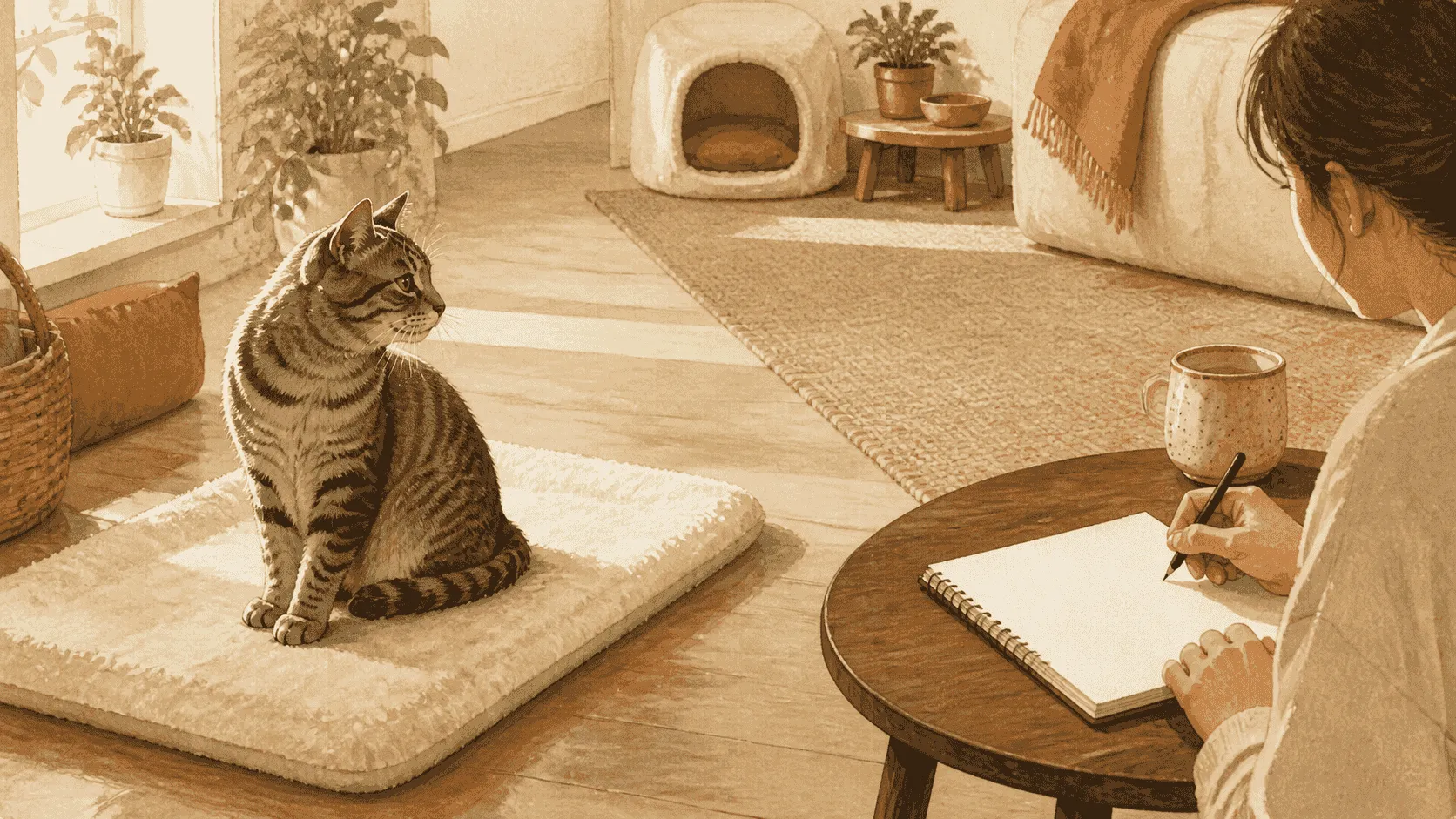
When you notice your cat licking itself, sort the observation into one of three lanes:
- Familiar pattern: The cat grooms in its usual way, the coat looks like its baseline, and there are no accompanying changes. Let the behavior finish and keep learning what is normal for this individual.
- Changed pattern: Grooming is more frequent, concentrated on a new area, or paired with a coat or skin change. Write down when it started, where it happens, and what else changed. That record is more useful than choosing a cause from the lick alone.
- Health boundary: Repeated hairballs, frequent or severe vomiting, inability to keep food or water down, or changes in appetite, weight, stool, thirst, or behavior deserve veterinary attention.
Cats Protection guidance makes an important distinction here: brushing may reduce loose hair swallowed by some cats, but recurrent hairballs can accompany gastrointestinal or skin problems. A 2013 review in the Journal of Feline Medicine and Surgery likewise describes feline vomiting as a sign with many possible causes; its pattern and associated changes help a veterinarian investigate, while appearance alone does not provide a diagnosis.
When Self-Grooming Needs a Veterinarian
Contact your veterinarian when grooming changes suddenly, becomes persistent, or arrives with a changed coat, skin concern, apparent discomfort, reduced grooming, vomiting, appetite change, weight change, stool change, altered thirst, or a broader behavior shift. A cat can look settled for part of a day and still need assessment if the overall pattern has changed.
Do not turn a hairball into a home diagnosis, and do not respond with butter, oils, laxatives, supplements, or an improvised diet change. The approved evidence supports observation and professional direction, not a home remedy. If vomiting is frequent or severe, or food and water will not stay down, ask your veterinarian promptly rather than waiting for the next grooming session to explain it.
The safest answer to “why do cats lick themselves?” is therefore two-part: a cat’s specialized tongue helps move saliva into fur, and the individual meaning of a grooming change must be judged from the whole pattern. Watch the usual areas, note what is different, and let the next action follow the evidence you can actually see.
Sources
Petzette's claim cards for this article point to the following scientific, veterinary, or animal-welfare sources.
- Hollow Cat-Tongue Papillae Wick Fluid Into Fur: Peer-reviewed feline anatomy, high-speed imaging, micro-CT, and grooming-mechanics study
Noel AC, Hu DL. Cats use hollow papillae to wick saliva into fur. *Proceedings of the National Academy of Sciences*. 2018;115(49):12377-12382.
- Feline Vomiting Evidence Review 2013: Peer-reviewed evidence-based clinical literature review
Batchelor DJ, Devauchelle P, Elliott J, et al. Mechanisms, causes, investigation and management of vomiting disorders in cats: a literature review. Journal of Feline Medicine and Surgery. 2013;15(4):237-265.
- Cats Protection Hairballs And Vomiting: Veterinary-boundary cat-welfare guidance