Behavior04 October 2026
Why Do Cats Purr While Sleeping? Read the Rest Pattern
Why do cats purr while sleeping? Learn what a familiar sleep-bound purr can and cannot tell you, what to record, and when to call a veterinarian.
TextPetzette Editorial
Read5 Min

Evidence status
Source-backed editorial
- Evidence record
- 7 claim cards linked to 7 documented sources.
- Independent expert review
- Not commissioned. Petzette Editorial is responsible for the published wording.
- Source record checked
- 18 September 2026
- Scope
- General guidance. Individual animals and circumstances can differ.
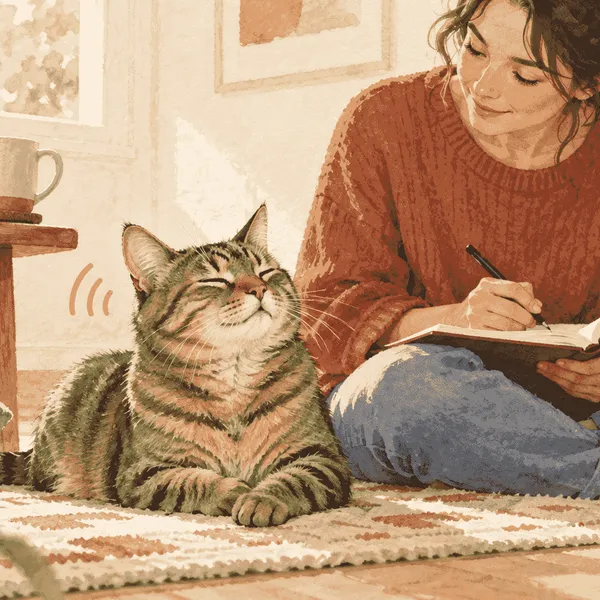
Why do cats purr while sleeping? The sound can be part of a familiar rest pattern, but purring alone cannot tell you whether a cat is comfortable, asking for something, or experiencing a health problem. The safer first decision is modest: let the cat sleep, compare the sound and the surrounding pattern with that individual cat’s baseline, and record a change without trying to decode it at home.
If the cat appears to be working to breathe, is breathing with an open mouth, or does not return to usual responsiveness, this is no longer a purring question. Seek urgent veterinary direction.
A sleeping purr is context, not a universal translation
The 2009 Current Biology study “The cry embedded within the purr” found that some cats can use a purr with a cry-like component while soliciting food from people. Human listeners rated those tested solicitation purrs as more urgent than non-solicitation purrs. That is a useful reminder that purring can vary with context; it is not a dictionary for every cat or every situation.
The study did not establish what a purr during sleep means. It also did not show that a purr proves happiness, hunger, pain, or comfort. Our broader guide to why cats purr covers that research and its limits. For this narrower question, keep the scene attached to the sound: is the cat asleep, what happened before the purr, and what does the cat do when naturally awake?
Let the nap remain undisturbed
Cats Protection guidance describes cats as resting or sleeping in intermittent bouts for a substantial part of the day and recommends quiet, comfortable places where they can rest without interruption. Its new-kitten guidance makes the same practical point for a young cat settling into a home: protect sleep rather than keeping the kitten awake to match a human schedule.
Do not wake, pick up, restrain, stroke a sensitive area, or deliberately recreate the sound to test what the purr means. A home experiment can interrupt the very pattern you are trying to understand and can add stress without answering a health question.
If the purr is accompanied by a small paw, whisker, eye, or limb movement, keep that observation separate from the sound. A 2008 Journal of Physiology study recorded sleep-wake cycles in adult cats and described phasic activity and muscle twitches during REM sleep. Those small sleep movements can fit REM-related physiology, but a sleep-only twitch does not prove a dream, clear a seizure, or explain the purr. The cat sleep-twitching guide explains what to record when the movement itself is the concern.

Use a three-lane pattern check
The sound matters less than whether it is familiar, changed, or paired with a more urgent sign.
Familiar and sleep-bound: The purr happens during an ordinary nap, the cat appears to be breathing comfortably, any movement is brief and stays within sleep, and the cat returns to its usual awake pattern when it naturally gets up. Leave the cat undisturbed and keep observing ordinary life. This is an observation lane, not a medical clearance.
New or different: The purr is suddenly different, markedly more frequent, persistent, or arrives with a change in sleep, hiding, appetite, drinking, grooming, movement, litter use, or interaction. A marked change in a cat’s usual vocalization deserves veterinary advice; it should not be reduced to attention-seeking or explained by the sound alone. Record the pattern and contact your veterinarian.
Urgent or concerning: The cat seems unable to breathe comfortably, breathes with an open mouth, shows visibly increased breathing effort, becomes injured during a forceful or prolonged episode, or does not return to usual responsiveness. Contact a veterinarian or emergency veterinary service promptly. Do not wait for another sign, try a home remedy, give medication, inspect the mouth, or use a breathing count to decide whether the cat is safe to wait.
Breathing difficulty is a clinical sign, not a diagnosis. Veterinary guidance and a 2025 emergency cohort support urgent assessment, but they do not let a caregiver identify asthma, heart disease, infection, anxiety, or another cause from posture or sound at home.
Make a short note without turning it into a test
If the pattern is unfamiliar but not visibly urgent, write down:
- whether the cat was clearly asleep, waking, relaxed but awake, or fully alert;
- when you first noticed the purr, how long it lasted, and whether it repeated;
- what happened immediately before and after it, including whether the cat stayed asleep or woke naturally;
- whether the sound seemed different from this cat’s usual purr; and
- whether appetite, drinking, grooming, movement, litter use, breathing, hiding, or interaction also changed.
A naturally captured, short clip may help a veterinarian understand timing if making it does not disturb, follow, corner, touch, or provoke the cat. A recording is context for a professional conversation, not a diagnosis. Do not keep filming a distressed cat or delay urgent contact while trying to collect a better example.
The most useful comparison is with this cat’s own baseline. One quiet nap, one active moment, or one purr cannot clear a cat medically, and one unusual sound cannot name the cause. If the pattern is new, marked, persistent, or paired with another change, bring the timeline to your veterinarian.
The next step is small
For a familiar sleep-bound purr, protect the nap and notice what the cat does when naturally awake. For a changed pattern, write the time, setting, duration, and accompanying changes, then ask your veterinarian how they want to assess it. For apparent breathing difficulty or a cat who is not returning to usual responsiveness, move straight to urgent veterinary contact.
Purring during sleep does not need a mystical translation. Read the whole rest pattern, leave the sleeping cat in control of the moment, and let a veterinarian handle what observation cannot settle.
Sources
Petzette's claim cards for this article point to the following scientific, veterinary, or animal-welfare sources.
- The Cry Embedded Within The Purr: Peer-reviewed paper
- Cornell Senior Cat Special Needs: Veterinary school feline health guidance
- Cats Protection Kitten Sleep And New-Home Rest Guidance: First-party animal-welfare guidance for kitten sleep and settling into a new home
- Cat Sleep Twitching And REM Context: Peer-reviewed feline sleep physiology with veterinarian-authored owner guidance.
- FelineVMA Cat Meowing Guidance: Feline veterinary-association caregiver guidance on meowing and vocalization
- Sick Cat Observation And Veterinary Escalation: Cross-source veterinary-school, veterinary-manual, and established animal-welfare guidance for observing possible illness in cats
- Cornell University College of Veterinary Medicine, Cornell Feline Health Center. *Choosing and Caring for Your New Cat.* The page says a sick cat may stop grooming and lists appetite loss, persistent vomiting, diarrhea, discharge, sneezing, weight loss, urinary changes, breathing changes, lethargy, and rapidly appearing or increasing swelling among signs that warrant veterinary contact. The page was directly reviewed and reports an update of May 2017.
- Feline Breathing Difficulty: Urgent Referral and Diagnostic-Uncertainty Boundary: Evidence synthesis of a peer-reviewed feline emergency cohort, veterinary-school guidance, a peer-reviewed veterinary manual, and established welfare emergency guidance. It supports a narrow recognition, no-home-diagnosis, and urgent-professional-direction boundary for apparent breathing difficulty in cats. It is not a diagnostic guide, first-aid protocol, transport plan, treatment guide, or prognosis source.
- Abboud N, Deschamps J-Y, Joubert M, Roux FA. *Emergency Dyspnea in 258 Cats: Insights from the French RAPID CAT Study.* Veterinary Sciences. 2025;12(3):242. doi:10.3390/vetsci12030242; PMID:40266956; PMCID:PMC11946846.