Behavior17 September 2026
Why Do Dogs Hate Cats? Read the Chase Before You Act
If your dog seems to hate your cat, read the chase pattern first: add distance, protect exits, and reset introductions safely.
TextPetzette Editorial
Read5 Min
Evidence status
Source-backed editorial
- Evidence record
- 5 claim cards linked to 3 documented sources.
- Independent expert review
- Not commissioned. Petzette Editorial is responsible for the published wording.
- Source record checked
- 15 August 2026
- Scope
- General guidance. Individual animals and circumstances can differ.
Why do dogs hate cats? “Hate” is usually a conclusion, not an observation you can safely act on. A dog who stares, barks, lunges, follows, or tries to chase a cat may be showing excitement, fear, frustration, learned reinforcement, or a change that needs health context. One scene cannot identify the cause.
The useful first-year decision is smaller: can you prevent chasing while you learn what happens? Start with distance, protect the cat’s exits, and treat the introduction as a staged process. The goal is not to force friendship. It is to make the next interaction safe enough to read.
Treat “hate” as a question, not a diagnosis
Dogs Trust’s guidance on chasing distinguishes several possible contexts rather than assigning every chase to aggression or prey drive. A reaction also depends on the setting: a dog may respond differently behind a barrier, on a lead, in a narrow hallway, or when a cat suddenly runs. The word “reactive” is similarly a description of a response, not a diagnosis or a prediction of what this dog will do next.
Write down what you can actually see:
- What did the cat do just before the dog reacted?
- How far apart were they, and was there a barrier or lead?
- Could the dog look away, eat a reward, or follow the handler?
- Could the cat leave, hide, climb, or return to a dog-free room?
- Was this a new pattern, or is it becoming more frequent or intense?
That record gives a veterinarian or qualified behavior professional better information than “my dog hates cats.” It also helps you notice the distance at which the dog can still make a calm choice.
Stop the chase from becoming the lesson
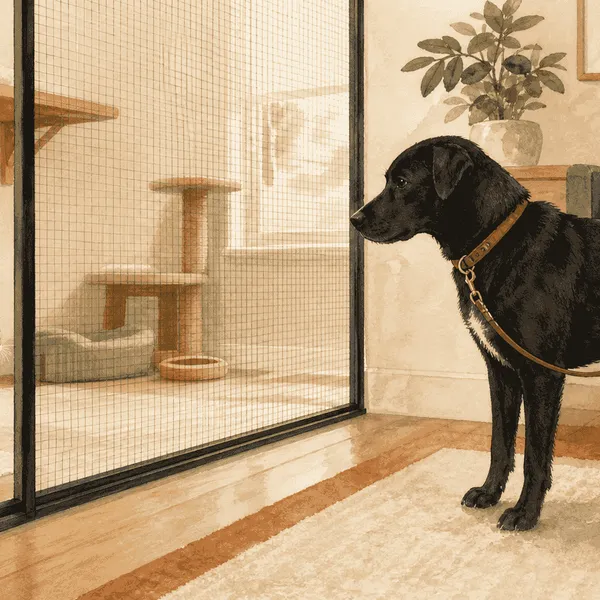
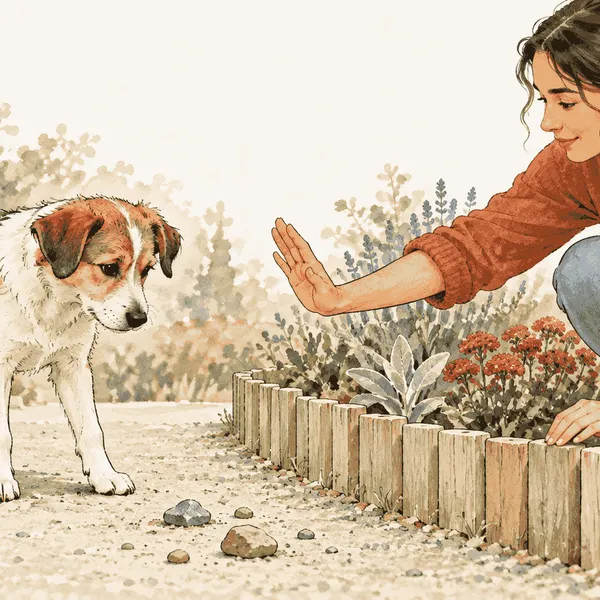
If the dog already owns the cat’s movement with their eyes, the scene is too difficult for a training exercise. Dogs Trust recommends working far enough from a moving trigger for the dog to remain calm and responsive, while a lead, long line, quieter route, or secure area prevents another chase. In a home, that may mean a closed door, a properly tested barrier, separate rooms, or a handler who can move the dog away before the cat runs.
Do not test the pair with a loose “see what happens” greeting. Do not let them chase so the cat learns to stay away, and do not punish the dog or the cat for warning signals. The immediate task is management: calmly create distance, keep the cat’s route open, and prevent another rehearsal. A barrier or lead helps manage space but does not make unsupervised contact safe.
When the dog cannot disengage, stop the session rather than moving closer. Reward-based work may be part of an individual plan, but the evidence does not create one universal distance, cue, lead, harness, or progression rate for every dog.
Reset a cat-and-dog introduction in stages
Cats Protection and Blue Cross recommend beginning with separation and scent, then moving to controlled visual and closer contact only at both animals’ pace. If the dog and cat were introduced too quickly, go back to the last stage where the scene was uneventful:
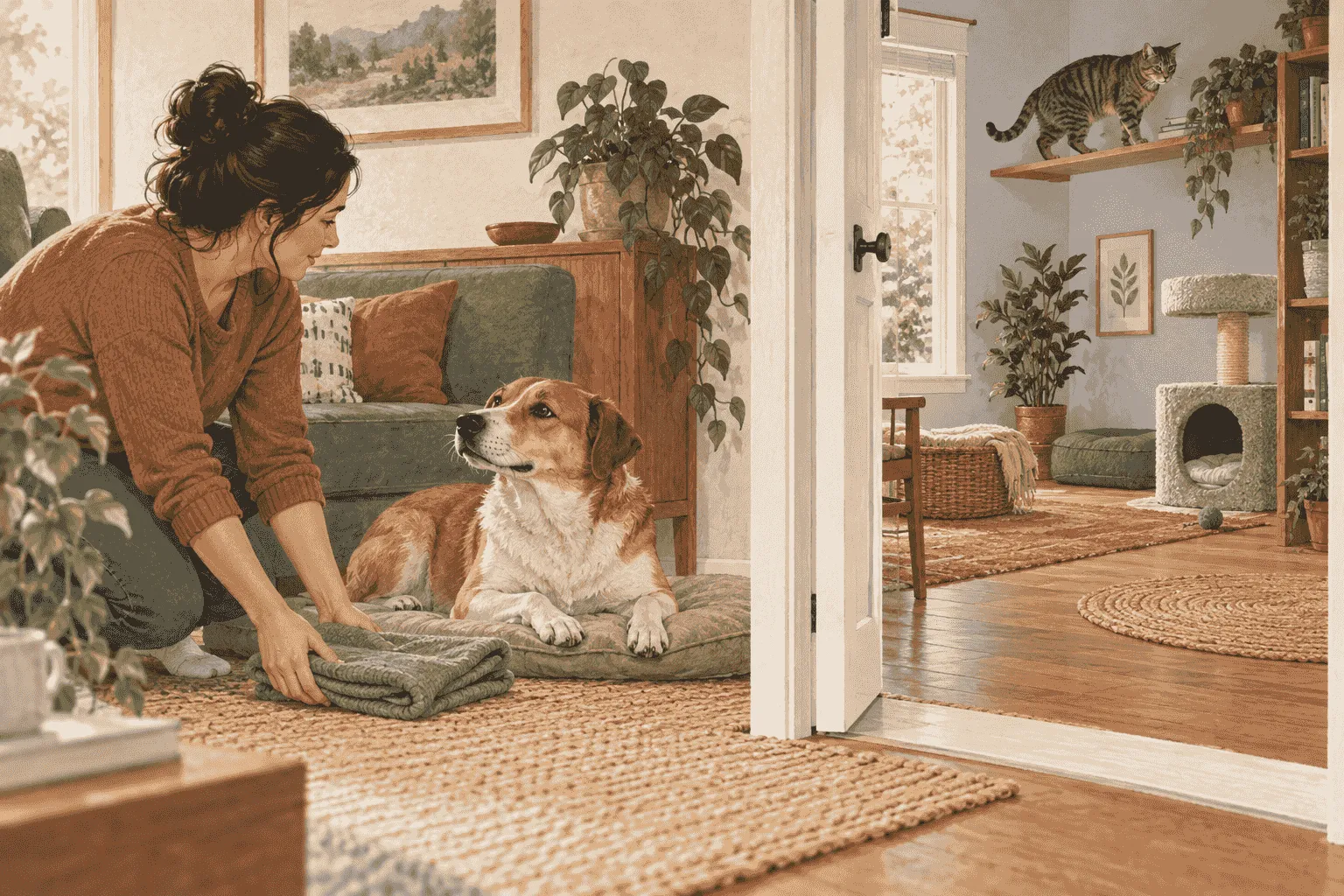
- Separate spaces: Give the cat a dog-free room with food, water, toileting, hiding places, and a route that the dog cannot block. The dog should have their own calm area too.
- Scent before sight: Exchange bedding or another safe scent item so each animal can investigate without sharing a room. There is no need to hold one animal near the other.
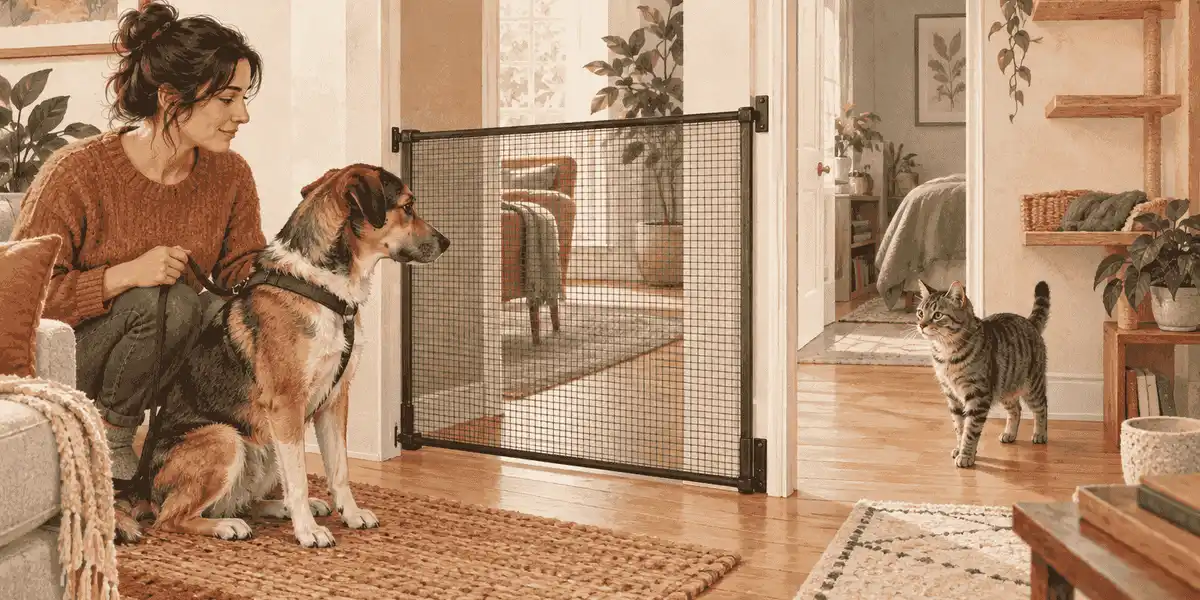
- Secure visual contact: Use a barrier that fits this cat and dog. A small kitten may pass through an ordinary gate gap, and a barrier is only useful if it cannot be crossed unexpectedly.
- Brief, controlled proximity: Move closer only while the dog can stay controlled and the cat can choose to leave. End while the scene is still calm, then return to separation.
There is no fixed number of days that proves readiness. A hiss, retreat, fixed stare, repeated bark, or chase attempt is information to add distance or return to an earlier stage—not a reason to repeat the same difficult meeting until one animal stops objecting. The new-kitten introduction reset guide shows the cat-led version of this sequence; the same escape-and-no-chase boundary matters when the dog’s behavior is the part you are watching.
Make the cat’s escape real
The cat needs more than a theoretical exit. Keep a clear route to a dog-free room, a secure high place, or another area the dog cannot reach. Let the cat decide whether to watch, approach, or leave. Never hold the cat for a forced sniff, and do not assume a quiet dog is ready for shared access just because the first minute looked uneventful.
Kittens need extra physical protection because their small size and quick movement can excite a dog. Keep them separated whenever you cannot supervise directly, even if the dog has previously appeared gentle. The pair may eventually share space, but a calm meeting does not guarantee future compatibility.
Know when to pause and get help
Keep full separation and seek qualified behavior help if the dog repeatedly attempts to chase, the cat’s fear does not ease when you increase distance, or you cannot make the barriers and routes physically secure. Do not leave the animals to sort out conflict. A professional can assess the actual home setup and the pattern you record.
Involve your veterinarian if the response is sudden, escalating, paired with other behavior or health changes, or unlike the dog’s usual pattern. A new sensory or health change can affect behavior, and an online guide cannot examine either animal or predict injury risk. If safety is in doubt, protect separation first and ask for individual direction.
Your next step is concrete: draw the two animals’ routes through the home, mark every place the cat can retreat, and identify the distance at which the dog can notice the cat without chasing. Start there. “Hate” does not tell you what to do; a safe, observable pattern does.
Sources
Petzette's claim cards for this article point to the following scientific, veterinary, or animal-welfare sources.
- Cat And Dog Introductions: Staging, Choice, And Safety: Established UK animal-welfare guidance
- Dogs Trust Chasing Cars, Bikes, Joggers, And Animals: Animal-welfare behaviour and safety guidance
- Canine Reactivity: Trigger Context, Managed Distance, and Diagnostic Boundary: Cross-source evidence note combining a peer-reviewed veterinary clinical review, veterinary-school behavior guidance, a veterinary behavior society position statement, and established welfare guidance. It supports observation, managed distance, non-forced contact, and individual veterinary/behavior referral only; it is not a diagnosis, treatment, equipment, legal, or dog-park recommendation.
- Stelow E. “Diagnosing Behavior Problems: A Guide for Practitioners.” *Veterinary Clinics of North America: Small Animal Practice*. 2018;48(3):339–350. DOI: 10.1016/j.cvsm.2017.12.003; PMID: 29429600. Official NCBI E-utilities metadata and abstract were directly retrieved on 2026-08-15 after the browser-facing PubMed page presented a reCAPTCHA interstitial. The accessible abstract says clinical behavior diagnosis requires behavioral and health history, direct observation and examination, and medical and behavioral differentials.