Behavior26 August 2026
Why Do Cats Put Their Butt in Your Face? Read the Approach
Why do cats put their butt in your face? Learn how to read the approach, keep contact optional, and notice changes that need a veterinarian.
TextPetzette Editorial
Read4 Min
Evidence status
Source-backed editorial
- Evidence record
- 6 claim cards linked to 7 documented sources.
- Independent expert review
- Not commissioned. Petzette Editorial is responsible for the published wording.
- Source record checked
- 17 July 2026
- Scope
- General guidance. Individual animals and circumstances can differ.
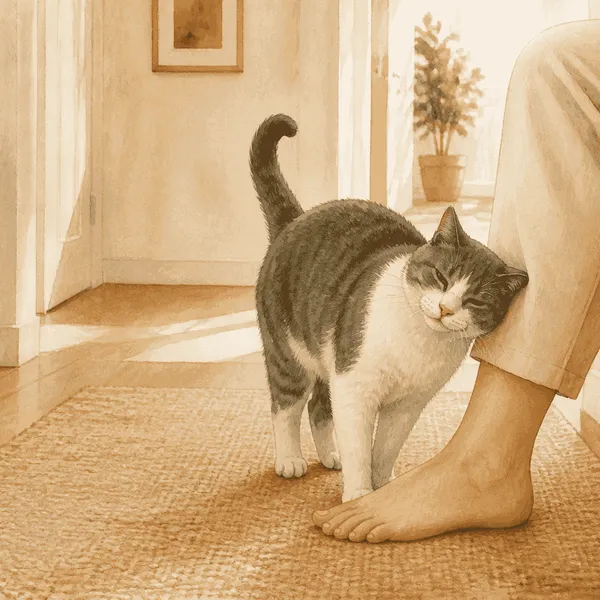
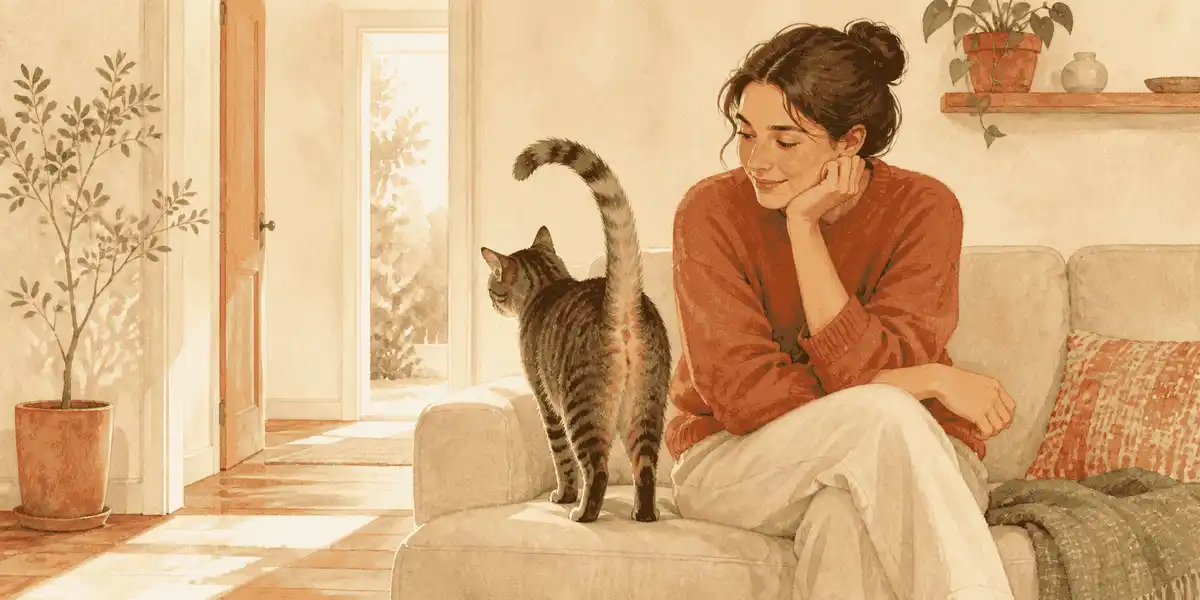
Why do cats put their butt in your face? For a new cat owner, a tail-up, rear-facing approach can look like an insult or a request for a scratch. The safer answer is less certain: it may be part of a familiar social sequence, but one posture cannot tell you whether your cat wants touch. The useful first-year decision is how to acknowledge the approach while keeping the cat free to stay, turn, or leave.
Why Do Cats Put Their Butt in Your Face? Start With the Whole Moment
Cats communicate with combinations of signals, not one-feature subtitles. A 2023 Behavioural Processes study of 53 cat-cafe cats found that facial movement combinations differed between affiliative and non-affiliative cat-to-cat interactions. That study does not decode a household cat’s exact feeling from a tail, rear-facing pose, or still image. It supports a more practical habit: add the body, partner, place, and next action before you decide what the approach means.
Notice three parts of the scene:
- The approach: Did your cat come to you by choice, pause nearby, or climb onto a place where turning around was simply the easiest position?
- The whole body: Are the ears, eyes, whiskers, mouth, shoulders, and pace loose, or is the cat tense, turning away, or trying to create distance?
- The exit: Can the cat turn, walk away, or settle elsewhere without being followed or held in place?
The whole-cat body-language context check gives this same observation habit a broader frame. A rear-facing cat may be comfortable, curious, or simply arranging its body; the pose alone cannot select one explanation.
What Cat Scent Can Add—and What It Cannot Prove
Related cat-human signals give us a cautious clue. Cats Protection guidance describes face or body rubbing as something that can greet familiar people and refresh familiar scent. A rear-facing moment is not identical to a cheek rub, so do not turn that guidance into a claim that your cat is deliberately “claiming” you. It is safer to say that scent and social context can be part of close cat communication, while the exact reason for this individual posture remains uncertain.
One small study shows why the uncertainty matters. In a 2025 PLOS ONE home experiment, 30 cats sniffed unfamiliar-person odour for an average of 4.82 seconds, compared with 2.40 seconds for caregiver odour and 1.93 seconds for a blank. That supports familiar-versus-unfamiliar odour discrimination in that setup. It does not show that a cat presenting its rear is asking for an inspection, identifying one person by smell alone, or reporting a complete emotional state.
If your cat’s rear-facing approach is part of a calm arrival, let it remain an observation rather than a test. There is no need to sniff, touch, or create a reaction to prove what the cat intended.
How to Respond to a Cat’s Rear-Facing Greeting
Make your reply easy to accept or decline. The 2021 Frontiers in Veterinary Science study of 100 well-socialized rehoming cats found more positive and fewer conflict-linked behaviors after people received brief guidance on choice, body-language attention, touch location, and pauses. The study changed several parts of the interaction together, so it does not create a magic timer for every cat. It does support a low-pressure sequence:
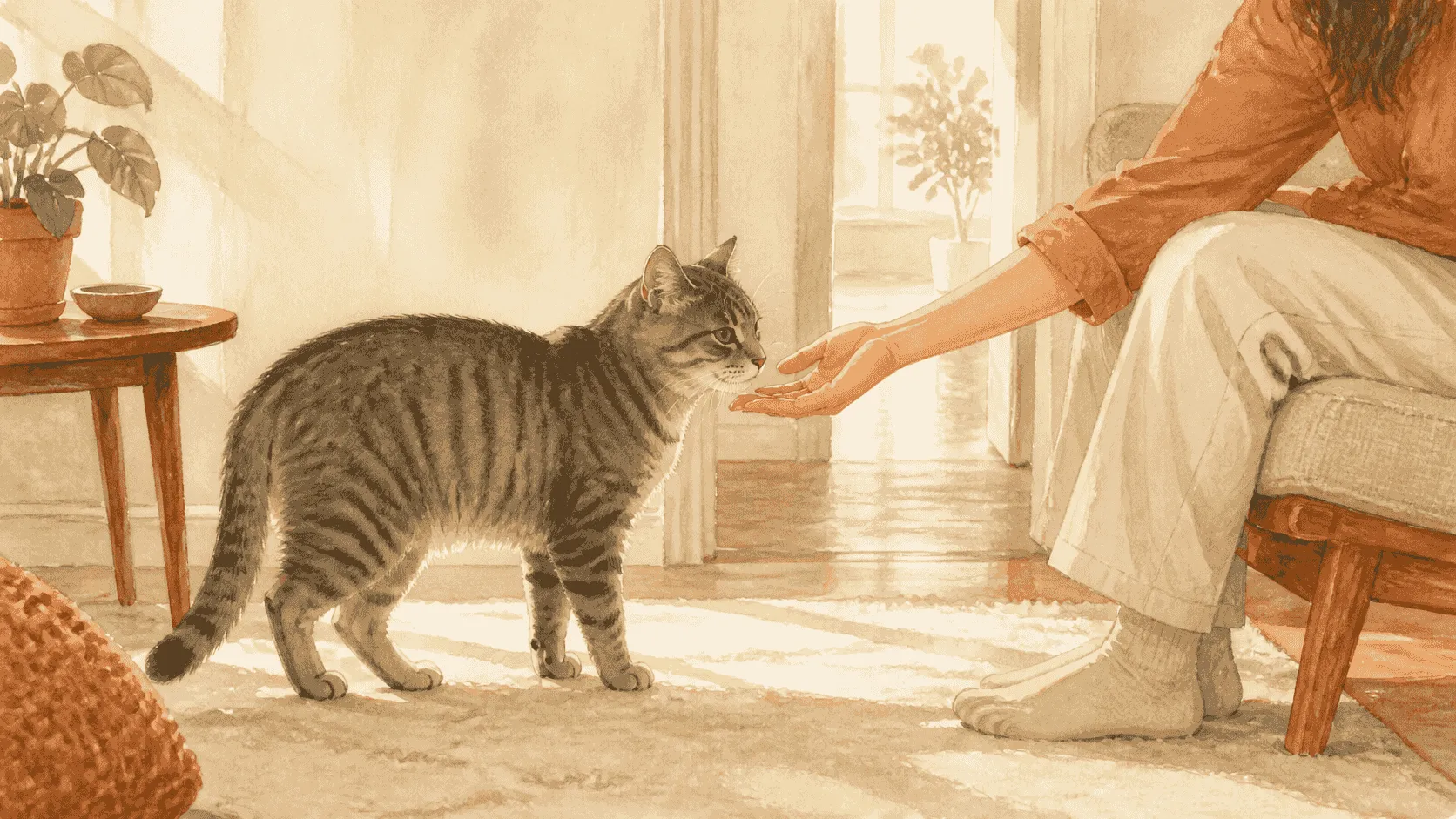
- Pause your hands. Do not grab the tail, hold the cat in position, or turn the rear-facing moment into forced contact.
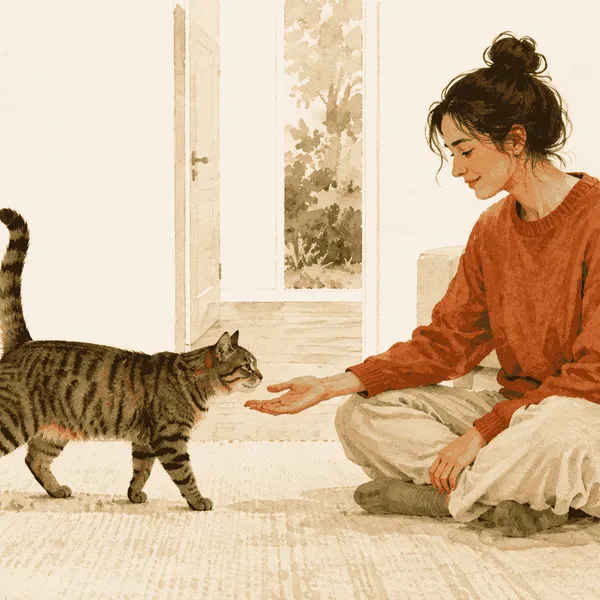
- Offer a familiar area. If the cat stays relaxed, keep your hand still near a cheek or another area the cat already accepts. Let the cat close the distance.
- Pause again. One second of comfortable touch can be a complete handling lesson. If the cat leans away, turns, stiffens, or leaves, let that end the interaction.
This is different from assuming that a rear presentation is a request for lower-back or tail-base scratching. Individual preferences vary, and a cat that approaches you can still want space from a particular touch. The cat-rubbing greeting guide covers cheek and body contact; this page keeps the focus on how to respond when the approach points the other way.
When a New Rear-Facing Pattern Needs a Veterinarian
One brief, familiar rear-facing approach is not a diagnosis. The next step changes if the behavior is sudden, excessive, forceful, uncomfortable, or part of a broader change in touch tolerance or body language. Stop testing the area, give the cat room, and contact your veterinarian if you are seeing signs that the cat may be painful or unwell.
Do not use the pose to rule a problem in or out. A cat can approach and still need a health check, just as a cat can turn away for an ordinary reason. Your notes are most useful when they describe the time, setting, approach, body tension, touch offered, and what happened next—not when they assign a motive.
A Four-Step Rear-Facing Check for Today
When your cat points its rear toward you, use this short plan:
- Let the approach happen by choice. Keep a route away open.
- Read the combination. Add posture, ears, eyes, pace, distance, and the room.
- Acknowledge without insisting. Pause, offer a familiar touch only if the cat stays comfortable, and stop when the cat leaves.
- Compare with the baseline. Record a marked change and ask your veterinarian when the pattern is sudden or uncomfortable.
The answer to “why do cats put their butt in your face?” may stay partly unfinished. Treat the rear-facing moment as information, not a command or a complete translation. Keep the response small, preserve the cat’s exit, and let the next choice tell you more.
Sources
Petzette's claim cards for this article point to the following scientific, veterinary, or animal-welfare sources.
- Cats Protection Cat Rubbing And Bunting: Animal-welfare behaviour guidance
- Cats Sniffed Unfamiliar Human Odour Longer In One Home Test: Peer-reviewed feline olfaction experiment
Miyairi Y, Kimura Y, Masuda K, Uchiyama H. Behavioral responses of domestic cats to human odor. PLOS ONE. 2025;20(5):e0324016.
- Cat Facial Signals In Social Interactions 2023: Peer-reviewed observational study
- AAFP/ISFM Feline Environmental Needs Guidelines 2013: Peer-reviewed veterinary guidelines plus client-facing practice resource
- Cat Interaction Choice And Control Study 2021: Peer-reviewed controlled before/after human-training study
- Cats Protection Belly Display And Petting: Animal-welfare body-language guidance
- Cats Protection One-Second Handling Training: Animal-welfare handling guidance