Behavior & Training03 August 2026
Cat Body Language: A Whole-Cat Context Check
Learn how to read cat body language by comparing face, posture, movement, distance, and context before deciding how to respond.
TextPetzette Editorial
Read4 Min

Evidence status
Source-backed editorial
- Evidence record
- 7 claim cards linked to 8 documented sources.
- Independent expert review
- Not commissioned. Petzette Editorial is responsible for the published wording.
- Source record checked
- 23 July 2026
- Scope
- General guidance. Individual animals and circumstances can differ.
Cat body language is most useful when it helps you decide what to do next—not when it pretends to be a dictionary. A tail, narrowed eyes, a belly, a hiss, or a purr can be one part of a moment. Read the full scene first, then make your response smaller if your cat looks unsure. That protects choice and gives you a clearer observation to act on.
Skip the Cat Body Language Chart; Take a Scene Snapshot
One feature cannot carry the whole message. A 2023 Behavioural Processes study of 53 cats found that combinations of facial movements differed between affiliative and non-affiliative cat-cat interactions. It does not turn ears, eyes, whiskers, or mouth position into a household emotion decoder. It does make a useful practical point: look at the combination, then add the body, partner, and situation.
Before you reach for a cat body language chart, pause long enough to notice four things:
- What changed: a visitor, a noise, a new hand, another animal, or a move toward food or a resting spot.
- The face and body together: eyes, ears, whiskers, mouth, body tension, an arch or crouch, and the way the tail is being carried or moved.
- Movement and distance: whether the cat approaches, pauses, leaves, hides, blocks a route, or has a clear exit.
- The next moment: whether the cat settles, moves closer, turns away, or repeats the pattern.
Cat tail language and cat ear body language belong inside that snapshot, rather than in separate one-signal codes. A tail wag, an ear shift, or a sitting or lying position can be a clue, but a relaxed-looking still image can leave out the approach, retreat, and room layout that make the next choice clearer.
How to Read Cat Body Language Before You Touch
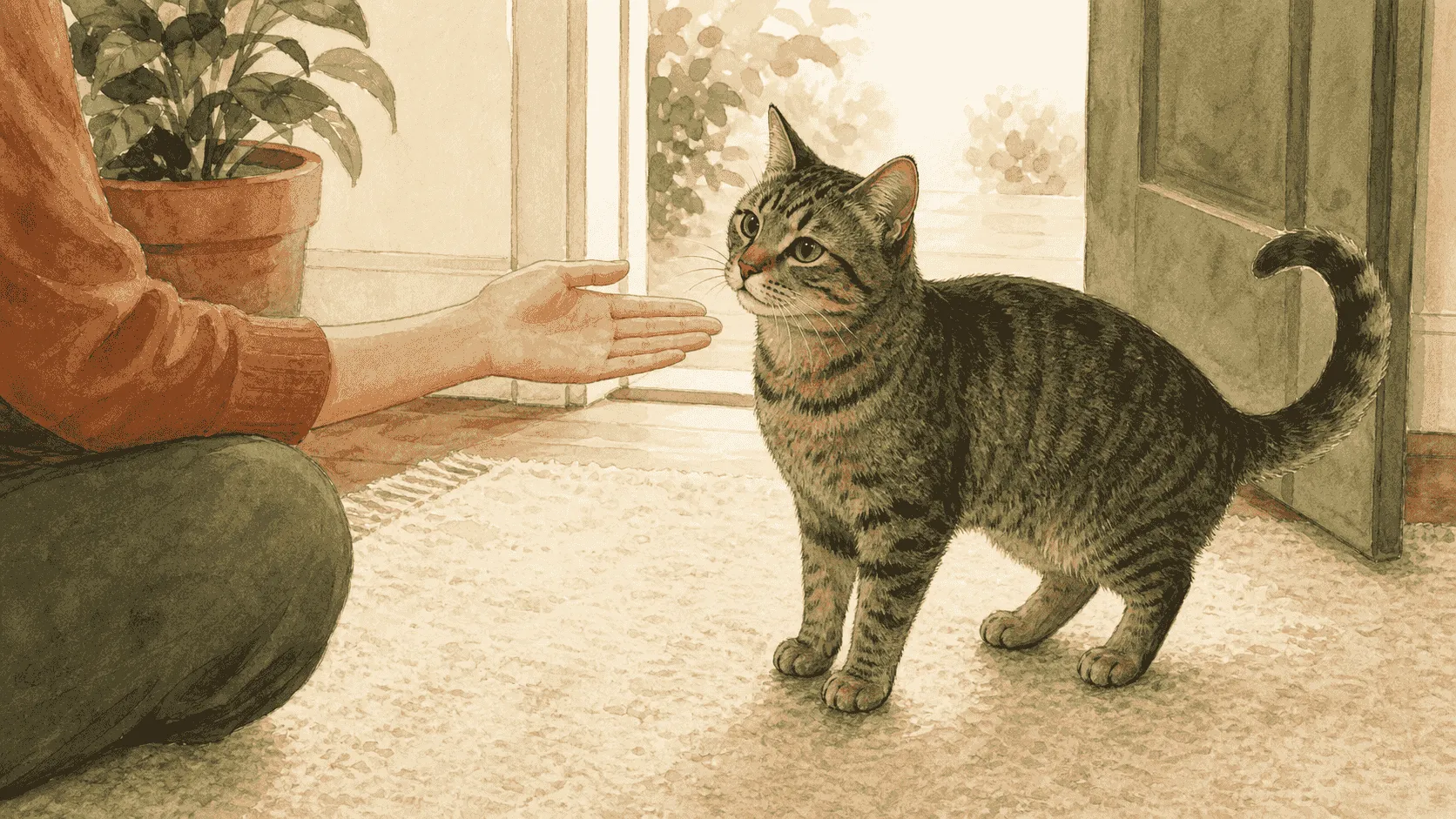
Start with what the cat chooses. The AAFP/ISFM feline environmental-needs guidelines place predictable, positive interaction and cat control at the center of a workable home. If the cat moves away, do not follow with more touch. If the cat stays or returns, offer brief, low-pressure contact and pause before adding more.
Slow blinking can fit this approach when a cat is already relaxed. In a 2020 Scientific Reports study, cats showed more half-blinks and eye narrowing after an owner’s slow-blink interaction; cats were also more likely to approach an unfamiliar experimenter who slow blinked. Treat it as a quiet invitation, not a test of affection: soften your gaze, blink slowly, and wait to see what this cat chooses.
A visible belly needs the same restraint. It can be part of a relaxed posture, but it is not automatic permission for belly contact. Cats Protection guidance recommends watching whether the cat stays, nudges, tenses, or moves away. Offer cheek or head contact only if the cat seems to want it, then let the response set the length of the interaction.
A Hiss, Purr, or Meow Is Only One Piece
Sound adds information, but it is not the whole interaction. In a small 2026 PeerJ home-based experiment with 24 cats, responses to visual cat displays varied with the display’s activity and positive or negative category, while brief isolated sounds produced less clear differences. The study cannot label a live cat’s emotion. Its useful lesson is to restore the missing scene: posture, movement, route, distance, and what happened just before the sound.
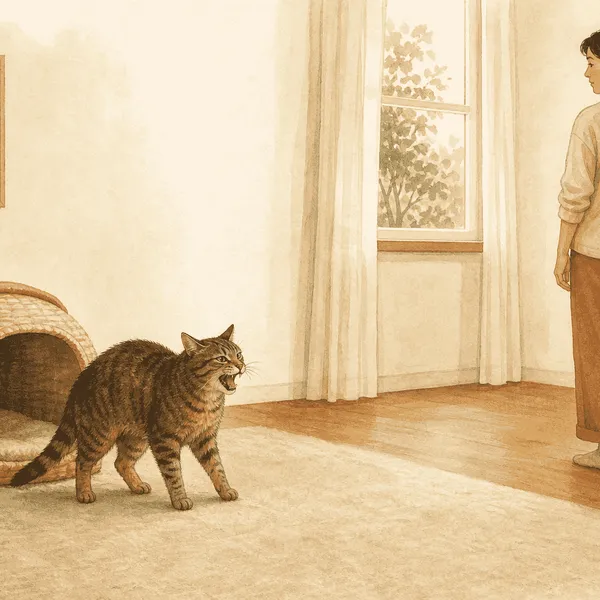
If your cat hisses, step back calmly and keep an escape or hiding route open. Do not pet, restrain, correct, or punish the cat to make the moment end faster. Our three-path check for a hissing cat can help you decide what to record next. A purr also benefits from context rather than a fixed subtitle; the guide to reading a cat’s purr explains that narrower question.
Make Your Response Smaller, Then Observe
The kindest response is often a pause. A 2021 Frontiers in Veterinary Science study of 100 well-socialized shelter cats found that a short visitor lesson on choice, body-language attention, touch location, and pausing was associated with more positive and fewer conflict-linked behaviors. That does not create a magic number of seconds for a home cat. It supports a simple sequence:
- Give space first. Shift back, lower your attention, and leave the cat a clear route away.
- Offer rather than insist. Let the cat initiate or resume contact; keep touch brief and predictable.
- Change one pressure point. Reduce noise, move away from a bottleneck, or end a busy interaction before trying again.
This is not a way to solve every behavior concern at home. It is a way to avoid adding pressure while you learn what the cat’s next movement tells you.
When Body Language Is a Veterinarian Question
Ask a veterinarian when hissing is new, unusual for this cat, or linked to touch in one area. Do the same for a marked change in the usual meow’s tone or amount, especially if it appears with changes in eating, drinking, toileting, activity, or touch tolerance. Those observations help describe a pattern; they do not diagnose pain, fear, hunger, or illness from home.
Your next step is small: notice the scene, make room for the cat’s choice, and write down what changes. Cat body language becomes more useful when it guides a calmer response—not when it asks you to guess a complete story from one tail or sound.
Sources
Petzette's claim cards for this article point to the following scientific, veterinary, or animal-welfare sources.
- Cat Facial Signals In Social Interactions 2023: Peer-reviewed observational study
- Cat Slow Blink And Human-Cat Communication: Peer-reviewed paper
- Cats Respond To Visual And Auditory Cues From Other Cats: Peer-reviewed home-based cat social-cognition experiment
Spoelstra KE, Vonk J, van Berlo E, Kok J, Kret ME. Purr-ceiving feelings: domestic cats respond to intraspecific cues of emotion. *PeerJ*. 2026;14:e21292.
- Cats Protection Hissing Guidance: Current cat-welfare behavior guidance
- Cats Protection Belly Display And Petting: Animal-welfare body-language guidance
- AAFP/ISFM Feline Environmental Needs Guidelines 2013: Peer-reviewed veterinary guidelines plus client-facing practice resource
- Cat Interaction Choice And Control Study 2021: Peer-reviewed controlled before/after human-training study
- FelineVMA Cat Meowing Guidance: Feline veterinary-association caregiver guidance on meowing and vocalization