Behavior & Training17 August 2026
Why Do Dogs Like Squeaky Toys? A Safer Play Check
Why do dogs like squeaky toys? Learn what a squeak can and cannot tell you, how to use the toy safely, and when to choose a quieter game.
TextPetzette Editorial
Read4 Min
Evidence status
Source-backed editorial
- Evidence record
- 5 claim cards linked to 8 documented sources.
- Independent expert review
- Not commissioned. Petzette Editorial is responsible for the published wording.
- Source record checked
- 17 August 2026
- Scope
- General guidance. Individual animals and circumstances can differ.
Why do dogs like squeaky toys? A squeak can get a dog’s attention, but it does not translate the dog’s feelings or intentions. The useful first-year decision is more practical: does this toy make a safe, voluntary game for the dog in front of you, or is a quieter activity the better choice today?
The Study Does Not Isolate the Squeak
A 2025 study in Frontiers in Behavioral Neuroscience observed 29 young dogs with two rubber chew toys: one non-scented and non-squeaking, and one peanut-butter-scented toy with a squeaker. The dogs spent more time interacting with and sniffing the scented squeaker toy.
That result is interesting, but it cannot tell us that the sound was the reason. The study changed scent and squeaking at the same time, and only one dog activated the squeaker during the five-minute observation sessions. It is more accurate to say that this particular combined toy drew attention in this small group than to give the sound a universal meaning.
The study also followed the dogs at home for one week. Owner reports did not show a clear change in off-limit chewing, ordinary toy chewing, or mouthing and nipping for either study toy. A squeaky toy can start an activity; it is not a stand-alone behavior plan.
Read the Dog’s Response, Not a Story
Chewing and play can have more than one function, and a damaged object does not reveal one simple motive. Rather than deciding that a dog is acting out, overly excited, or hunting, watch the moment you can actually see.
Use a short check before you leave the toy out:
- Choice: Does the dog approach the toy, use it briefly, and have room to walk away?
- Body and setting: Is the dog able to pause or redirect, with enough quiet space away from people, children, or other dogs?
- Condition: Is the toy still whole, large enough not to swallow, and free from split seams or loose pieces?
Interest can be enough information for a game. A dog that walks away does not need to be persuaded to continue, and a dog whose response feels hard to interrupt needs less pressure, not a louder test. The broader dog toy safety guide can help with fit, supervision, and retiring damaged toys.
Use a Squeaky Toy as One Activity, Not a Fix
Safe chewing and play outlets can give a dog an appropriate job for the mouth and brain. They do not replace training, a predictable routine, a walk, or professional help when the pattern needs it. Keep household objects that are not meant for chewing out of reach, then make the permitted activity easy to find and supervise.
If mouthing hands or clothes is the concern, keep the response calm and consistent: pause the interaction, redirect to an appropriate object when that is safe, and avoid turning the toy into a reward for grabbing people. Our calm puppy-mouthing plan lays out that wider response.
Run a Safety Check Before the Next Squeak
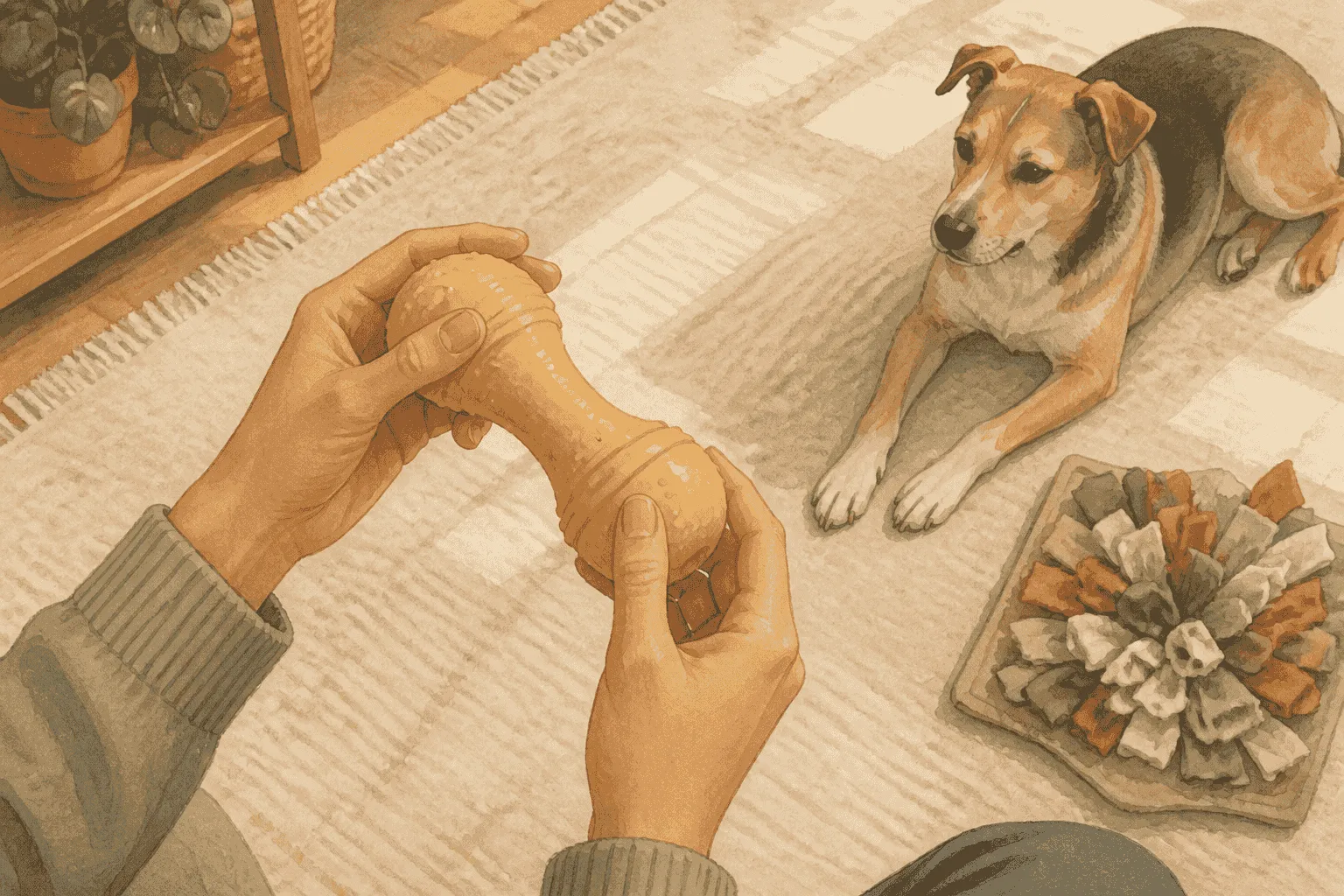
The sound is only one feature. Before play, compare the toy with the dog’s mouth, rotate it in your hands, and look for damage. A toy that can be swallowed whole, has a loose squeaker or fragment, or has changed shape is not one to keep testing. Put it away and choose a different activity.
Supervision reduces the chance that a problem goes unnoticed, but it does not make a toy risk-free. If a piece is missing or ingestion may have happened, contact your veterinarian promptly. Vomiting, appetite loss, abdominal pain, diarrhea, dehydration, or lethargy after possible ingestion need veterinary assessment rather than a wait-and-see experiment.
When a Quieter Game Is the Better Choice
You do not need to prove that a squeaky toy is good or bad for this dog. If the dog seems comfortable and the toy passes the safety check, a brief supervised game may fit. If the dog avoids it, cannot settle after it, or begins to damage it quickly, end the session and offer a simpler option instead: a calm sniffing activity, an easy search, or a quiet rest break.
Enrichment works best as a menu, not a test of what a dog should like. Make the next activity easy enough to understand, keep the dog free to disengage, and adjust from what you observe. A sudden, dangerous, persistent, or escalating change in chewing or behavior deserves a pause and a conversation with your veterinarian or a qualified reward-based behavior professional.
The next step is small: inspect the toy, offer it without pressure, and watch what happens. That gives you a safer answer than a theory about what one squeak means.
Sources
Petzette's claim cards for this article point to the following scientific, veterinary, or animal-welfare sources.
- Scented Squeaker Chew Toys In Puppies (2025): Peer-reviewed original research
Sonowal R, Hall NJ, Stellato AC. To chew or not to chew? Exploring the influence of scented chew toys on puppy chewing. *Frontiers in Behavioral Neuroscience*. 2025;19:1602063. doi:10.3389/fnbeh.2025.1602063.
- Dog Chewing Function And Welfare Review 2025: Peer-reviewed narrative review
- RSPCA Dog Home And Chewing Outlets: Animal-welfare organization guidance
- Gastrointestinal Foreign Bodies In 72 Dogs: Peer-reviewed multicentre retrospective clinical study
Di Palma C, et al. *Animals*. 2022;12(11):1376. doi:10.3390/ani12111376.
- Blue Cross: How To Play With Your Dog: Animal-welfare and behavior guidance
- Cornell: Gastrointestinal Foreign-Body Obstruction In Dogs: Veterinary-school clinical education
- Dog Nosework Positive Judgment Bias 2019: Peer-reviewed animal behaviour paper with Purdue Canine Welfare Science summary
- Blue Cross Dog Enrichment: Animal welfare charity guidance / dog enrichment advice