Behavior18 August 2026
Why Do Cats Knock Things Over? A Safer Setup Check
Why do cats knock things over? Use a safer home reset, a catchable play option, and a pattern check instead of punishing or guessing.
TextPetzette Editorial
Read4 Min

Evidence status
Source-backed editorial
- Evidence record
- 5 claim cards linked to 6 documented sources.
- Independent expert review
- Not commissioned. Petzette Editorial is responsible for the published wording.
- Source record checked
- 16 July 2026
- Scope
- General guidance. Individual animals and circumstances can differ.
Why do cats knock things over? A paw sending a pen, glass, or hair tie to the floor can make a new owner want an instant explanation. But one knocked item does not identify revenge, boredom, attention-seeking, pain, or any other single motive. Cornell Feline Health Center describes destructive behavior as commonly normal investigation and play, while noting that boredom can contribute in some situations.
The useful first decision is smaller: reset the immediate hazard, offer a suitable activity, and record the context before trying to change the pattern. That keeps a frustrating moment from becoming a punishment problem—or a guess about what your cat is thinking.
Treat the Knocked Item as a Setup Cue
Start with what you can observe. What was the object? Where was it? What happened in the minute before the cat touched it, and what happened after? A cat who nudges a bottle from a desk, a cat who sweeps a hair tie from a bedside table, and a cat whose behavior has changed abruptly may need different next steps.
Cornell’s guidance is helpful here because it shifts the question away from character. Normal investigation and play can look inconvenient in a home, but neither a fallen object nor a busy evening proves why it happened. Use the moment to adjust the environment instead of testing a theory by scolding, startling, or physically moving your cat away.
If you need a gentle redirection plan after the reset, our guide to changing cat behavior without punishment can help you make the next acceptable choice easy to find.
Reset Small Hazards Before You Add More Toys
Begin with the surfaces your cat can reach. Cats Protection advises keeping hair ties and rubber bands out of reach because they can be swallowed. FelineVMA’s Cat Friendly Homes guidance gives the same safety boundary for string, yarn, ribbon, and toys with loose swallowable parts: interactive play is fine when you are actively present, then the materials go away.
Put small loops, string, loose pieces, and damaged toys in closed storage rather than leaving them on a bedside table, desk, or floor. Move breakable items from the cat’s usual route while you learn the pattern. This is not a promise that one cleared table solves the behavior. It simply removes a known hazard while you make the room easier to share.
If a hair tie, rubber band, string, or other material may have been swallowed, contact your veterinarian promptly. Do not pull visible material or try to create a home fix.

Offer a Catchable Activity, Then End It Safely
Boredom can be one possible contributor to destructive behavior, but it is not a diagnosis. A short, predictable play opportunity is a useful experiment because it gives your cat a permitted activity without asking them to ignore the room.
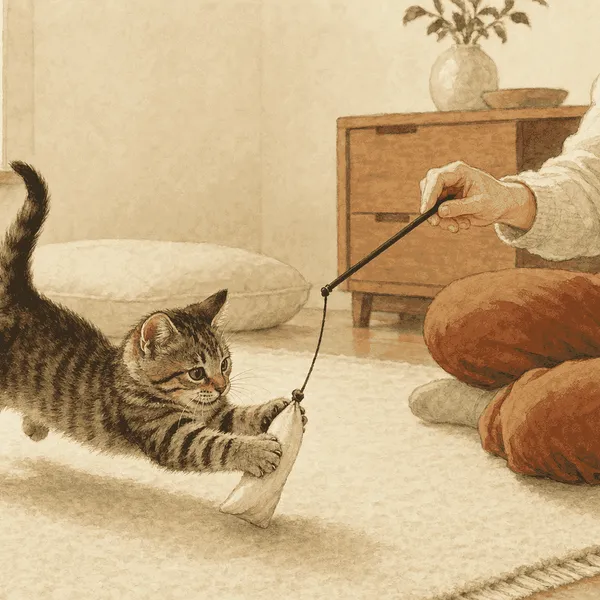
Use a supervised toy that the cat can stalk, pounce on, and physically catch. Cats Protection cautions that a laser-only game can leave the hunt without a catchable ending. If you use a moving toy, make the final beat something paws can hold, then put away strings and any loose parts when the session ends.
Keep hands and feet out of the game. Cornell’s feline behavior guidance recommends toys at a distance from skin when play biting or pouncing is the likely pattern. The first-year kitten toy guide can help you check toy condition, supervision, and storage without turning a product into a promise.
Change One Part of the Routine at a Time
For several days, keep a brief note: the surface, object, time, what the cat was doing beforehand, and what happened next. Then change one part of the setup. You might clear a particular table before the usual busy period, offer a short supervised activity first, or make a safer resting or play space more available.
The note is not a behavior diagnosis. It is a way to find repeatable context without deciding that your cat is bored, demanding attention, or being difficult. If one change does not help, return to the record rather than increasing pressure or adding a pile of new toys all at once.
This same pattern-first approach can be useful with another common home concern: a cat scratching post setup works best when it matches the cat’s actual surface and position preferences, not a label on the box.
Know When It Is More Than a Setup Question
Contact your veterinarian if the behavior is sudden, severe, escalating, or otherwise unusual for your cat. The same is true if the object knocking arrives with apparent pain, reduced appetite, withdrawal, or another health change. A toy, cleared shelf, or behavior diary cannot rule out a medical contributor.
If the pattern makes people or other animals unsafe, create distance and ask for qualified behavior support alongside veterinary guidance. Avoid turning repeated stressful encounters into lessons. The goal is a home where your cat has safer choices, not a test of whether they can resist an object.
Use a Three-Step Home Reset
- Secure: Put away hair ties, rubber bands, string, loose pieces, and breakables from the cat’s usual route.
- Offer: Set up one brief, supervised, catchable play activity, then inspect and store it.
- Observe: Note the context and call your veterinarian for a sudden or concerning change.
A knocked object is useful information, even when its exact meaning stays uncertain. Reset the room, give your cat a safe option, and let the next observation—not a story about motive—shape the next step.
Sources
Petzette's claim cards for this article point to the following scientific, veterinary, or animal-welfare sources.
- Cornell Cat Destructive Behavior, Play, And Scratching: Veterinary school feline behavior guidance
- Cat Friendly Homes: Playing With Your Cat: Veterinary-association caregiver guidance
- Cats Protection: Keeping Your Cat Safe In The Home: Animal-welfare household-safety guidance
- Surgical Gastrointestinal Foreign Bodies In Cats, 2009-2021: Peer-reviewed retrospective clinical study
Gollnick HR, et al. *Journal of Feline Medicine and Surgery*. 2023;25(6). doi:10.1177/1098612X231178140.
- Cats Protection 2025 Behaviour Guide: Catchable Play: Animal-welfare behaviour guide
- Cornell Cat Play Aggression: Veterinary school feline behavior guidance