Behavior30 August 2026
Why Do Dogs Twitch in Their Sleep? Read the Whole Pattern
Why do dogs twitch in their sleep? Learn when small movements fit sleep, what to record, and when a new pattern needs your veterinarian.
TextPetzette Editorial
Read4 Min
Evidence status
Source-backed editorial
- Evidence record
- 2 claim cards linked to 2 documented sources.
- Independent expert review
- Not commissioned. Petzette Editorial is responsible for the published wording.
- Source record checked
- 30 August 2026
- Scope
- General guidance. Individual animals and circumstances can differ.
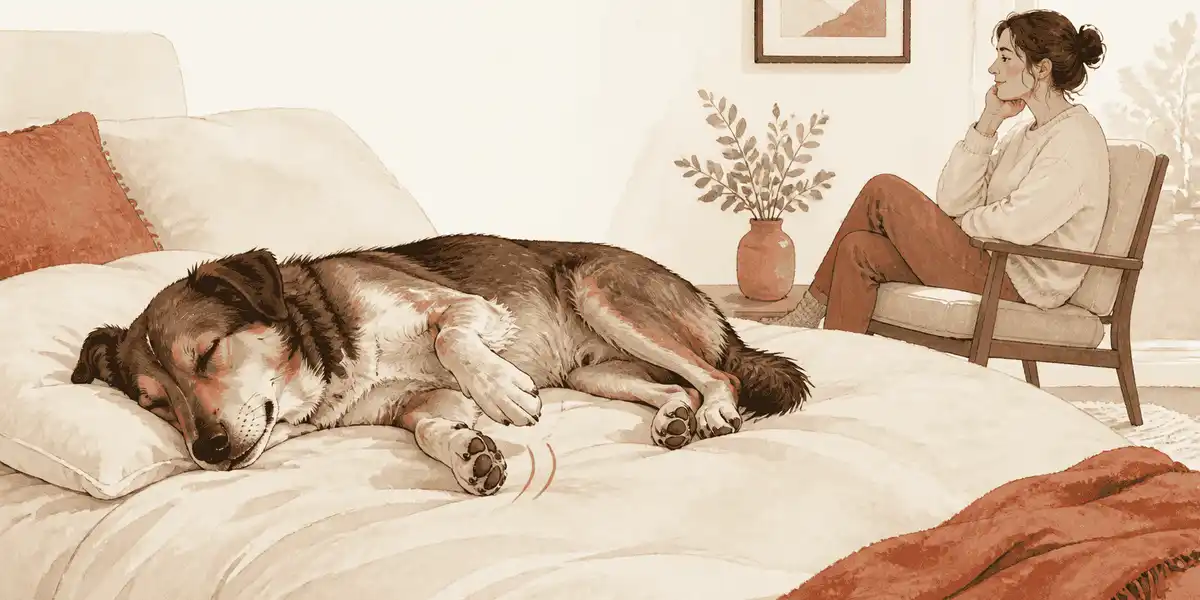
Why do dogs twitch in their sleep? A small paw flick, facial movement, or quiet sound can catch a new owner’s attention fast. Brief, relaxed sleep twitching can fit REM-associated behavior, but the movement alone cannot tell you what a dog is dreaming about—or whether a particular episode is medically important. The useful decision is more practical: leave a familiar, quiet pattern undisturbed, record a changed pattern safely, and ask your veterinarian about forceful, prolonged, injurious, or otherwise concerning movement.
What a Sleep Twitch Can Describe
Sleep movement is real behavior, but it is not a diagnosis. In a 2022 study in Animals, Carrie Tooley and Sarah E. Heath analyzed caregiver reports from 1,330 dogs. Twitching or vocalizing as though dreaming was the second most commonly reported sleep characteristic. That is useful context for an owner who sees an occasional small movement, but it is still a caregiver questionnaire—not a sleep-lab measurement for each dog, and not a universal rule about what every twitch means.
The safest wording is therefore narrow. A brief twitch, small vocalization, or similarly light movement while a dog appears relaxed may fit a sleep-stage pattern. It does not prove a dream, establish a cause, or provide an all-clear. The surrounding pattern matters more than the cute-looking signal by itself.
This is different from asking whether your dog is sleeping more than their individual routine suggests. That guide is about amount and change in rest; this one is about what movement during sleep looks like and what to do with uncertainty.
Read the Movement Without Waking the Dog
Start with distance. Watch whether the movement is brief and localized or whether it is forceful, prolonged, spreading, or repeatedly changing. Notice whether the dog seems settled while asleep and returns to their usual behavior after waking naturally. You do not need to assign a dream or test the dog by touching, startling, or deliberately waking them.
Make the observation specific enough to be useful later:
- What moved: one paw, the face, several limbs, or the whole body?
- How long did it last, and did it stop on its own?
- Was it a familiar pattern, or is it new, more intense, or happening more often?
- Did the dog appear comfortable when awake, or did another change concern you?
These questions turn “my dog twitched” into a context check. They also keep you from over-reading one frame of a sleeping dog. If the movement is small, relaxed, brief, and familiar, protecting quiet rest while you continue noticing the pattern is a reasonable next step. It is observation, not a promise that nothing else could be happening.
When Sleep Movement Is a Different Pattern
Escalate the question when the movement no longer looks like the dog’s usual sleep behavior. A new forceful or prolonged episode, movement that risks injury, or a meaningful change in the pattern deserves veterinary assessment. The same is true when you are worried about the dog’s wider awake behavior or health, rather than only the sleeping movement.
A 2018 case series in the Journal of Veterinary Internal Medicine examined 61 dogs with tetanus and described abnormal sleep behavior in a medically selected population. Some sleep-related movements could resemble seizures. That finding is important as a boundary, not as a prediction: it does not mean an ordinary twitch points to tetanus or that every unusual movement is a seizure. It means appearance can overlap, so a new or concerning pattern should not be sorted out with an internet checklist or a home “test.”
If an episode looks like an apparent seizure, use the record-and-call steps in the seizure guide and contact a veterinarian. Do not diagnose from a video, and do not delay professional advice while trying to decide whether the dog is dreaming.
Build a Short Record, Not a Verdict
If it is safe and does not disturb the dog, record a short video from a respectful distance. Add the date, setting, approximate duration, what moved, how forceful it seemed, whether the pattern was familiar, and what the dog was like before and after. Cornell’s guidance on apparent seizures likewise emphasizes timing, context, and video as useful information for a veterinary assessment; the record supports the conversation but does not replace it.
Keep the camera secondary to safety. Do not restrain the dog, put hands near the mouth, provoke movement, or wake the dog to see whether it happens again. If the episode is prolonged, injurious, or accompanied by a significant change when awake, stop collecting evidence and seek veterinary guidance.
A Three-Lane Twitch Check
Use this simple decision aid when you are unsure:
- Small, relaxed, and familiar: let the dog rest, note the pattern, and compare it with future sleep rather than making a diagnosis from one twitch.
- New or unclear: make a calm, distant record if possible and ask your veterinarian how promptly they want to assess the change.
- Forceful, prolonged, injurious, or paired with other concern: prioritize veterinary contact over further observation.
The main question is not “Can I prove what my dog is dreaming?” You cannot from a twitch alone. Ask instead: “Is this a brief, familiar sleep movement, or a changed pattern that needs a professional look?” That framing gives a new owner a useful next action while leaving diagnosis where it belongs—with a veterinarian.
Sources
Petzette's claim cards for this article point to the following scientific, veterinary, or animal-welfare sources.
- Canine Sleep Twitching And REM Observation: Peer-reviewed canine sleep-behaviour and veterinary-neurology evidence note. It supports a narrow distinction between small sleep movements that may fit REM-associated behaviour and new, forceful, or otherwise concerning movements that need veterinary assessment. It is not a home diagnosis guide, a dream-content source, a seizure-differentiation test, or a treatment source.
- Tooley C, Heath SE. *Sleep Characteristics in Dogs; Effect on Caregiver-Reported Problem Behaviours.* Animals. 2022;12(14):1753. doi:10.3390/ani12141753; PMID:35883300; PMCID:PMC9312228. The caregiver questionnaire included 1,330 dogs, and twitching or vocalising as though dreaming was the second most commonly reported sleep characteristic in the study table. The paper does not establish an optimal sleep duration or diagnose an individual dog's sleep movement.
- Dog Seizure: Owner Observation and Veterinary-Escalation Boundary: Cross-source veterinary-school, veterinary-association, and peer-reviewed veterinary-manual evidence note. It supports a narrow owner-observation, safety, and professional-referral boundary after an apparent seizure in a dog. It is not a diagnosis guide, a cause list for an individual dog, a first-aid training protocol, a treatment plan, a medication guide, or a prognosis source.
- Cornell University College of Veterinary Medicine, Riney Canine Health Center, *Managing seizures.* Direct original page rendered and HTTP-200 verified on 2026-08-21. It says a first event should be timed, safely recorded if possible, followed by a veterinary examination as soon as possible, and notes that a veterinarian must distinguish a seizure from cardiac or vestibular events. It directs immediate clinic care when seizure activity has continued for more than five minutes.