Behavior30 September 2026
Why Do Cats Trill? Read the Greeting in Context
Why do cats trill? A vocalization review offers a greeting context, not a universal translation; learn what to watch and when to call a veterinarian.
TextPetzette Editorial
Read5 Min
Evidence status
Source-backed editorial
- Evidence record
- 4 claim cards linked to 5 documented sources.
- Independent expert review
- Not commissioned. Petzette Editorial is responsible for the published wording.
- Source record checked
- 28 August 2026
- Scope
- General guidance. Individual animals and circumstances can differ.
Why do cats trill? For a new cat owner, the most useful answer is not “because your cat is happy.” A trill can fit a familiar greeting or another individual context, but the sound is not a complete translation. Start with the whole scene: who was nearby, what your cat did before and after the sound, and whether this pattern is ordinary for that cat.
What Cat Trilling Describes
“Trill” is a useful label for a sound, not a diagnosis or a mood caption. A 2020 review in the Journal of Veterinary Science organizes known feline vocalizations into an ethogram and describes trilling as a greeting call in a reported context. The same review warns that vocal categories can be difficult to distinguish and that sounds vary between cats in pitch, duration, intensity, and tone.
That combination matters. A label can help you describe what you heard, but it cannot tell you exactly what your cat intended. Two cats may use similar-sounding calls in different situations. One cat may also change the sound depending on whether a familiar person approaches, another cat appears, play begins, or the household routine shifts.
The review is a literature summary, not a controlled test of your individual cat. Treat “greeting” as one reported context rather than a promise that every trill means welcome, affection, or a request to be touched. If you are trying to distinguish a trill from a chirp or another short vocalization, describe the setting and body movement instead of trying to win an audio-labeling contest.
Why Might a Cat Trill During a Greeting?
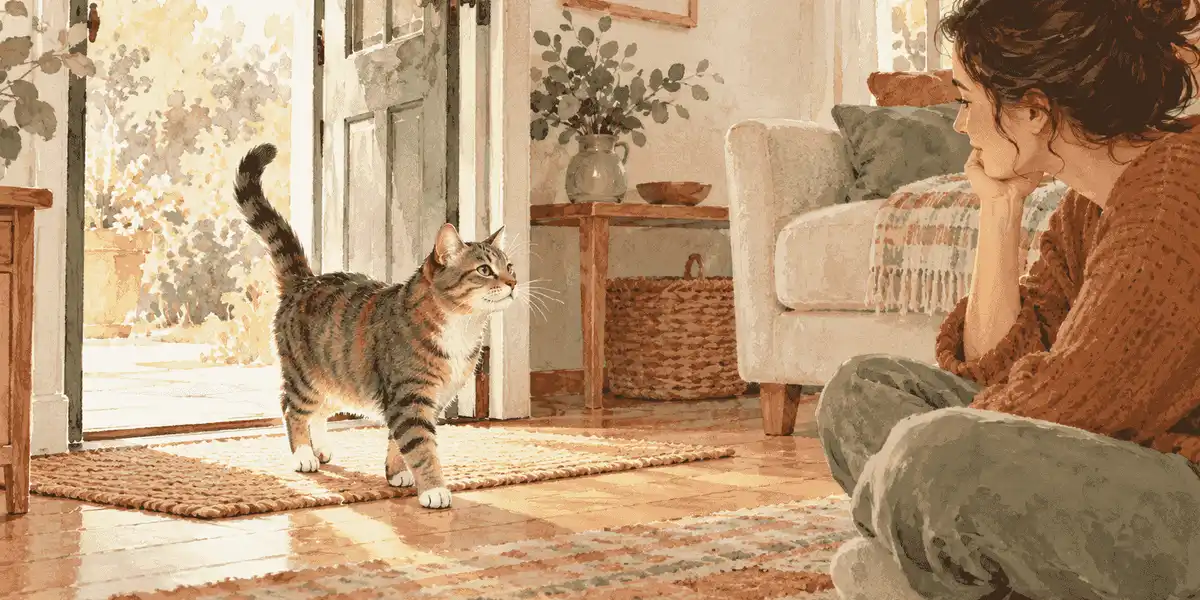
A cat may trill while approaching a familiar person or cat, turning toward you, or beginning a predictable interaction. That sequence can be worth noticing because the sound arrives with movement, distance, posture, and a choice about whether to come closer. It still does not prove that the cat wants a longer interaction.
The practical question is not “Is this a friendly sound?” It is “What does this cat choose next?” Does the cat approach and pause, rub and leave, look toward a resource, or continue through the room? Does the body stay loose, or do the ears, eyes, tail, posture, and route change? A trill alongside an open path and a cat who can disengage gives you more information than the sound alone.
This is also why a trill should not be treated as a universal subtitle. In a small 2026 PeerJ experiment, cats responded more clearly to combinations of visual displays than to brief isolated vocalizations. The study had a small sample and limited stimuli, so it does not prove that cats rely on sight more than sound in every live interaction. It does support a modest rule: put the sound back into the scene before deciding what it means.
For a broader vocalization check, see why cats meow in context. For the different window-and-wildlife decision, why cats chirp explains why chirping and chattering around prey should not be collapsed into one greeting story.
Let the Trill Stay Optional
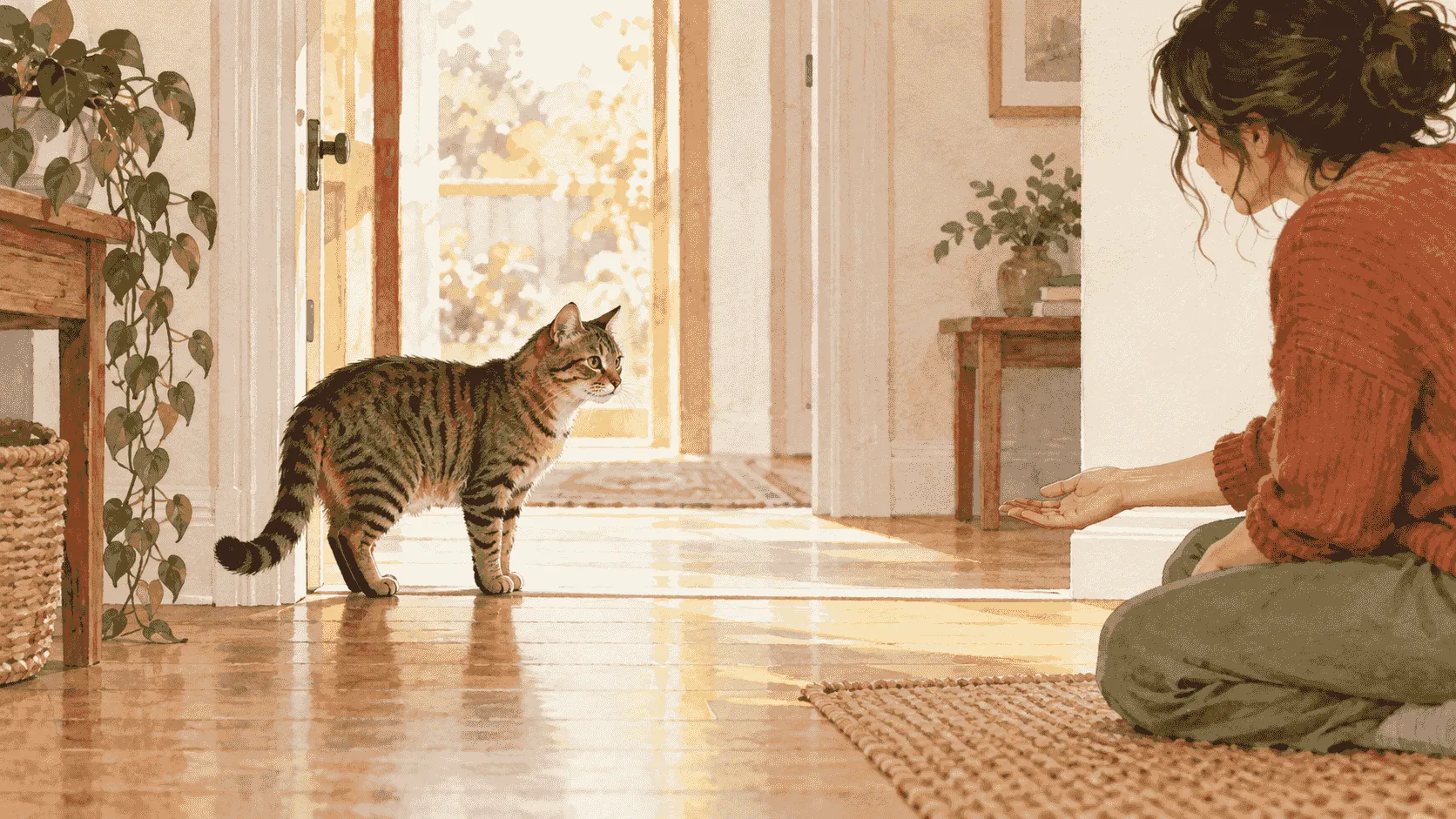
When the sound appears during a familiar, comfortable approach, keep your response small. Turn toward the cat without blocking its path. Offer a brief hand at a comfortable distance, then pause. Let the cat decide whether to lean in, stay nearby, move away, or return later.
The AAFP/ISFM feline environmental-needs guidance places predictable, positive, cat-led interaction alongside safe places, separated resources, play, and respect for scent. A controlled before-and-after study of interactions with rehoming-center cats also found more positive behavior after people learned to offer choice, watch body language, limit touch, and pause. Those findings support a style of interaction, not a magic timer or a guarantee for every household.
Do not follow a cat that turns away just because it trilled first. Do not pick up a cat to confirm that the sound was affectionate. A greeting can end after one second, and a cat who leaves has supplied useful information about the moment. Necessary handling and veterinary care are separate decisions that may require a professional plan.
A Trill Is Not a Health Test
A familiar trill from a cat who is eating, moving, resting, and interacting as usual can remain an observation. But the sound itself cannot rule out pain, stress, illness, or a change in the home. A cat may vocalize in more than one context, and a caregiver’s interpretation can become overconfident when the rest of the pattern is missing.
Compare the sound with that cat’s baseline. Note whether the trill is suddenly different, much more frequent, persistent, or paired with changes in appetite, drinking, litter-box use, grooming, movement, breathing, energy, or touch tolerance. Feline Veterinary Medical Association guidance advises veterinary attention for a marked change in a cat’s usual vocalization. A recording and short timeline can help explain the pattern, but neither can diagnose the cause.
Ask your veterinarian promptly when the vocal change is sudden, severe, persistent, or accompanied by signs that your cat is unwell or uncomfortable. Do not use a familiar-sounding trill to reassure yourself through a wider change, and do not keep repeating a handling test to see whether the sound returns.
Your Next Trill Check
For the next few episodes, make four small notes:
- Scene: Who was present, where was your cat, and what changed just before the trill?
- Whole body: What did the ears, eyes, posture, tail, movement, and route do?
- Choice: Could your cat approach, pause, leave, and return without being followed or cornered?
- Baseline: Was this familiar, or was the sound new, persistent, or paired with another change?
Why do cats trill? A greeting may be part of the answer in some reported contexts, but it is not the whole answer for every cat. Use the sound as a prompt to observe, keep contact optional, and pass a changed pattern to your veterinarian rather than turning one vocalization into a verdict.
Sources
Petzette's claim cards for this article point to the following scientific, veterinary, or animal-welfare sources.
- Feline Vocal Communication Review And Chirp Ethogram: Peer-reviewed veterinary behavior review of domestic-cat vocal communication
Tavernier C, Ahmed S, Houpt KA, Yeon SC. Feline vocal communication. Journal of Veterinary Science. 2020;21(1):e18.
- Cats Respond To Visual And Auditory Cues From Other Cats: Peer-reviewed home-based cat social-cognition experiment
Spoelstra KE, Vonk J, van Berlo E, Kok J, Kret ME. Purr-ceiving feelings: domestic cats respond to intraspecific cues of emotion. *PeerJ*. 2026;14:e21292.
- FelineVMA Cat Meowing Guidance: Feline veterinary-association caregiver guidance on meowing and vocalization
- AAFP/ISFM Feline Environmental Needs Guidelines 2013: Peer-reviewed veterinary guidelines plus client-facing practice resource
- Cat Interaction Choice And Control Study 2021: Peer-reviewed controlled before/after human-training study