Behavior02 August 2026
Cat Hissing: Use a Three-Path Context Check
Cat hissing calls for space first. Use a three-path context check for people, pet introductions, and unusual touch-related changes.
TextPetzette Editorial
Read3 Min

Evidence status
Source-backed editorial
- Evidence record
- 5 claim cards linked to 5 documented sources.
- Independent expert review
- Not commissioned. Petzette Editorial is responsible for the published wording.
- Source record checked
- 23 July 2026
- Scope
- General guidance. Individual animals and circumstances can differ.
Cat hissing is best treated as a pause button, not a personality verdict. Stop moving closer, keep an escape or hiding route open, and look at the scene before choosing what happens next. The useful first-year decision is not “What does this sound always mean?” It is whether to create space, reset an introduction, or contact your veterinarian about a new pattern.
Why Do Cats Hiss? Start With Distance
Cats Protection describes hissing as a warning from a distressed cat that needs space. It does not prove aggression, dislike, or one particular emotion. Handling, environmental pressure, fear, stress, and a possible health concern can overlap, so the sound cannot identify its own cause.
Use the same immediate response whether you understand the trigger or not:
- Stop reaching, petting, or advancing.
- Turn slightly away and add distance if you can do so safely.
- Leave the route to a carrier, doorway, perch, or covered retreat clear.
- Do not scold, restrain, cuddle, or hiss back.
If anyone could be bitten or scratched, prioritize distance and a barrier without cornering the cat. A calmer scene gives you more useful information than another attempt at contact.
Read the Whole Cat, Not Just the Sound
A 2026 PeerJ experiment tested 24 adult cats from 13 households with brief sights and sounds from other cats. Responses to the visual displays varied with both activity and positive or negative category, while the isolated sounds produced less clear response differences. The small study was not a household emotion test, but it reinforces a practical limit: a hiss, purr, or trill is not the whole interaction.
Replay the scene with four details:
- Trigger: What changed immediately before the hiss?
- Body: Did posture, movement, or touch tolerance change too?
- Distance: Could the cat move away, or was a route blocked?
- Pattern: Is this familiar for this cat, or newly different?
A cat may hiss, stay nearby, or rub against you during one sequence. That combination does not make the hiss “friendly” or prove aggression. Pause contact, keep the exit open, and let the cat’s next movement add context.
The context-first guide to cat purring uses the same series-level rule: sound belongs beside the body, setting, and sequence—not in a universal dictionary.
Use the Three-Path Cat Hissing Check
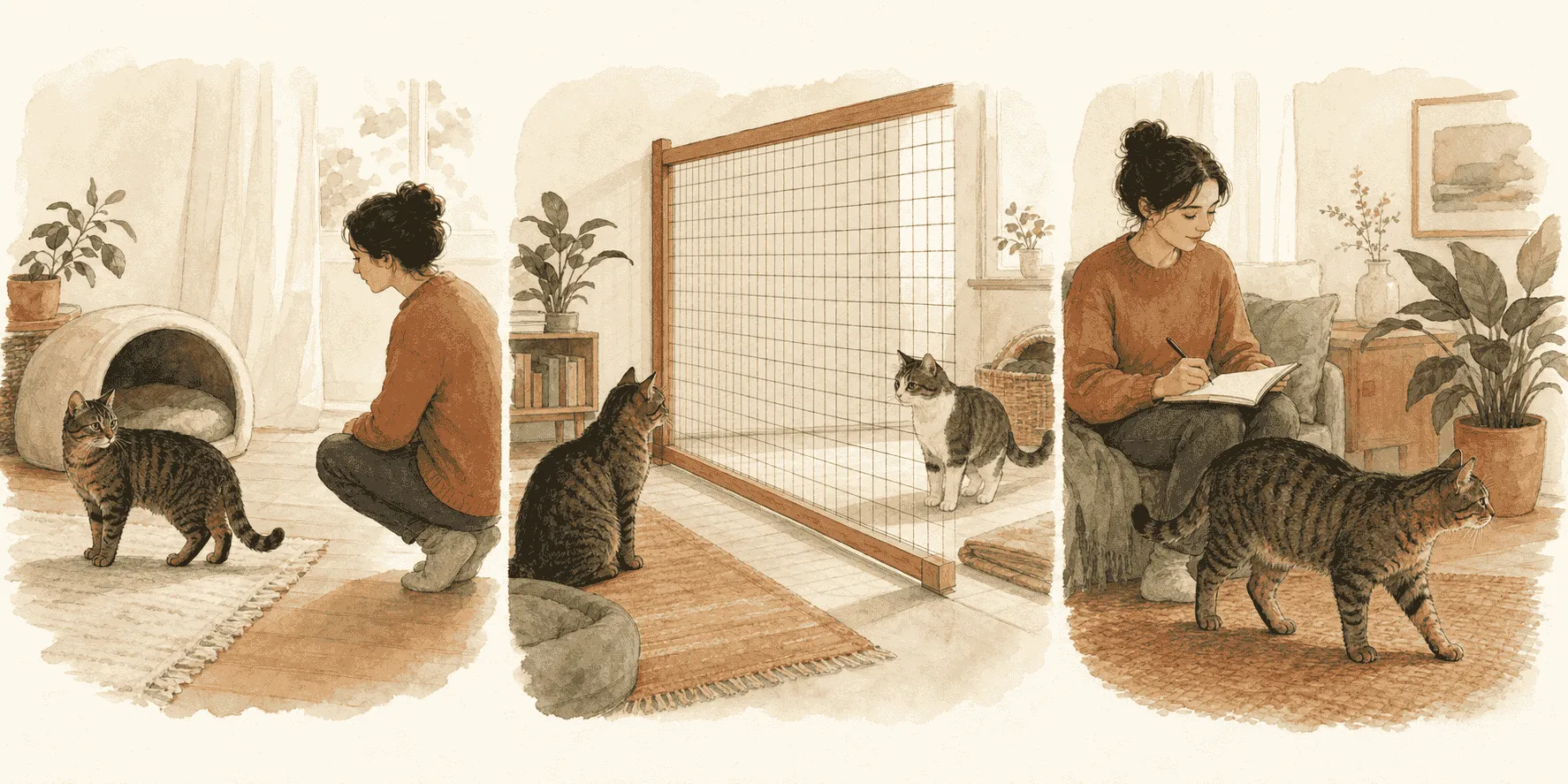
Path 1: The cat hisses at a person
Back away and let the cat choose whether to remain, retreat, or reappear. If this is a newly adopted cat facing unfamiliar people and rooms, use the detailed distance-and-choice reconnection plan. It owns the base-room setup and gradual return to contact; this page helps you identify that route.
Path 2: The hiss happens during a pet introduction
Do not move the animals closer to test the relationship. For cat-to-cat introductions, Cats Protection guidance and the 2024 FelineVMA intercat-tension guideline support going back from physical proximity to a barrier, or from visual contact to separate spaces and scent exchange. There is no fixed timeline or promise of friendship.
In a kitten–dog meeting, a hiss can mean the kitten needs more room. Restore the barrier, prevent chasing, and return to the last stage where both animals were comfortable. The kitten-and-dog introduction reset covers the secure setup and supervision boundary.
Path 3: The hissing is new or linked to touch
Stop touching the area. Do not press again to confirm a sore spot. Cats Protection advises veterinary assessment when hissing is unusual for that individual cat or repeats when a particular area is touched, because pain or another health context may contribute.
When Cat Hissing Needs Professional Help
Contact your veterinarian when hissing is newly different, repeats with touch in one place, or appears with changes in eating, drinking, toileting, movement, grooming, activity, or social behavior. Hissing alone cannot diagnose pain or disease, and a cat still eating does not rule out a health concern.
Keep pets separated and seek qualified behavior help if introductions remain tense, chasing continues, routes or resources are being blocked, or you cannot keep the setup safe. Professional help should move sooner when the behavior is sudden or severe or someone is at risk.
Your next useful step is small: create space, write down the trigger, body, distance, and pattern, then choose one path. That decision respects the warning without pretending the sound explains the whole cat.
Sources
Petzette's claim cards for this article point to the following scientific, veterinary, or animal-welfare sources.
- Cats Protection Hissing Guidance: Current cat-welfare behavior guidance
- Cats Respond To Visual And Auditory Cues From Other Cats: Peer-reviewed home-based cat social-cognition experiment
Spoelstra KE, Vonk J, van Berlo E, Kok J, Kret ME. Purr-ceiving feelings: domestic cats respond to intraspecific cues of emotion. *PeerJ*. 2026;14:e21292.
- Cat And Dog Introductions: Staging, Choice, And Safety: Established UK animal-welfare guidance
- 2024 AAFP Intercat Tension Guideline Brief: Veterinary consensus-guideline brief
- Cats Protection Gradual Cat Introductions: Animal-welfare behavior guidance