Health Signals09 September 2026
Cat Excessive Grooming: When to Call Your Veterinarian
Cat excessive grooming can be a health signal. Learn what to record, why location is not a diagnosis, and when your veterinarian should help.
TextPetzette Editorial
Read5 Min
Evidence status
Source-backed editorial
- Evidence record
- 3 claim cards linked to 1 documented source.
- Independent expert review
- Not commissioned. Petzette Editorial is responsible for the published wording.
- Source record checked
- 09 September 2026
- Scope
- General information, not an individual diagnosis or treatment plan.
Cat excessive grooming is not a problem you can settle by counting every lick. The useful first-year decision is whether this cat’s pattern is familiar, noticeably changed, or accompanied by coat or skin damage that should move the question to a veterinarian. A location can help you describe what you see, but it cannot identify the cause at home.
This is a narrower decision than asking why cats groom themselves. The guide to why cats lick themselves covers ordinary self-grooming mechanics and the wider pattern check. This page is for the moment when grooming seems more frequent, longer, more focused, or visibly different.
Decide Against This Cat’s Own Baseline
There is no universal number of grooming sessions that separates normal from excessive. Cats differ, and a single long grooming bout is not a diagnosis. Start with the pattern you know from this individual:
- Is grooming happening more often or lasting longer than usual?
- Is the cat returning to one area instead of moving through its familiar routine?
- Does the coat look thinner, broken, or different in that area?
- Is there visible skin change, a lesion, or an unusually large hairball pattern?
The important signal is a meaningful change from baseline, especially when it persists or concentrates in one place. A familiar coat and a familiar rhythm support observation; they do not require you to manufacture a problem. A new pattern deserves a clear note rather than a confident label.
Map the Pattern Without Naming a Cause
Cornell University College of Veterinary Medicine’s Feline Health Center describes excessive grooming as a health signal when frequency or duration changes, hair is lost, or the skin is damaged. It also makes a useful distinction about location: a cat may focus licking on an area associated with itch or pain, while other patterns can be widespread. Those observations overlap across possible causes.
That means “belly,” “legs,” “tail,” or “one flank” is a description, not an answer. Do not turn a body map into a diagnosis such as allergy, parasites, infection, pain, or anxiety. Do not press the area to test it, shave the coat to investigate, clean the skin with a new product, or give medication because a location seems to point somewhere. Those steps can add irritation and still cannot tell you what is happening.
Observe from a comfortable distance and write down:
- Where: the exact area, or whether the grooming is spread across the body.
- How: more frequent, longer, more intense, or simply more noticeable than usual.
- What changed: coat thinning, hair loss, a lesion, visible skin damage, or an excessive hairball pattern.
- When: the first day you noticed the change and whether it has continued.
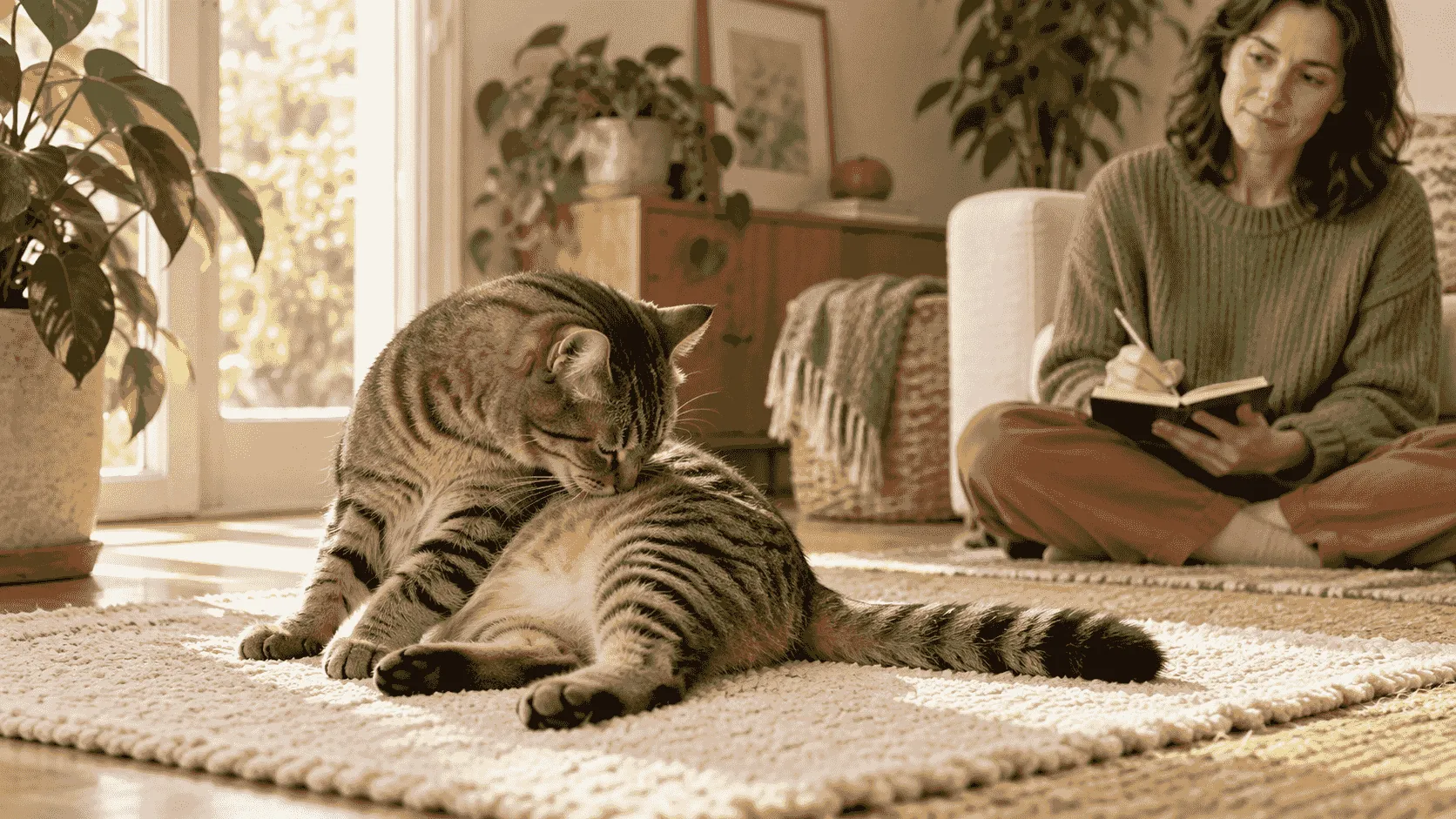
The record is not a home examination. It is a way to give your veterinarian a more useful starting point than “the cat is grooming a lot.”
Know When the Next Step Is Veterinary Advice
Ask your veterinarian to assess the pattern when grooming is new, persistent, repeatedly focused on one area, or visibly damaging the coat or skin. Hair loss, bald areas, lesions, and excessive hairballs also change the decision. You do not need to wait for the skin to become raw before asking for help.
The purpose of that visit is a cause check, not a confirmation of the label you chose at home. Cornell’s guidance notes that an underlying medical problem should be considered before environmental stress is treated as an explanation. Even when a household change happened around the same time, timing alone does not prove that stress is the cause.
Do not use a normal appetite, a calm few minutes, or the cat’s ability to settle as clearance. The question is whether the overall grooming pattern has changed and whether the coat or skin is being affected. If you can see damage or the change is continuing, share that information with the veterinary team rather than waiting for a home fix to work.
Support the Cat Without Trying to Treat It
While arranging veterinary advice, keep the cat’s environment predictable. Familiar items, gradual changes, a safe vertical retreat, and calm play or enrichment can support the cat while you observe. They are supportive steps, not proof that the problem is behavioral and not a substitute for a cause check.
This is also not the moment to launch several interventions at once. Avoid adding a new diet, supplement, medication, parasite product, topical, or grooming tool as a test unless your veterinarian gives an individual plan. If the cat is already focused on a spot, more handling can make the observation harder and may add stress or irritation.
The practical goal is simple: reduce unnecessary disruption, preserve a clear record, and keep the professional-help boundary visible. “How do I stop my cat from over-grooming?” is not safely answered by forcing the behavior to stop before you know why it changed.
Take a Useful Note to Your Veterinarian
A short timeline can make the first conversation clearer. Include:
- the cat’s usual grooming pattern and the date you noticed a difference;
- whether the change is longer, more frequent, focused, or widespread;
- the exact body area and whether the coat or skin looks different;
- any visible hair loss, lesion, skin damage, or excessive hairball pattern;
- whether a household or routine change happened before you noticed it.
Keep the wording observational. “She has returned to the inside of her back leg several times each evening since Monday” is more useful than “she has anxiety.” “There is a thinner patch and a visible skin change” is more useful than choosing a skin diagnosis from a search result.
If the cat will not tolerate close inspection, do not corner, restrain, shave, or press the area to complete your notes. A safe observation from a distance is enough to tell the veterinarian what changed.
Keep Routine Grooming in Its Own Lane
Ordinary coat care is a separate decision. If the cat’s self-grooming pattern and coat are at baseline, use the calm cat-grooming routine to plan voluntary, low-pressure brushing. Routine grooming should not be used to explain away a sudden change in self-grooming, and a new health signal should not be treated as a coat-maintenance project.
The boundary is therefore straightforward: compare with the cat you know, map the change without naming its cause, and ask your veterinarian when the pattern is new, persistent, focused, or damaging. Observation can make the next appointment better. It cannot replace the assessment.
Sources
Petzette's claim cards for this article point to the following scientific, veterinary, or animal-welfare sources.
- Cornell Cats That Lick Too Much: Veterinary-school feline-health guidance