Behavior11 September 2026
Dog Behavior Explained: Read the Whole Pattern First
Dog behavior explained for a new owner: read the whole pattern, protect choice, teach the next behavior, and know when professional help matters.
TextPetzette Editorial
Read7 Min
Evidence status
Source-backed editorial
- Evidence record
- 8 claim cards linked to 10 documented sources.
- Independent expert review
- Not commissioned. Petzette Editorial is responsible for the published wording.
- Source record checked
- 30 August 2026
- Scope
- General guidance. Individual animals and circumstances can differ.
Dog behavior explained in one sentence would be misleading. A new dog’s bark, retreat, jump, stare, or change in routine can have different possible contexts, and the same action can look different in a different dog or situation. The useful first decision is not which label to attach. It is what changed, what the whole dog is doing, and what small adjustment makes the next moment safer and clearer.
That approach is especially useful in a first year, when a puppy or newly adopted adult is learning a home while you are still learning the individual. Start with the first-time dog owner’s 30-day routine for the wider setup. This guide focuses on the behavior decision inside that routine: observe, reduce pressure, teach a practical alternative, and recognize when a veterinarian or qualified behavior professional should lead.
Dog Behavior Starts With a Pattern, Not a Label
Begin with a baseline. Notice ordinary appetite, sleep, movement, toileting, play, rest, handling comfort, and interest in people or the environment. A new dog does not need to reveal a fixed personality in the first few days. The early job is to give the dog enough predictable routine that you can see what is familiar and what is changing.
Dogs Trust guidance recommends reading the individual dog, the whole body, and the situation because a single behavior can have different meanings in different contexts. A tail movement, yawn, lip lick, stare, or raised patch of hair is an observation—not a complete emotion, pain, fear, or safety test. The dog’s route, posture, movement, distance, and what happens next add more useful information.
That limit is also supported by research. Bremhorst and colleagues’ 2022 Animal Cognition study tested facial actions in 28 dogs across specific reward contexts; no single action consistently classified the study’s two conditions. A 2024 systematic review by de Winkel and colleagues, covering 39 observational dog-welfare studies, likewise found limited validation and context-dependent meaning. These studies do not make observation useless. They explain why a homemade score or online body-language chart should not be treated as a diagnosis.
Use a Four-Part Dog Behavior Note
When something catches your attention, write four short lines instead of a verdict:
- Before: What changed just beforehand? Note a visitor, food, a doorway, another dog, a sound, a hand moving closer, or the end of an activity.
- During: What is the whole body doing? Include posture, face, ears, tail, movement, tension, distance, and whether the dog can leave.
- Choice: Is the dog approaching, pausing, turning away, hiding behind you, moving toward a resting place, or trying to create more space?
- After: What happened when you stopped, added distance, lowered the noise, or made the route easier?
This record helps separate a repeatable pattern from a memorable one-off. It also keeps you from testing a theory by repeating a trigger, cornering the dog, staring, or holding a body part still for a better look.
In a 2012 PLOS ONE study, dogs encountered a potentially scary object while an owner or stranger delivered emotional messages. The tested dogs used human information around that uncertain object, which supports a modest practical point: when something feels strange, your dog may check your reaction before deciding what to do. Keep your response calm and give the dog room. A cautious response is information, not evidence that you caused the dog’s feelings or that the dog will copy every emotion.
Make the Environment Easier to Succeed In
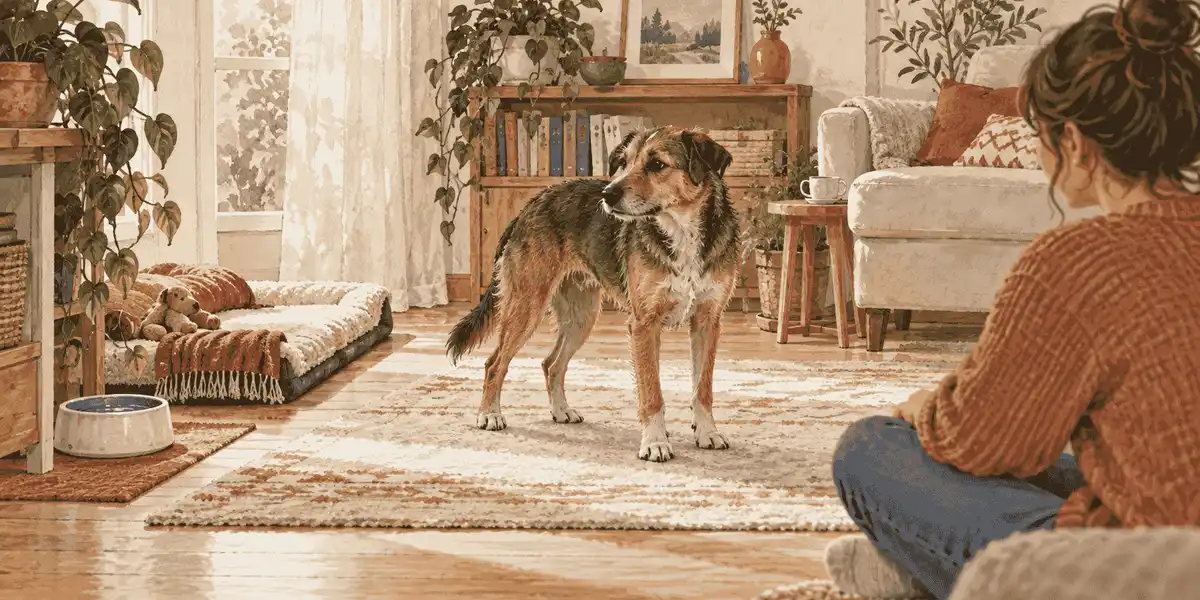
Behavior often becomes easier to read when the home stops asking for too much at once. Give the dog a comfortable, low-traffic place that is large enough for normal rest and free from obvious hazards. Dogs Trust describes a useful safe space as one the dog can enter and leave freely, without punishment or people following them in. It is a retreat, not a holding area or a treatment for fear.
Set a household rule that the dog can rest without being pulled out, hugged, or surrounded. Visitors can wait for an invitation rather than reaching over the dog. If the dog chooses distance, protect that choice. A dog that moves away has given you a useful answer even when you do not know the complete reason.
Reduce one pressure point at a time. Close a curtain before predictable window activity, move a busy interaction farther from the resting space, or shorten a handling session. Management is not a failure to train; it prevents another rehearsal while you learn what the dog can comfortably do. The environment still needs ordinary food, toileting, exercise, social contact, and rest rather than becoming a program of avoidance.
Teach the Next Behavior With Rewards
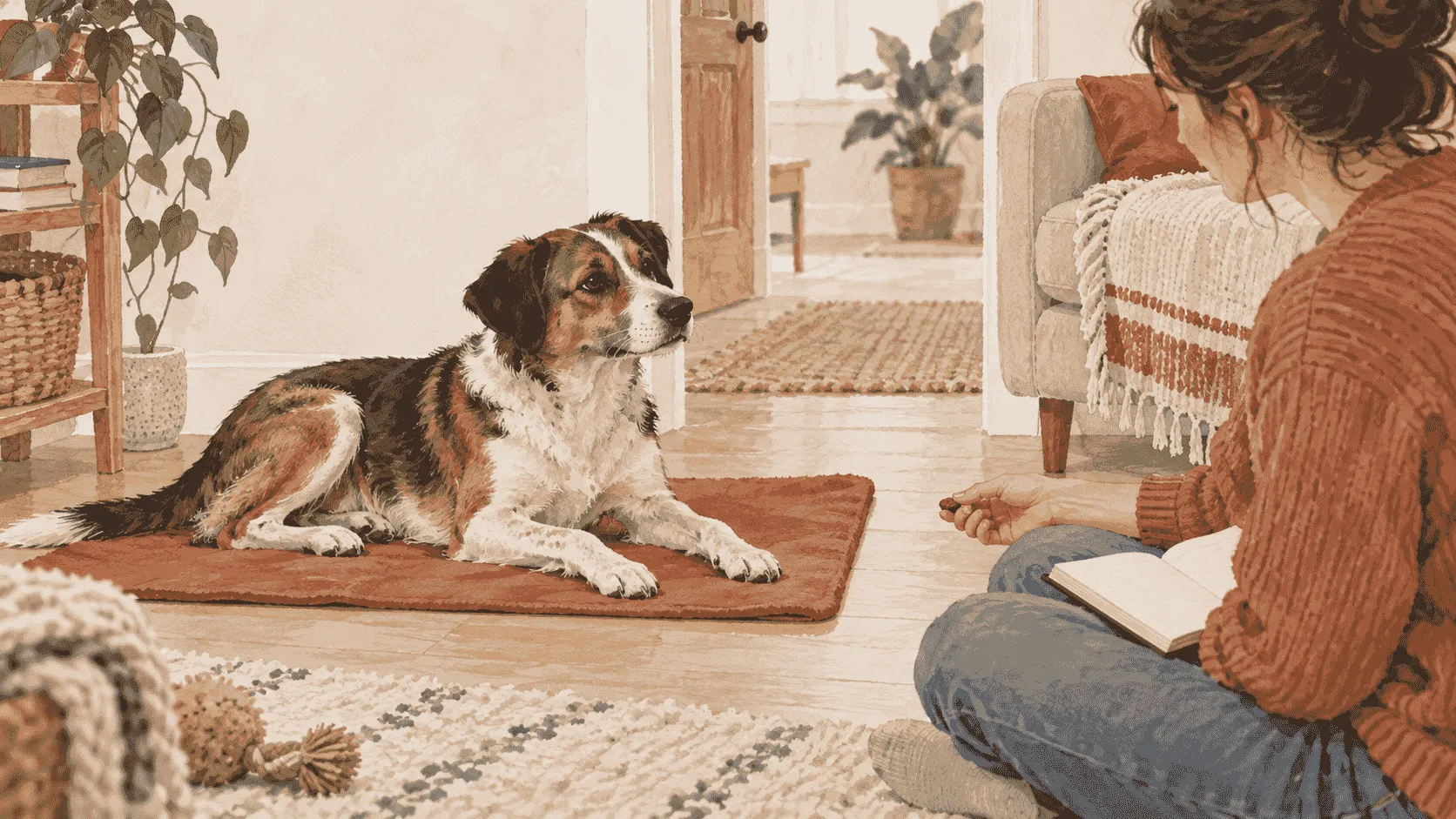
Once the situation is manageable, choose one behavior that helps the dog and the household. That might be looking back at you, moving to a mat, keeping four paws on the floor, or turning away from a window. Reward the response while the dog can still perform it, then stop before the moment becomes difficult.
The American Veterinary Society of Animal Behavior’s 2021 position statement recommends reward-based methods for common training and behavior modification. Reward-based training is not a lack of boundaries. It provides structure by teaching what to do instead of relying on fear, pain, intimidation, or discomfort.
For barking, start with the trigger and the pattern rather than trying to silence the sound. The dog-barking guide covers the more specific sequence of recording context, reducing predictable triggers, and rewarding a calm alternative. For a greeting, do not assume a loose tail or an excited jump means the dog wants contact; make room for an opt-out and reward a safer alternative when the whole body is comfortable.
Do not promise that one reward fixes every behavior problem. Serious fear, aggression, separation-related distress, compulsive behavior, noise phobia, or bite risk needs veterinary and qualified behavior support alongside immediate safety management.
Build Handling as a Cooperative Skill
Handling is part of dog behavior because touch changes the situation. Prepare for grooming, paw checks, harnessing, and veterinary visits in tiny repetitions rather than waiting until a full procedure is necessary.
Dogs Trust handling guidance supports a simple sequence: touch an already comfortable area briefly, remove your hand, reward, and pause. Add only one small step while the dog’s body remains relaxed. The dog should be able to move away; a treat does not override pain or turn refusal into stubbornness.
If the dog stiffens, withdraws, hides, struggles, or shows sudden sensitivity, stop. Record what happened and ask your veterinarian about a new or painful change. A qualified behavior professional can help with an established fear or a handling plan, but the first step is not to hold the dog still until the struggle ends.
When Dog Behavior Is a Health or Safety Question
New, persistent, or marked changes deserve a wider check. Dogs Trust advises veterinary review when a dog starts barking without a previous pattern or becomes notably more frequent or different. Barking alone cannot identify pain, illness, hearing change, or another condition, but a change from this dog’s baseline is worth reporting rather than treating as a training failure.
Resource guarding also needs a safety-first response. A growl is not the only possible sign: freezing, blocking, hovering, rapid swallowing, hiding an item, or moving away with it can belong to the same broader pattern. Do not reach into a bowl, take an item to prove a point, punish the warning, or tell the dog to sort it out. Create distance, use a barrier if needed, prevent another confrontation, and arrange veterinary and qualified behavior support. A 2018 expert-consensus study and a large owner survey both support treating resource guarding as a pattern that needs individual assessment, not a dominance story or a universal exchange trick.
Get professional help promptly for injury risk, a bite, repeated escalation, severe fear, escape attempts, collapse, obvious pain, or a dog who cannot settle enough to remain safe. A short note or naturally captured video can help a professional understand timing, but never follow, corner, provoke, or restrain a dog to collect better footage.
A Repeatable First-Year Dog Behavior Check
Use this five-minute reset whenever a behavior feels confusing:
- write the baseline and the change in plain language;
- check the whole body, route, distance, and immediate context;
- lower one pressure point and see whether the dog gets more choice;
- reward one safe, useful alternative while the dog can still do it; and
- call your veterinarian or a qualified behavior professional when the change is sudden, persistent, risky, or beyond a simple home adjustment.
The goal is not to explain a dog’s behavior from a single clue. It is to make the next decision more humane and more useful: protect rest and choice, teach the behavior you want repeated, and let professional assessment handle what observation cannot settle.
Sources
Petzette's claim cards for this article point to the following scientific, veterinary, or animal-welfare sources.
- Dogs Trust Body Language Context Guidance: Welfare organization dog body-language guidance
- Dog Body-Language Observation Limits And Raised-Hackles Context: Cross-source peer-reviewed canine-welfare evidence and established animal-welfare guidance. This note supports a narrow public boundary: visible cues can guide calmer observation and space, but neither one cue nor an owner-made tally is a validated at-home emotion, stress, welfare, aggression, pain, or bite-prediction test.
- Bremhorst A, Mills DS, Würbel H, Riemer S. *Evaluating the accuracy of facial expressions as emotion indicators across contexts in dogs.* Animal Cognition. 2022;25:121-136. doi:10.1007/s10071-021-01532-1; PMID:34338869; PMCID:PMC8904359. The directly rendered PMC full text reports a 28-dog laboratory study of positive anticipation and frustration across food and toy contexts. Although several facial actions differed between the study conditions, no individual action consistently classified the associated state. The authors state that diagnostic-accuracy measures are needed for candidate emotion indicators.
- Dogs Social Reference Humans Around Novel Objects: Peer-reviewed paper
- Dogs Trust Safe Space For Dogs: Animal-welfare home-environment guidance
- AVSAB Humane Dog Training 2021: Veterinary behavior society position statement
- Dogs Trust Gradual Handling Guidance: Animal-welfare cooperative handling guidance
- Dogs Trust Barking Causes Triggers And Support: Established animal-welfare guidance for low-risk behavior observation, management, and training boundaries
- Canine Resource Guarding Expert Definition Study: Peer-reviewed mixed survey and qualitative expert-consensus study
- Canine Resource Guarding Factors In Multi-Dog Contexts: Peer-reviewed cross-sectional owner survey
- Dogs Trust Resource Guarding Safety: Animal-welfare behavior guidance