Nutrition16 July 2026
Grain-Free Puppy Food: What the Label Can—and Can't—Tell You
Grain-free puppy food is not a one-word safety test. Weigh growth needs, FDA uncertainty, label facts, and veterinary advice.
TextPetzette Editorial
Read4 Min

Evidence status
Source-backed editorial
- Evidence record
- 6 claim cards linked to 6 documented sources.
- Independent expert review
- Not commissioned. Petzette Editorial is responsible for the published wording.
- Source record checked
- 16 July 2026
- Scope
- General information, not an individual diagnosis or treatment plan.
Grain-free puppy food can sound like a cleaner or safer default. But “grain-free” tells you what a recipe leaves out, not whether the finished food is complete for growth, well formulated, carefully tested, or right for your puppy. The useful decision is not simply grain or no grain. It is whether the whole diet has a sound reason and enough evidence behind it.
Grain-Free Puppy Food Is a Label, Not a Verdict
Start with the quiet statement on the back of the package. In the United States, look for a nutritional adequacy or intended-use statement saying the food is complete and balanced for dogs in the growth life stage. The Association of American Feed Control Officials develops model nutrient profiles and label standards, but it does not approve, certify, test, or endorse individual foods.
That growth statement is a first screen, not a final score. World Small Animal Veterinary Association guidance explains that an ingredient list alone cannot show ingredient quality, digestibility, nutrient availability, or how the finished food performs. Words such as “natural,” “premium,” and “grain-free” do not supply those missing answers.
Use our broader puppy-food label checklist to check life stage, formulation expertise, finished-product analysis, quality controls, research, and manufacturer transparency. Those questions matter whether the recipe contains rice, peas, both, or neither.
What the FDA’s DCM Investigation Actually Says
The US Food and Drug Administration has investigated reports of non-hereditary canine dilated cardiomyopathy, or DCM, in dogs eating certain diets. Its current Q&A says reports have involved both grain-free and grain-containing foods. Most report-associated diets had non-soy pulse ingredients, such as peas or lentils, high in their ingredient lists.
That pattern deserves care, but it is not proof that grain-free food causes DCM. The FDA says pulses have been used in pet foods for many years without evidence that they are inherently dangerous, and the agency does not know the specific connection between the reported diets and DCM. Voluntary reports can flag a question; they cannot by themselves establish cause, incidence, or a universal product risk.
So avoid two shortcuts: “grain-free is dangerous” and “grain-containing is guaranteed safe.” Neither follows from the evidence. A grain-free label is not a diagnosis, a recall notice, or a complete safety test.
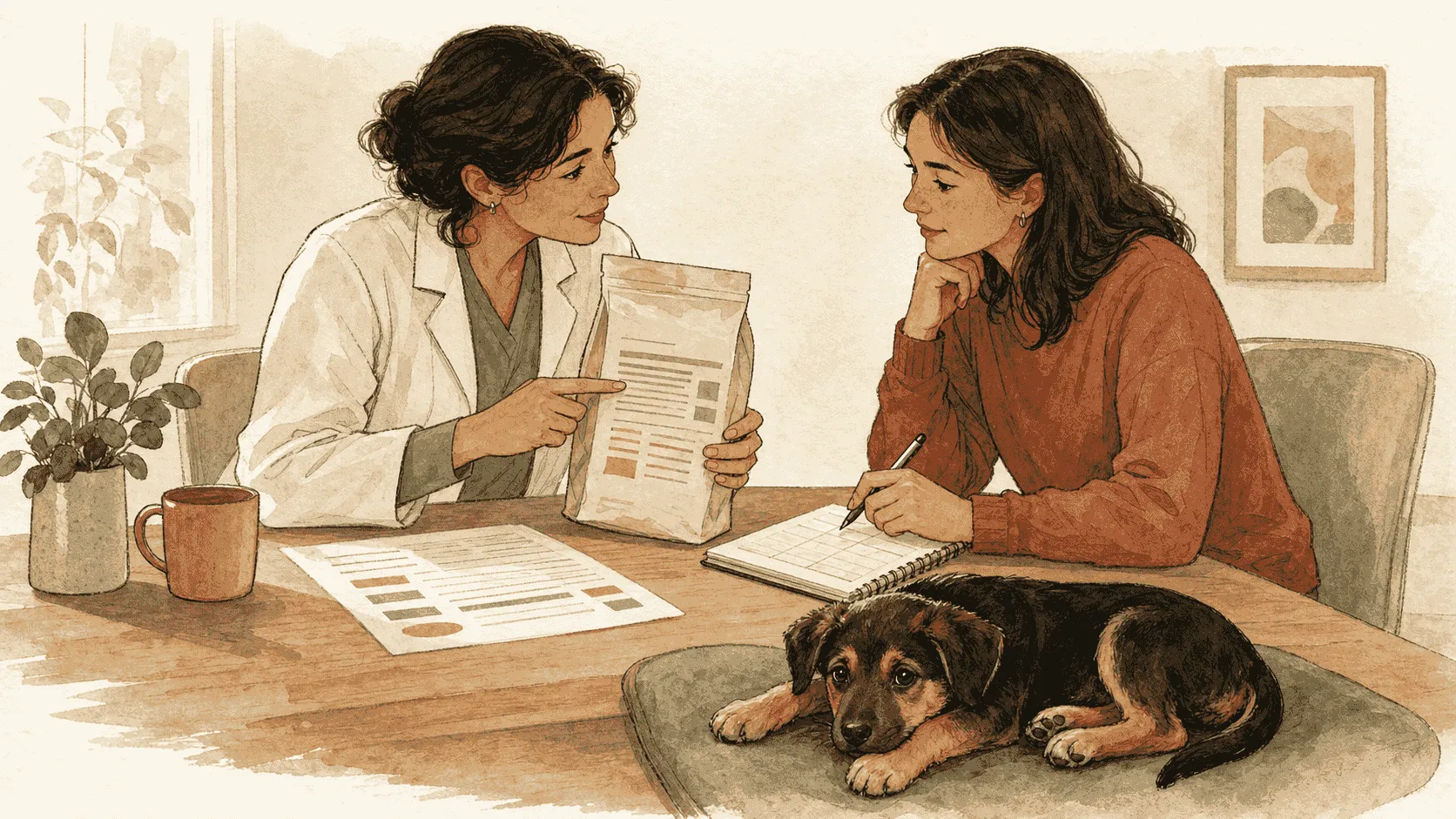
Use a Better Puppy-Food Checklist
If you are comparing a grain-free dog food for a growing puppy, ask these questions in order:
- Is it complete and balanced for growth? Treats and products intended only for supplemental feeding cannot replace a main growth diet.
- Is it suitable for the puppy’s expected adult size? A puppy expected to become large or giant needs a food suitable for large-breed growth. Do not add calcium unless your veterinarian recommends it.
- Who formulated and tested the finished food? Look for qualified nutrition expertise, finished-product analysis, clear quality controls, relevant research, and useful answers from the manufacturer.
- Why are you avoiding grain? If the reason is a suspected food reaction or ongoing digestive sign, pause the ingredient guessing. A veterinarian may need to assess the puppy or direct a structured diet trial.
- How will you monitor fit? Growth, weight, body condition, appetite, stool, activity, and health can change the plan. The bag cannot assess the puppy in front of you.
This checklist does not name a universal winner. It helps you reject a weak reason for choosing one food while preserving room for an individual veterinary plan.
If Your Puppy Already Eats Grain-Free Food
Do not panic, diagnose heart disease from the label, or make a rushed switch based on a headline. Photograph the adequacy statement and full ingredient list, record the exact food and every treat or topper, and bring that feeding history to your veterinarian. The FDA specifically encourages owners to discuss diet changes with their veterinarian, who may consult a board-certified veterinary nutritionist.
If a routine change is appropriate and your puppy is otherwise well, move gradually and keep the rest of the feeding plan steady enough to watch appetite, stool, and tolerance. Follow a veterinarian-directed transition instead when there is illness or a therapeutic diet. Our guide to changing food for a puppy with digestive concerns explains where routine switching should stop and professional assessment should begin.
The Decision to Make Today
When shopping, choose a complete growth food with credible formulation and quality controls; do not let “grain-free” make the decision for you. When already feeding one, document the whole diet and ask your veterinarian whether there is a specific reason to keep it or change it.
The uncertainty is real: the FDA has identified a report pattern without establishing one simple cause. Your next step can still be concrete. Check the growth statement, write down why you are considering grain-free puppy food, and take the label plus that reason to your veterinary team.
Sources
Petzette's claim cards for this article point to the following scientific, veterinary, or animal-welfare sources.
- FDA Non-Hereditary Canine DCM Diet Q&A: US federal animal-food regulatory guidance and surveillance update
- AAHA Nutrition And Weight Management Guidelines 2021: Peer-reviewed veterinary clinical guideline
Cline MG, Burns KM, Coe JB, et al. 2021 AAHA Nutrition and Weight Management Guidelines for Dogs and Cats. Journal of the American Animal Hospital Association. 2021;57:153-178.
- AAFCO Pet Food Labels And Nutritional Adequacy: US feed-control association consumer and regulatory guidance
- WSAVA Selecting Pet Food Toolkit 2021: Global veterinary nutrition toolkit / food-selection guidance
- WSAVA Principles Of Wellness 2025: Global veterinary-association wellness guidance
- Cornell Dog Diarrhea Guidance: Veterinary-school clinical owner guidance