Nutrition03 August 2026
How Much Wet Food to Feed a Cat: Build a Daily Plan
How much wet food to feed a cat starts with the exact label, then becomes one measured daily plan with monitoring and veterinary guidance.
TextPetzette Editorial
Read4 Min

Evidence status
Source-backed editorial
- Evidence record
- 6 claim cards linked to 5 documented sources.
- Independent expert review
- Not commissioned. Petzette Editorial is responsible for the published wording.
- Source record checked
- 20 July 2026
- Scope
- General information, not an individual diagnosis or treatment plan.
How much wet food to feed a cat is not a universal number of cans, trays, cups, or grams. The useful start is the feeding direction on the exact food, then one measured daily plan that accounts for everything the cat eats. That lets a new owner notice a real pattern instead of treating a generic chart—or one eager look at the bowl—as the final answer.
This guide is for a generally healthy adult cat settling into a new home. A growing kitten, a pregnant or nursing cat, a cat with low body condition, or a cat on a therapeutic diet needs a different plan with a veterinarian.
Start With the Exact Wet Food Label
First, find the nutritional adequacy or intended-use statement and the feeding directions on the same product. In the United States, the Association of American Feed Control Officials explains that a label can identify the species and life stage for which a complete-and-balanced claim is substantiated. For an adult cat, the regular food should match the cat’s life stage and condition; a label is a useful screen, not an endorsement or a guarantee that one food fits every cat.
The label also separates a nutritional foundation from an extra. A product described for intermittent or supplemental feeding is not intended to do the main job of a complete daily diet. If you use treats, toppers, or table food, count them in the full record. AAHA’s 2021 Nutrition and Weight Management Guidelines use a 90/10 framework for generally healthy pets: complete and balanced food provides at least 90 percent of calories, while extras stay at 10 percent or less. That ceiling is not a promise that every extra suits your cat; our cat human-food safety check can help with that separate question.
Package directions are still starting points. They cannot see the food’s energy density, your cat’s activity, body condition, health history, or every extra offered during the day. A canned-food chart or calculator can organize a starting thought, but it cannot safely replace the directions for the exact food and the cat in front of you.
Turn the Label Into One Daily Record
Make the plan visible before you adjust it. For one ordinary day, write down:
- The food’s name, life-stage statement, and label feeding directions.
- The full wet-food amount offered, measured consistently before it is divided into meals.
- Any dry food, treats, toppers, table bites, or food offered by another person.
- What remains after each meal and whether another cat can reach the bowl.
If wet and dry food share the routine, treat them as parts of one daily plan rather than two full daily allowances. When the labels are hard to reconcile, or the right starting total is unclear, ask your veterinarian to help interpret the actual products. Do not copy a portion from a different food just because the scoop or can looks similar.
For a newly arrived cat, Cornell Feline Health Center guidance supports keeping the familiar food available in a clean, quiet location away from the litter box and other animals while you learn what the cat is actually eating. A calmer setup can make the record easier to read; it does not explain away an appetite change.
Divide the Same Allowance Into Calm Opportunities
The 2018 American Association of Feline Practitioners feeding consensus supports dividing a cat’s normal daily allowance into multiple small feeding opportunities. Smaller meals change the pattern, not the day’s total. You might portion the measured food into a few predictable opportunities that fit the household, then keep the total in the notebook.
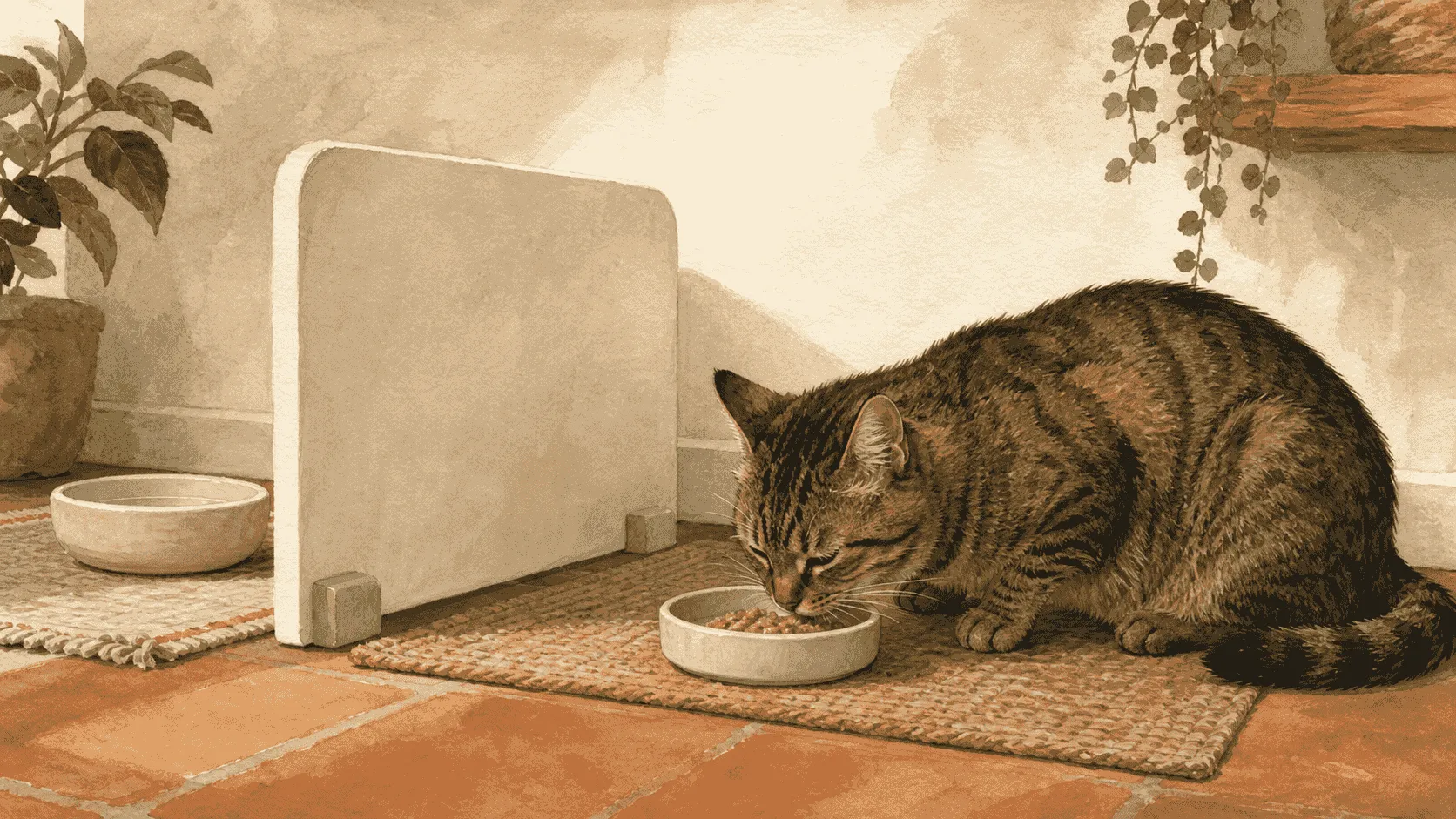
In a multi-cat home, distance and visual privacy can help each cat reach food without competition. Notice whether one cat waits in a doorway, rushes, leaves when the other arrives, or repeatedly switches bowls. Those observations do not label either cat; they show whether access is reliable. If an adult cat regularly reaches a kitten’s food, the separate feeding plan for adult cats and kittens covers that different life-stage decision.
Change Food Slowly Enough to Observe It
If an otherwise well cat needs a routine food change, World Small Animal Veterinary Association guidance supports a gradual transition so you can watch acceptance, stool, and tolerance. Keep the rest of the routine steady enough to tell what changed. Repeatedly swapping foods, bowls, rooms, and meal times all at once can make the record less useful.
This is not a home-treatment plan for a cat who is unwell. A new cat that refuses food needs prompt veterinary contact, and Cornell advises against forcing food into the cat’s mouth. Vomiting, diarrhea, pain, low energy, a sudden appetite change, suspected toxin or foreign-object exposure, or a veterinary-directed therapeutic diet puts the situation outside a routine transition.
Recheck What the Label Cannot See
AAHA’s 2021 guideline recommends revisiting diet history, weight, body condition, muscle condition, life stage, activity, and health over time. Keep a short record of the exact food, daily offer, intake, extras, appetite, and any veterinary advice. Look for a trend rather than reacting to a single unfinished dish or a hungry-looking expression.
Ask your veterinarian if weight or body condition is changing, appetite shifts, digestion changes, or the plan is difficult to interpret. If this is sudden or severe, ask your veterinarian promptly rather than continuing to tweak portions. A kitten has a growth-specific decision, so use the measured kitten-feeding plan rather than carrying an adult-cat routine backward into growth.
Your next step is simple: photograph the wet-food label, measure one ordinary day’s offer, list every extra, and note what is actually eaten. That record gives you a safer starting point than a universal wet-food amount and something useful to bring to the next veterinary visit.
Sources
Petzette's claim cards for this article point to the following scientific, veterinary, or animal-welfare sources.
- AAHA Nutrition And Weight Management Guidelines 2021: Peer-reviewed veterinary clinical guideline
Cline MG, Burns KM, Coe JB, et al. 2021 AAHA Nutrition and Weight Management Guidelines for Dogs and Cats. Journal of the American Animal Hospital Association. 2021;57:153-178.
- AAFCO Pet Food Labels And Nutritional Adequacy: US feed-control association consumer and regulatory guidance
- Cornell New-Cat Appetite And Feeding Guidance: Veterinary-school feline health and new-cat care guidance
- AAFP Consensus Statement On Feline Feeding Programs: Veterinary consensus statement
- WSAVA Principles Of Wellness 2025: Global veterinary-association wellness guidance