Behavior & Training13 August 2026
Why Do Dogs Chase Their Tails? A Pattern-First Check
Why do dogs chase their tails? Use a calm pattern check to record context, avoid guessing the cause, and know when to call your veterinarian.
TextPetzette Editorial
Read4 Min
Evidence status
Source-backed editorial
- Evidence record
- 5 claim cards linked to 3 documented sources.
- Independent expert review
- Not commissioned. Petzette Editorial is responsible for the published wording.
- Source record checked
- 13 August 2026
- Scope
- General guidance. Individual animals and circumstances can differ.
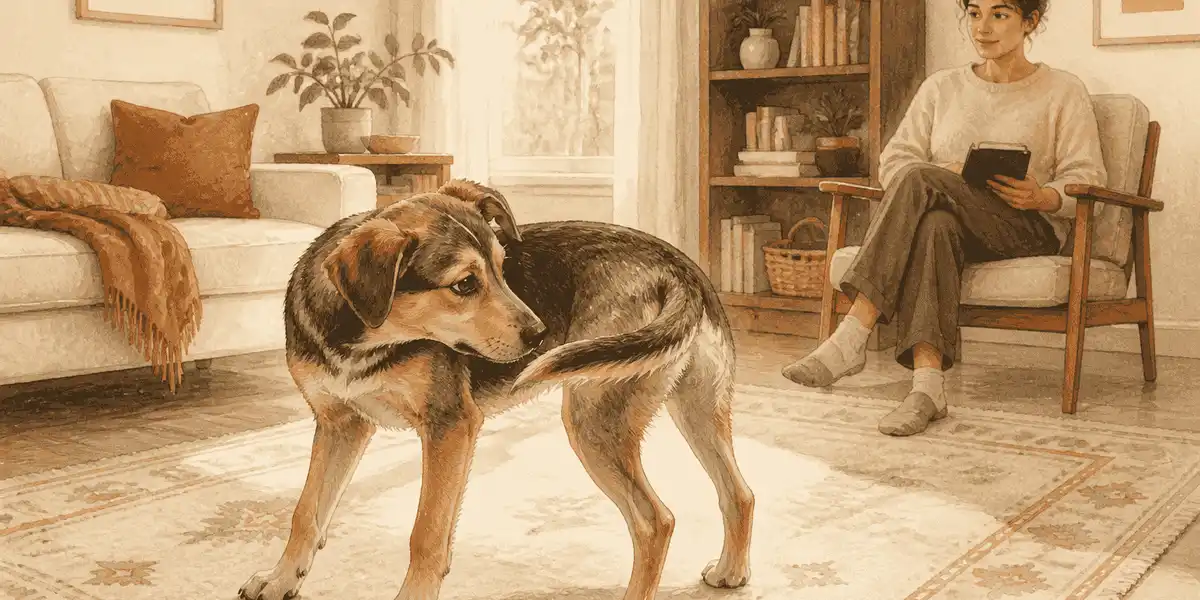
Why do dogs chase their tails? A fast circle is easy to see and easy to turn into a story. It does not identify one reason, though. The useful first-year decision is whether you are looking at a brief pattern to describe or a change that needs veterinary attention. Start by making the observation clearer instead of trying to name the cause.
Start With a Pattern, Not a Cause
The MSD Veterinary Manual includes tail chasing among possible stress displacement behaviors. Its clinical review also explains that abnormal repetitive behavior can have medical contributors, and that tail chasing may indicate tail-area orthopedic or neurologic pain. Those are possibilities to assess, not labels an owner can apply from one spin.
That makes a calm scene snapshot more useful than “bored,” “anxious,” or “compulsive.” What was happening just before? Is the dog loose, tense, resting, playing, or responding to something nearby? What happens when the circle ends? The dog body-language pause map can help you make that broader observation without turning one body part into a complete emotional story.
Avoid treating a young dog’s interest in its tail as a home all-clear, and avoid treating any single episode as proof of a problem. Tail chasing can have more than one context. Your job is to notice the pattern, not to settle the diagnosis.
Make a Short Tail-Chasing Record
MSD’s owner guidance recommends a behavior history that includes onset, frequency, episode length, context, changes over time, daily routine, environment, and video. For tail chasing, a short record can be simple:
- when you first noticed it and the dog’s age;
- what happened just before the episode and what followed it;
- how often it occurs and about how long it lasts;
- whether the dog can move on to an ordinary activity;
- any tail biting, skin change, injury, or other change you notice; and
- a brief video from a safe distance, if you can take one without provoking another episode.
Write facts rather than a theory: “spun twice after visitors arrived, then rested” is more helpful than “was overstimulated.” A video and a log can help your veterinarian see a pattern; neither replaces an examination. Do not repeat the situation or delay a call just to collect better footage.

Choose a Low-Pressure Next Move
While you observe, keep your response quiet and predictable. The American Veterinary Society of Animal Behavior recommends reward-based teaching for behavior work rather than fear, pain, intimidation, or discomfort. If your dog can voluntarily turn to a familiar, appropriate activity, offer that option and reward the choice. The aim is to teach a useful next behavior, not to punish the circle.
This is also a reason to leave the cause open. A scolding response can add pressure without telling you why the dog was turning in the first place. A calm pause, a voluntary alternative, and a factual note preserve information for the next decision.
Know When the Veterinarian Should Lead
Ask your veterinarian for guidance if tail chasing is new, increasing, frequent, difficult to interrupt, paired with tail biting or injury, or unlike your dog’s usual movement. The MSD review advises that medical contributors need to be ruled out before a compulsive-behavior diagnosis, so a home explanation is not the finish line.
Bring your short record and any safe video. Do not give medication, treat parasites, or try a home remedy based on an online cause list. Your veterinarian can decide whether the pattern needs a physical assessment, behavior support, or both.
Keep Tail Chasing Separate From Other Questions
Tail chasing can overlap with other worries without answering them. A dog who is tense during greetings, for example, needs a whole-body and interaction-context check. A dog who has trouble when left alone may need a separate departure pattern recorded; the first steps for rescue-dog separation anxiety explain how to document that broader question without guessing from one behavior.
For this question, stay precise: record what the tail chasing looks like, what surrounds it, and whether it is changing. That is enough to make the next step clearer.
Your Next Three Observations
- Make one brief note after each episode: before, during, after, and any change.
- Use a calm, reward-based alternative if your dog can choose one voluntarily.
- Contact your veterinarian if the pattern is new, escalating, repetitive, involves biting or injury, or concerns you.
The spin is visible. The cause is not. A pattern-first check gives your dog a calmer response and gives your veterinarian more useful information if help is needed.
Sources
Petzette's claim cards for this article point to the following scientific, veterinary, or animal-welfare sources.
- MSD Veterinary Manual: Dog Tail Chasing And Behavior Assessment: Current peer-reviewed veterinary clinical guidance plus current owner-facing veterinary guidance on abnormal repetitive behavior and behavior-history assessment in dogs.
- Dogs Trust Body Language Context Guidance: Welfare organization dog body-language guidance
- AVSAB Humane Dog Training 2021: Veterinary behavior society position statement