New Owner Guide18 July 2026
Newborn Kitten Care: The First Safe Steps
Newborn kitten care starts with checking for the mother, protecting warmth, and calling for an individual veterinary or foster plan.
TextPetzette Editorial
Read4 Min

Evidence status
Source-backed editorial
- Evidence record
- 4 claim cards linked to 2 documented sources.
- Independent expert review
- Not commissioned. Petzette Editorial is responsible for the published wording.
- Source record checked
- 18 July 2026
- Scope
- General guidance. Individual animals and circumstances can differ.
Newborn kitten care begins with a decision that feels counterintuitive: pause before you scoop up or feed a tiny kitten. A mother cat may be nearby, waiting for people to leave. But a kitten who is injured, exposed, cold, weak, or struggling to breathe needs prompt professional help. Your first job is to read the scene, protect the kitten from immediate danger, and get an individual plan.
A newborn kitten may not be orphaned
Finding a kitten alone does not establish that the mother is gone. Best Friends Animal Society guidance explains that mother cats may leave briefly or stay hidden while a person is close. If the kitten appears stable and the location is sheltered, step well back and watch for maternal care without hovering or repeatedly handling the kitten.
Look at the surroundings as well as the kitten. Traffic, predators, heavy rain, direct sun, or an exposed nest can change the decision. If you must move a stable kitten out of immediate danger, keep the move as short and nearby as the situation allows so the mother can still find the nest.
Do not rely on a universal waiting period. Weather, age, condition, and local hazards matter. If the kitten looks sick or injured, cries persistently, feels cold, lies limp, or has a breathing change, contact a veterinarian, emergency clinic, or experienced animal-welfare organization now.
What to do before you bring the kitten home
Use this short decision check:
- Visible injury, breathing difficulty, weakness, cold, or immediate danger: call a veterinarian or animal-welfare group and follow their transport directions.
- Apparently stable, sheltered, and clean: note the exact location, step away, and watch for the mother from a distance.
- The mother returns: leave the family together unless a professional advises intervention. Ask a local community-cat or rescue group about longer-term support.
- The mother does not return or the kitten worsens: arrange an assessment and experienced neonatal foster help promptly.
A photo of the kitten and nest, the time found, the location, and what you observed can make that first phone call more useful. A visual guess cannot confirm the kitten’s age or health, so describe what you see without trying to diagnose it.
Warmth comes before a feeding attempt
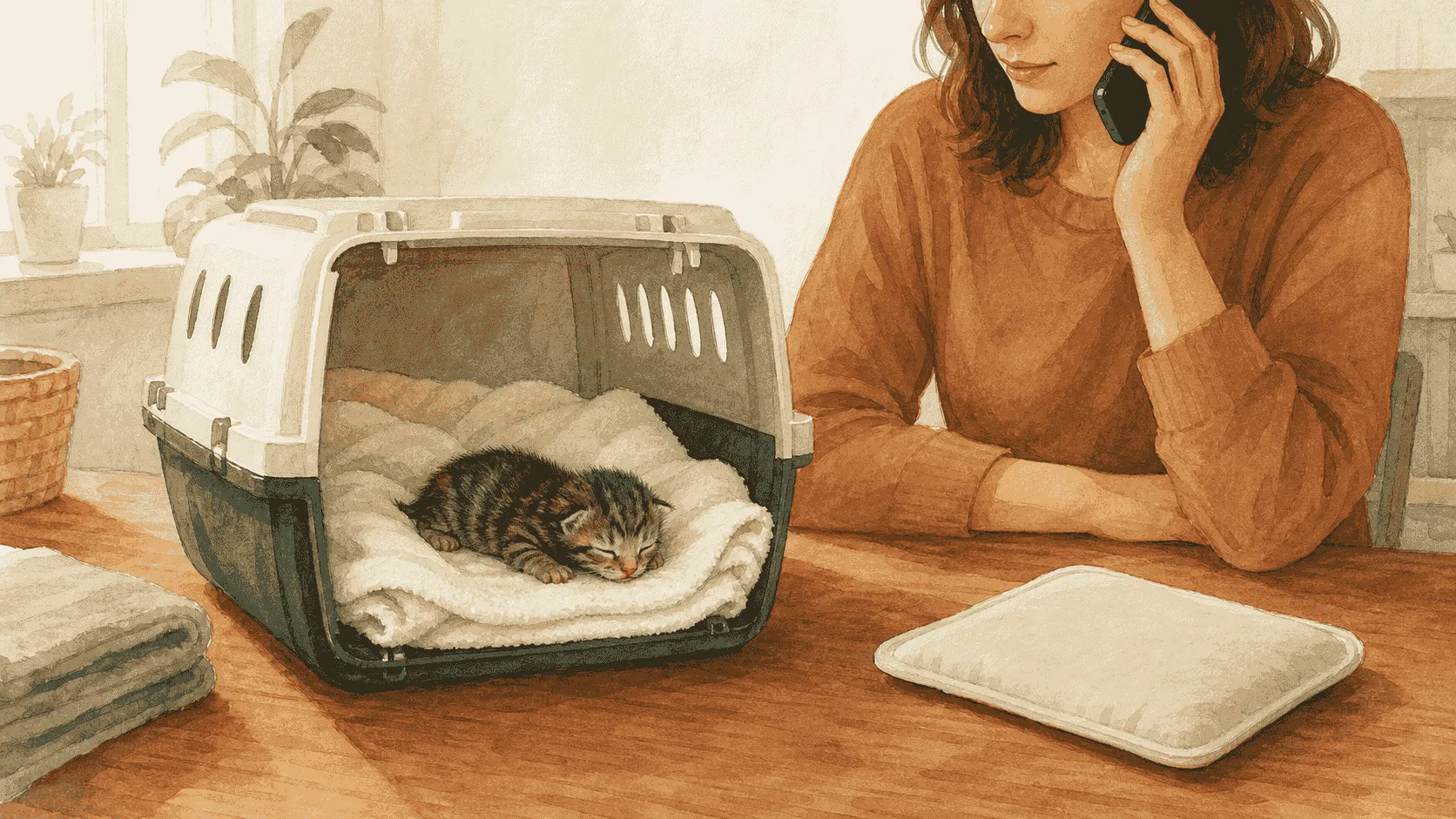
The Merck Veterinary Manual notes that neonatal kittens have immature temperature regulation during roughly their first four weeks. Chilling can interfere with nursing and digestion. Poorly controlled heat can also burn or overheat a kitten who cannot move away easily.
If a professional asks you to transport the kitten, keep the kitten dry in a draft-free carrier or box and use only the controlled, indirect warmth they recommend. Do not place the kitten directly on a heating pad or improvise with intense heat. Do not feed a kitten who feels cold, is weak, or cannot swallow normally. Call for veterinary or experienced foster direction first.
Get a newborn kitten feeding plan, not just a bottle
When the mother is safely caring for the kitten, maternal nursing is preferable. A truly orphaned newborn needs species-appropriate milk replacement and a plan for the individual kitten. Merck’s veterinary guidance favors commercially manufactured milk replacer over homemade versions when maternal milk is unavailable.
The right amount, interval, posture, and method depend on the kitten’s age, weight, condition, and swallowing ability. Ask a veterinarian or experienced neonatal foster program to set that plan. Do not substitute household milk, force-feed, or attempt tube feeding from an online description. Feeding a chilled or poorly swallowing kitten can lead to regurgitation or aspiration.
Monitor change, not one reassuring moment
Neonatal care is round-the-clock work. Merck recommends repeated checks of vigor and weight, while Best Friends emphasizes rapid age and health assessment for truly orphaned kittens. Follow the monitoring schedule your professional contact gives you, and record observations consistently rather than judging progress from one quiet nap.
Ask what changes should trigger an urgent call. Weakness, cold, refusal or inability to feed, vomiting, diarrhea, persistent distress, or altered breathing deserve prompt direction. Weight trends can be useful, but a number alone cannot establish that a kitten is healthy.
Your useful next step
Call a veterinarian or experienced neonatal kitten foster program with the scene details before you improvise care. The uncertainty that matters is whether the mother is still caring for the kitten and whether the kitten is stable enough to wait; both require context. If the kitten is older, weaned, and ready to move indoors, use the new kitten first-week setup checklist for the next stage—not as a substitute for neonatal assessment.
The safest first move is a calm sequence: check danger, look for the mother, protect warmth, and get a professional plan before feeding.
Sources
Petzette's claim cards for this article point to the following scientific, veterinary, or animal-welfare sources.
- Best Friends Found Kittens Guidance: Established animal-welfare guidance for people who find young kittens outdoors
- Merck Management Of The Neonate In Dogs And Cats: Veterinary reference guidance on neonatal puppy and kitten husbandry, warmth, monitoring, and nutrition