Behavior09 October 2026
Orange Cat Behavior: What Coat Color Can—and Can't—Tell You
Orange cat behavior is not a personality score. Learn what coat-color research can show, how to meet an individual cat, and when behavior needs help.
TextPetzette Editorial
Read6 Min
Evidence status
Source-backed editorial
- Evidence record
- 3 claim cards linked to 3 documented sources.
- Independent expert review
- Not commissioned. Petzette Editorial is responsible for the published wording.
- Source record checked
- 09 October 2026
- Scope
- General guidance. Individual animals and circumstances can differ.
Orange cat behavior is easy to turn into a story. An orange coat may bring to mind a friendly, fearless, or chaotic personality before you have met the cat. The more useful answer is narrower: coat color or pattern is not a reliable forecast of one cat’s personality, friendliness, aggression, or household compatibility.
Research leaves room for possible group-level associations, but the findings are mixed and often depend on owner ratings, limited populations, or a narrowly defined outcome. A color label can be part of a description. It is not a personality score. If you are choosing a cat, use known history and repeated observations, while remembering that a new home can change what you see.
What the coat-color research actually measured
A 2020 review in Animals examined 43 original papers about feline temperament. Its useful limit was not that physical features can never relate to behavior. It was that the evidence did not unquestionably support any physical characteristic as a reliable temperament predictor. Owner reports, different assessment methods, and the need for direct observation all make a simple color-to-personality rule unsafe.
A 2016 study in the Journal of Applied Animal Welfare Science analyzed Internet surveys from 1,274 cat guardians. It reported some group differences between colors, but the authors described those differences as relatively minor. They found little difference among colors in handling and veterinary-visit aggression and called for confirmation in other populations. A result about groups in one survey does not tell you what one orange, black, tabby, white, calico, or tortoiseshell cat will do in your home.
There is also a perception problem. A 2026 study in Animals asked 624 Australian adults to rate one digitally manipulated cat image. Coat color affected ratings of friendliness and adoptability in that setting. That is evidence about what people infer from a picture, not a demonstration of the real cat’s temperament or behavior. The image may change the observer’s first impression without changing the animal in front of them.
That distinction matters when a vivid online stereotype feels more certain than the underlying evidence. Some studies report possible color-associated differences, while reviews identify mixed methods, interacting influences, and incomplete evidence. The honest conclusion is not “color means nothing whatsoever.” It is that color does not make a dependable individual prediction.
Use the coat as a description, not a decision shortcut
Cats Protection’s choosing-a-cat guidance starts with the individual and the home. Time, money, living arrangements, and the personality you hope to live with all belong in the conversation. Its guidance also says that breed does not guarantee personality; genetics, early socialization, individual experience, age, and current needs matter. Coat color deserves the same careful boundary: it can describe appearance, but it cannot introduce the cat.
This is especially important when a search asks whether an orange cat is friendly, aggressive, calm, or suitable for children or dogs. A coat label cannot establish any of those answers. If children live in the home, consider the cat’s previous experience, personality, age, and handling tolerance, then add child education, adult supervision, and a retreat the cat can use. There is no color-based safety guarantee.
The same caution applies to a cat you meet at a rescue, shelter, foster home, or breeder. One quiet greeting is useful information, but it is still one moment in one setting. A cat may respond differently after a move, with unfamiliar people, or when the room, routine, and escape options change. Observation should build a question, not close it too early.
For the wider distinction between a label and an individual cat, see our guide to what cat-breed lists can and cannot tell you. It covers the related problem of turning population background into a promise about one animal.
A better orange-cat behavior checklist
If you are deciding whether a particular cat fits your home, replace the color shortcut with a small record. Ask the caregiver or rescue what they have observed, and notice whether the answer stays consistent across more than one situation.
- History: What is known about the cat’s previous home, handling, socialization, and relationships with people or other animals?
- Current choices: Does the cat approach, pause, retreat, rest, play, or seek distance when the setting changes? Record what happened rather than naming the emotion for them.
- Age and routine: Does the time, patience, and supervision your home can offer fit this life stage? Cats Protection notes that adult cats have more established personalities, while kittens require substantial time and patience.
- Handling: What kinds of ordinary contact has the cat experienced, and can the cat move away? Tolerance in one moment is not a promise that every person or situation will feel comfortable.
- Home fit: Are there children, resident pets, visitors, noise, or long quiet periods that should be part of the matching conversation?
Keep the questions concrete. “Is this an orange cat?” describes the coat. “What has this individual cat done around unfamiliar people, handling, rest, play, and routine changes?” helps you learn what still needs to be observed.
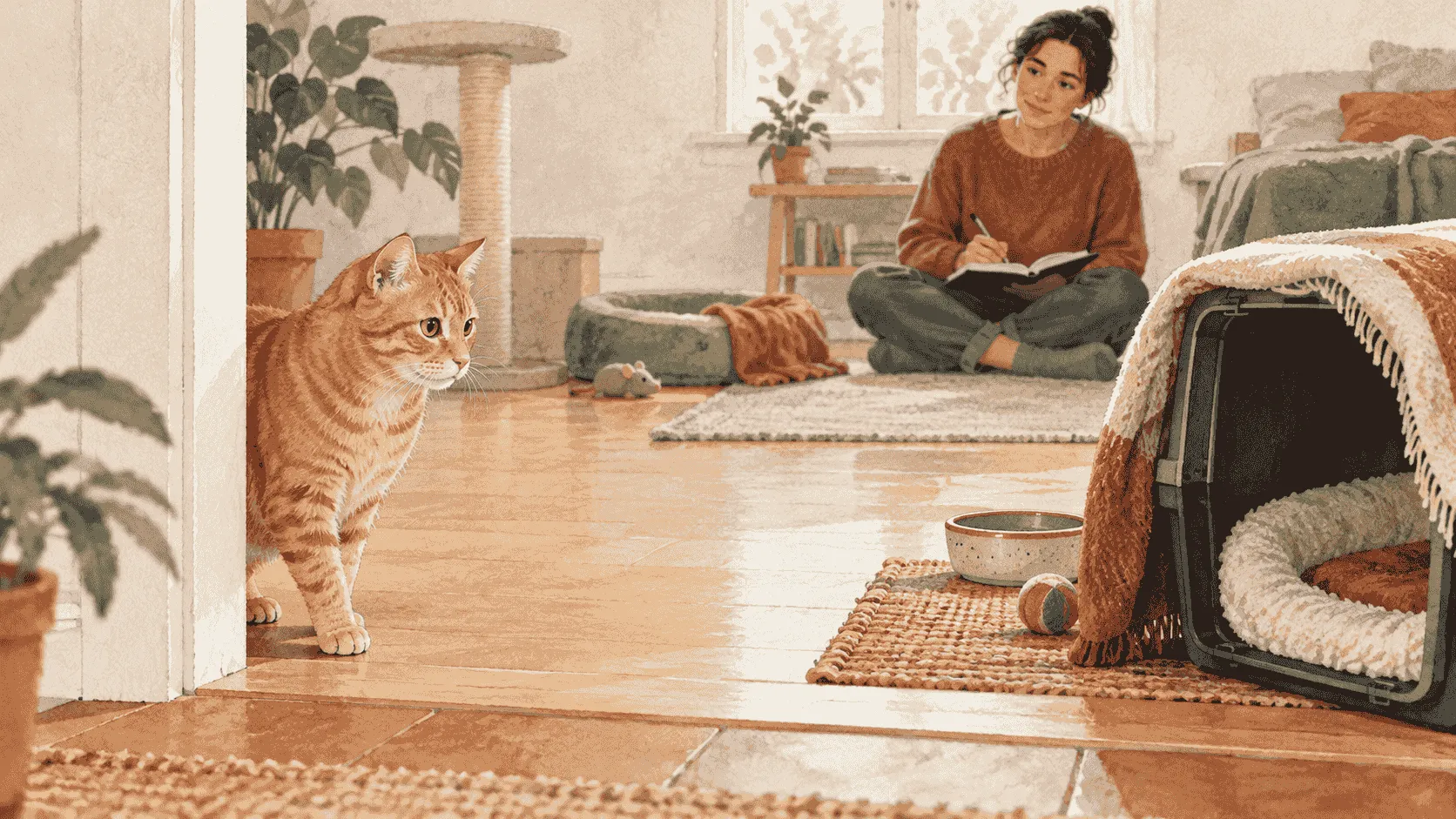
After adoption, let the record continue. A new cat may need a quiet base, predictable care, and time to show more of its ordinary behavior. The first week is not a personality exam, and hiding or caution should not be translated into a permanent label. Our first-time cat owner plan for the first 30 days covers the broader routine for observing eating, toileting, rest, play, handling, and voluntary contact without rushing the relationship.
What not to infer from an orange coat
Do not use “orange cat” as shorthand for friendly, difficult, cuddly, aggressive, safe, or unsafe. Do not use a photo, a coat pattern, or one study to decide that a cat will tolerate children, live easily with a dog, or enjoy handling. Those are individual questions with real consequences for the home.
The same applies to other coat and pattern labels. Black, tabby, white, bicolour, tortoiseshell, calico, and torbie cats should not be assigned fixed personality categories. If a page or video presents a color as proof, ask what was actually measured: a guardian’s impression, a group average, a static image, or the behavior of a specific cat across time. Those are different kinds of information.
Avoid swinging to the opposite extreme, too. The available evidence does not establish that coat color can have no biological or population-level association. It establishes a narrower and more useful boundary for a new owner: whatever group patterns may exist, they do not replace the individual cat’s history, observed behavior, needs, or uncertainty after a move.
When the behavior question needs help
Move the question to a veterinarian or qualified behavior professional when a cat’s behavior is sudden, severe, escalating, repeatedly unsafe, or very different from that cat’s established pattern. New fear, aggression, hiding, touch sensitivity, or other concerning changes should not be explained away as “just an orange-cat trait.” A color label is not a health assessment or a behavior diagnosis.
Create distance and a safe route rather than testing the cat again. Record what happened immediately before the change, what the cat did, whether an exit was available, and what happened afterward. Bring that neutral history to the professional; do not force contact, corner the cat, or try to prove a theory with repeated triggers.
Orange cat behavior can be an interesting search phrase, but the decision underneath it is practical: can you learn enough about this individual cat, prepare a fitting home, and keep observing after the move? Let the coat remain a description. Let history, repeated observation, welfare needs, and professional context carry the decision.
Sources
Petzette's claim cards for this article point to the following scientific, veterinary, or animal-welfare sources.
- Cat Coat Colour And Personality Prediction Limits: Cross-source feline behaviour, perception, and individual-matching evidence note
- Travnik IDC, Machado DS, Goncalves LDS, Ceballos MC, Sant'Anna AC. *Temperament in Domestic Cats: A Review of Proximate Mechanisms, Methods of Assessment, Its Effects on Human-Cat Relationships, and One Welfare.* Animals. 2020;10(9):1516.
- Cat Breed Behaviour Scientific Reports 2019: Peer-reviewed feline behavior and quantitative-genetics study
Salonen M, Vapalahti K, Tiira K, Maki-Tanila A, Lohi H. Breed differences of heritable behaviour traits in cats. Scientific Reports. 2019;9:7949.
- Cats Protection Choosing A Cat: Animal welfare charity guidance / cat-selection advice