Health Signals30 August 2026
Sick Cat Body Language: What to Record Before You Call
Sick cat body language can be subtle. Learn which changes to record in appetite, grooming, movement, and routine before calling your veterinarian.
TextPetzette Editorial
Read4 Min

Evidence status
Source-backed editorial
- Evidence record
- 3 claim cards linked to 3 documented sources.
- Independent expert review
- Not commissioned. Petzette Editorial is responsible for the published wording.
- Source record checked
- 30 August 2026
- Scope
- General information, not an individual diagnosis or treatment plan.
Seeing what looks like sick cat body language can make a new owner want to decode one pose. The safer question is narrower: what changed from this cat’s normal, how is it changing, and does it need a veterinarian now? A single tucked posture, quiet spell, or grooming pause cannot identify a cause at home. Use the whole pattern as an observation record, not a diagnosis.
Read Change Against the Cat You Know
A cat’s health-related change may be quiet rather than dramatic. Cats Protection notes that illness can show up as hiding more, drinking differently, eating less, sleeping more, sudden weight loss, or a change in grooming. Cornell University College of Veterinary Medicine also lists reduced appetite, vomiting or diarrhea, eye or nose discharge, sneezing, changes in urination, altered breathing, low energy, and a dull or poorly groomed coat among signs that deserve attention.
The useful comparison is the cat’s own baseline, not an online picture of a “sick cat.” Look for a meaningful departure in more than one part of the day:
- food or water interest, including a noticeable change from the usual pattern;
- movement, jumping, posture, or willingness to settle in familiar places;
- grooming, coat condition, facial expression, vocalization, or social interaction;
- hiding, sleep, energy, litter-box behavior, vomiting, diarrhea, sneezing, or discharge; and
- breathing that looks different from normal.
None of these observations identifies a disease by itself. They tell you what to describe and whether the change deserves a veterinary conversation.
Why Cat Pain Body Language Is Easy to Misread
Cats Protection describes pain-related changes such as withdrawal, sleeping more, reluctance to jump, stiffness, a hunched or squinty appearance, reduced eating or drinking, restlessness, a scruffy coat, vocalization, or overgrooming. But Merck Veterinary Manual cautions that decreased activity or appetite, weight loss, and poor grooming are not specific to pain. A cat can also be quiet while uncomfortable.
That uncertainty matters. “Is my cat in pain?” is not answered reliably by matching one ear position, back shape, or facial expression to a chart. Read the posture alongside movement, appetite, grooming, elimination, interaction, and the timing of the change. If several familiar routines shift together, record the pattern instead of trying to name its cause.
Record the Whole Pattern Before You Call
Make a short note that answers five practical questions:
- What is different? Compare today with the cat’s usual food, water, sleep, movement, grooming, litter, and social routine.
- When did it start? Write the approximate onset, how often it happens, and whether each episode is getting longer or more noticeable.
- What happens around it? Note what the cat was doing before and after, where it occurred, and any relevant change in the household routine.
- What else changed? Add appetite, drinking, vomiting, stool, urination, coat, energy, interaction, or breathing observations without interpreting them.
- What can the veterinarian see? If it is safe, a brief naturally captured video can supplement your description. Do not corner, restrain, or provoke the cat to recreate a posture.
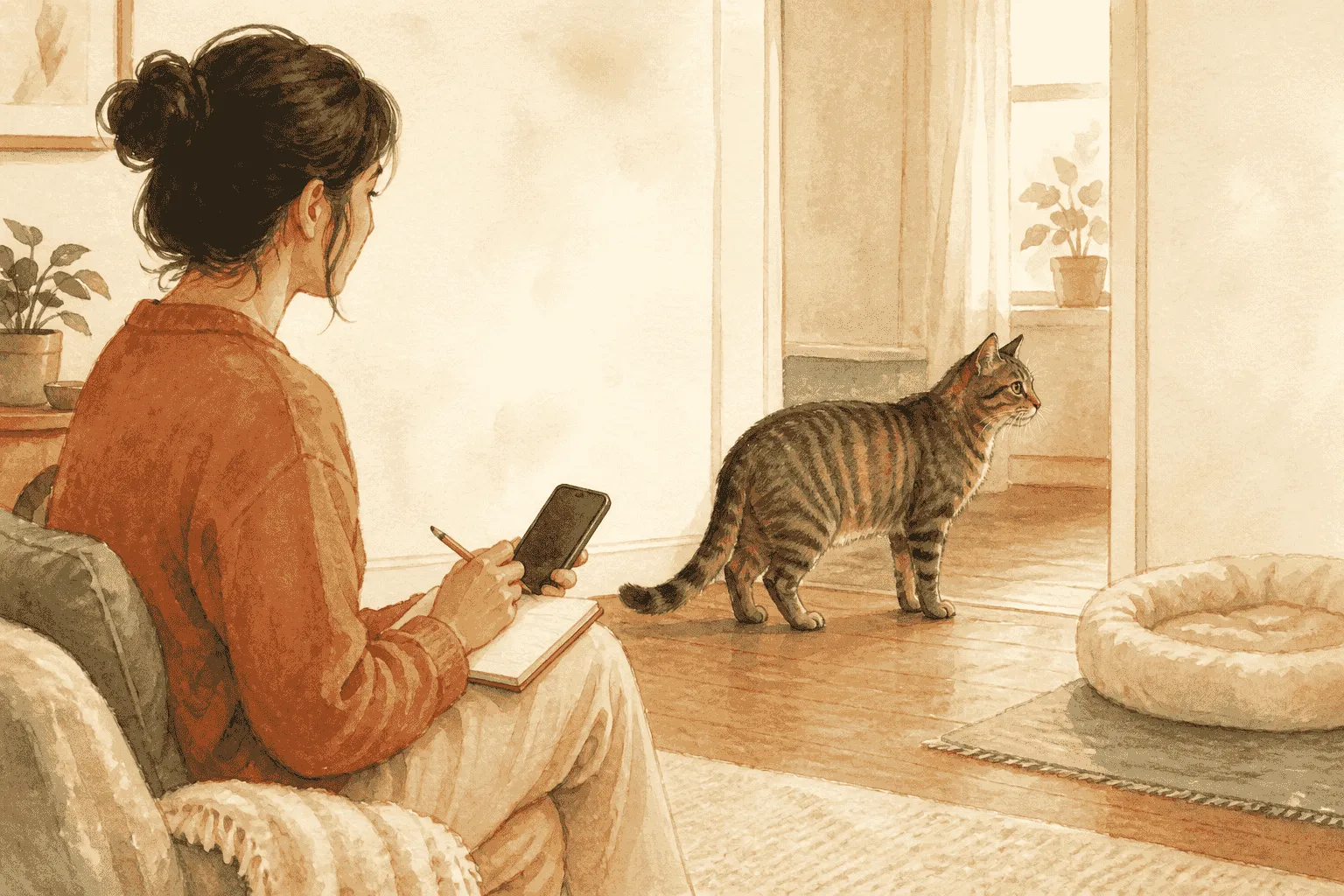
This record is useful because a veterinarian can assess the history, the actual behavior, and the pattern over time. Merck’s guidance on cat behavior also emphasizes onset, duration, frequency, what happened before and after, and changes in the daily routine. A written baseline helps separate a one-off odd moment from a change that is repeating.
Separate a Routine Call From an Urgent Breathing Change
A new, marked, persistent, or concerning change is a reason to contact your veterinarian. Do not wait for a perfect checklist or a dramatic pose; cats may show health changes subtly, and the meaning depends on the individual cat and context.
Breathing is the important exception to treat as an immediate escalation question. If breathing looks visibly difficult or effortful, or the cat is breathing with an open mouth, seek urgent veterinary direction rather than continuing to interpret body language at home. The goal is not to decide what the cat has. It is to get the right level of help while describing what you can see.
For a single sign that needs its own observation plan, such as vomiting, use the cat vomiting observation guide. For broader questions about space, touch, and reading a cat’s full posture in everyday interactions, see the whole-cat body-language context guide. This page owns the health-signal decision: record a change, judge its urgency, and bring the pattern to a veterinarian.
Your Next Step
Take one calm baseline note today: what the cat ate and drank, how they moved, how they groomed, where they rested, and what their litter-box and social routine looked like. If something changes, add the time and what happened around it. Then call your veterinarian when the change is new, marked, persistent, or concerning—and escalate breathing difficulty urgently. Observation is valuable, but it is not a home diagnosis.
Sources
Petzette's claim cards for this article point to the following scientific, veterinary, or animal-welfare sources.
- Cornell New-Cat Health Signs And Kitten Responsiveness Guidance: Veterinary-school feline health guidance for evaluating a new cat or kitten
- Sick Cat Observation And Veterinary Escalation: Cross-source veterinary-school, veterinary-manual, and established animal-welfare guidance for observing possible illness in cats
- Cornell University College of Veterinary Medicine, Cornell Feline Health Center. *Choosing and Caring for Your New Cat.* The page says a sick cat may stop grooming and lists appetite loss, persistent vomiting, diarrhea, discharge, sneezing, weight loss, urinary changes, breathing changes, lethargy, and rapidly appearing or increasing swelling among signs that warrant veterinary contact. The page was directly reviewed and reports an update of May 2017.
- Feline Breathing Difficulty: Urgent Referral and Diagnostic-Uncertainty Boundary: Evidence synthesis of a peer-reviewed feline emergency cohort, veterinary-school guidance, a peer-reviewed veterinary manual, and established welfare emergency guidance. It supports a narrow recognition, no-home-diagnosis, and urgent-professional-direction boundary for apparent breathing difficulty in cats. It is not a diagnostic guide, first-aid protocol, transport plan, treatment guide, or prognosis source.
- Abboud N, Deschamps J-Y, Joubert M, Roux FA. *Emergency Dyspnea in 258 Cats: Insights from the French RAPID CAT Study.* Veterinary Sciences. 2025;12(3):242. doi:10.3390/vetsci12030242; PMID:40266956; PMCID:PMC11946846.