Nutrition28 July 2026
What Can Dogs Not Eat? A Three-Hazard Checklist
What can dogs not eat? Learn how to respond to chocolate, xylitol, grape, or raisin exposure without guessing or trying a home remedy.
TextPetzette Editorial
Read3 Min

Evidence status
Source-backed editorial
- Evidence record
- 5 claim cards linked to 6 documented sources.
- Independent expert review
- Not commissioned. Petzette Editorial is responsible for the published wording.
- Source record checked
- 26 July 2026
- Scope
- General information, not an individual diagnosis or treatment plan.
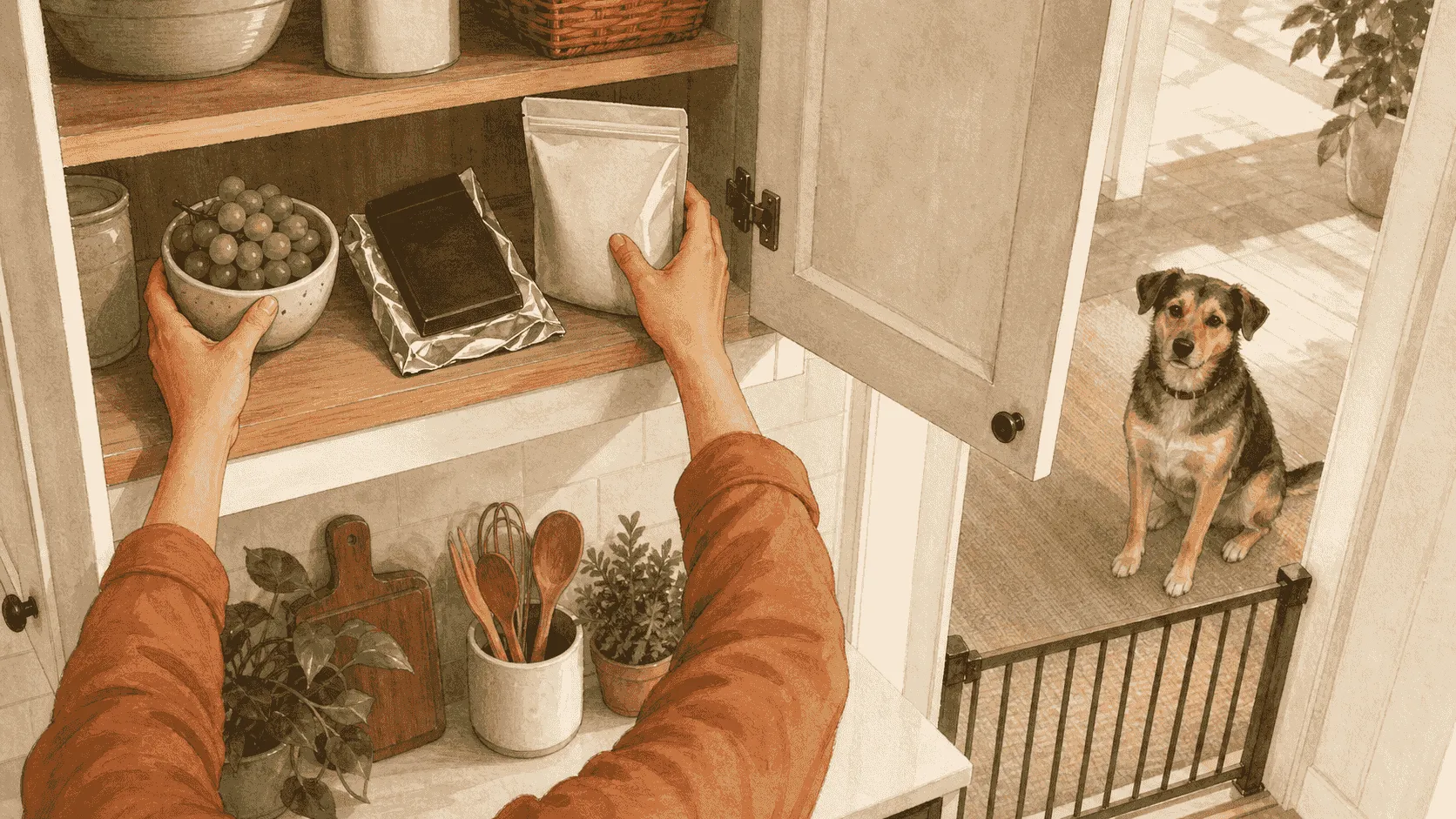
What can dogs not eat? If the question follows a possible exposure, start with the exact food rather than a giant online list. Chocolate, products containing xylitol, and grapes or raisins are three hazards that need prompt professional direction. Move the dog away from the food, keep the wrapper or label, note what may have been eaten and when, and call your veterinarian or an animal poison-control service.
This is an action checklist, not a complete catalog of household foods. Its job is to help you make the next decision without guessing at a “safe” amount or trying a home remedy.
Start With the Exposure, Not a Master List
Food names alone can hide the details that matter. “Chocolate” covers products with different cocoa content. Xylitol may sit inside a food, medicine, supplement, or dental product under another label name. Grapes can also appear dried as raisins or inside a mixed dish.
Use this order:
- Block access and keep other pets away.
- Save the food, package, ingredient label, or a clear photo of it.
- Estimate the possible amount without delaying the call.
- Note the time, your dog’s weight, and any changes you can see.
- Call a veterinarian, emergency clinic, or animal poison-control service for individual direction.
The American Veterinary Medical Association’s pet first-aid guidance puts professional contact before home treatment. Do not induce vomiting or give medication unless the professional handling the case directs you.
Chocolate Needs Four Facts, Not Home Math
After suspected chocolate ingestion, record the chocolate type, estimated amount, time since exposure, and the dog’s weight. Cornell University College of Veterinary Medicine identifies those as key risk variables and advises prompt emergency-veterinary contact rather than waiting for signs.
Keep the wrapper even when the missing piece looks small. A generic “one bite” rule cannot account for the product or the dog, and an online calculator should not replace the call. Let the veterinary professional assess the product details rather than treating the absence of immediate signs as clearance to watch at home.
Check Labels for Xylitol, Birch Sugar, or Wood Sugar
The US Food and Drug Administration warns that xylitol can appear on labels as birch sugar or wood sugar. It may be present in sugar-free foods and gum as well as dental products, cough syrups, medicines, and supplements.
If a dog may have swallowed a product containing one of those names, call immediately and keep the package beside you. Do not wait for the dog to look unwell, and do not turn the ingredient panel into a dose calculation. A 2015 multicenter clinical series of 192 dogs supports veterinary assessment and monitoring after xylitol ingestion; it does not establish a universal home-safe threshold.
Grapes and Raisins Do Not Have a Predictable Safe Count
Do not offer grapes or raisins as dog treats. MSD Veterinary Manual guidance associates ingestion with gastrointestinal illness and acute kidney injury in some dogs, while also explaining that the relevant fruit chemistry and individual outcomes vary. Cornell guidance similarly says an exact safe number cannot be predicted.
That uncertainty changes the decision: a known or suspected exposure deserves a prompt call even if the dog currently seems normal. Note whether the food was a grape, raisin, or mixed product, preserve the ingredient details, and report the possible amount and time. Seedless, organic, cooked, or dried forms do not create a home safety test.
For routine fruit choices—not an exposure—use the bounded examples in our dog fruit treat checklist.
Make the Kitchen Safer After the Call
Once the immediate case is in professional hands, use what happened to improve the setup. Check ingredient labels before a new human food or household product enters the dog’s reach. Store chocolate, grapes, raisins, and xylitol-containing products behind a closed door or high enough that the dog cannot access them. Make sure everyone in the household knows that “birch sugar” and “wood sugar” still mean xylitol.
Keep routine rewards separate from hazard triage. The everyday dog-treat guide explains how to verify ingredients and keep extras from displacing complete food. It is not a substitute for calling after a possible poisoning.
The useful answer to what foods dogs cannot eat is not the longest list you can memorize. For these three evidence-backed hazards, identify the exact product, save the details, and let a veterinary professional decide the next step.
Sources
Petzette's claim cards for this article point to the following scientific, veterinary, or animal-welfare sources.
- Cornell: Chocolate Toxicity In Dogs: Veterinary-school clinical guidance
- Retrospective Evaluation Of Xylitol Ingestion In 192 Dogs: Peer-reviewed multicentre retrospective study
DuHadway MR, Sharp CR, Meyers KE, Koenigshof AM. *Journal of Veterinary Emergency and Critical Care*. 2015;25(5):646-654.
- FDA: Xylitol Is Toxic To Dogs: Government veterinary-regulator guidance
- MSD And ASPCA Grape And Raisin Guidance For Dogs: Peer-reviewed veterinary manual and animal poison-control guidance
- Cornell Grape And Raisin Toxicity: Veterinary-school toxicology education
- AVMA Pet First Aid: Poison Response Boundary: Veterinary-association first-aid brochure