Health Signals08 October 2026
What Is Toxic to Cats? A Safer Exposure Check
Wondering what is toxic to cats? Sort food, plant, medication, and cleaner questions by exact labels, exposure details, and a veterinary call.
TextPetzette Editorial
Read7 Min
Evidence status
Source-backed editorial
- Evidence record
- 4 claim cards linked to 3 documented sources.
- Independent expert review
- Not commissioned. Petzette Editorial is responsible for the published wording.
- Source record checked
- Invalid Date
- Scope
- General information, not an individual diagnosis or treatment plan.
What is toxic to cats? It is tempting to look for one master list, but the safer first decision is narrower: are you planning a safer home, or may your cat have reached a particular food, plant, medicine, cleaner, or other product? The exact identity, what happened, and how your cat seems now matter more than a broad label such as “household item.”
This guide is an exposure-routing hub, not a complete poison database. It keeps the medication and cleaner boundaries together, then points you to more specific food and plant guides. If contact may already have happened, preserve the details and call a veterinarian or animal poison-control service before trying a home response.
Start With Prevention or Possible Exposure
If you are preparing a home for a new cat, scan reachable surfaces and storage before choosing a room-by-room list. Medicines, cleaners, foods, plants, and their packaging need a plan that keeps them beyond cat access. A closed container, high shelf, bag, drawer, or cabinet may be part of a plan, but no generic location should be treated as automatically cat-proof.
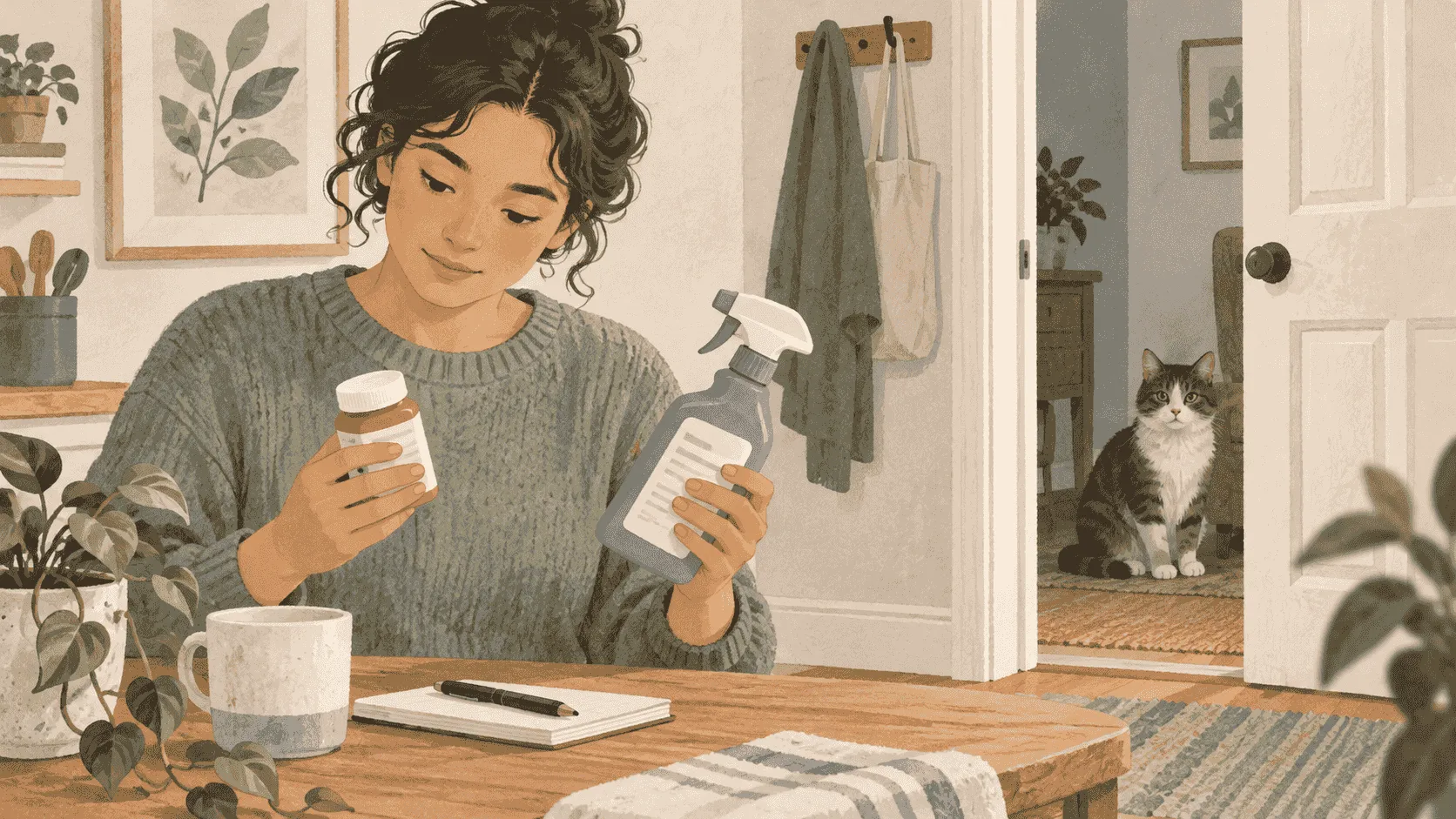
If you are looking at a disturbed package, a chewed container, a missing amount, or a spill, switch from prevention to information gathering:
- Move the cat away from the item and prevent further access.
- Keep the original label, package, plant label, or a clear full-label photograph when it is safe to do so.
- Record what may have happened, the possible amount, and the time—even when some details are unknown.
- Note your cat’s age, approximate weight, current medicines or health conditions, and any changes you can see.
- Call your veterinarian or an animal poison-control service and follow the direction given for this cat and this exposure.
The American Veterinary Medical Association’s pet first-aid guidance puts the product information and professional call ahead of improvised treatment. “Unknown” is useful information; it is not a reason to fill the gap with a guessed safe amount.
Medication Is a Label-and-Access Question
Human and animal medicines deserve special attention because packaging can look reassuring. The FDA Center for Veterinary Medicine says that child-safe medicine containers may not be pet-safe and specifically describes pets chewing pill vials, boxes, and blister packages. Its storage guidance supports keeping medicines in their original labelled containers and directing caregivers to professional advice after possible access. The University of Illinois College of Veterinary Medicine makes the same practical point: a pet may chew into a closed bottle, so a cap is not a guarantee.
The useful prevention question is not “Is this bottle child-resistant?” It is “What storage plan keeps this medicine beyond my cat’s reach, preserves the label, and works when a person is tired or carrying something?” Keep human and pet medicines separate from food and treats, retain the original label, and avoid transferring tablets into an unlabelled container. Those steps improve the information available if something is knocked down or chewed.
After possible medication access, a normal-looking cat is not an all-clear. ASPCA Animal Poison Control guidance says that an animal showing no signs after a potentially hazardous ingestion is not a reason to wait for signs to worsen before seeking help. A 2025 retrospective study in the Canadian Veterinary Journal described accidental pharmaceutical exposures in 223 dogs treated at one Canadian veterinary teaching hospital; some dogs had a normal clinical examination at presentation. That hospital finding is context for why outward appearance is not a home rule-out test. It is not a prediction for your cat, a named medicine, or a safe waiting period.
Do not try to identify the risk from a missing tablet, a chewed package, or a symptom search. Keep the package or label beside you and tell the professional what is known and what is uncertain. Do not give a human medicine, another pet’s medicine, food, milk, water, charcoal, or another remedy unless the professional handling the case directs it.
Cleaner Exposure Cannot Be Answered by the Word “Cleaner”
Cleaning products are not one veterinary risk category. The Merck Veterinary Manual’s corrosive-agent reference and Cornell University College of Veterinary Medicine’s small-animal toxin guidance separate ingredients and product classes because the substance, concentration, route, and exposure context can change the professional assessment. A familiar brand, mild smell, “natural” wording, or diluted appearance does not identify the right response for an individual cat.
If your cat may have licked, chewed, swallowed, or been contaminated with a cleaner, keep the container or a clear photograph of the full label if doing so is safe. Call a veterinarian or animal poison-control service promptly. Do not guess from the word “disinfectant,” “detergent,” or “bleach,” and do not choose vomiting, food, milk, water, charcoal, a neutralizer, or medication as a generic response.
For prevention, use each product only as its own label directs and keep your cat away from the working area. The label-led approach is deliberately less satisfying than a universal “safe after X minutes” rule, because ventilation, rinsing, drying, and re-entry directions vary by product. This page does not turn one cleaner’s instructions into a household-wide guarantee.
Food and Plant Questions Need Their Own Exact Check
Food and plant exposures are still exposure questions, but their evidence is easier to misuse when they are compressed into a general list. Use the food-hazard checklist for cats when the concern is a kitchen ingredient, recipe, snack, or drink. It keeps a bounded set of food hazards separate from routine human-food treats and explains why the wrapper or recipe matters.
Use the plants-toxic-to-cats-and-dogs owner checklist when the concern is a houseplant, bouquet, bulb, garden product, or uncertain botanical name. A common name or photograph may not identify the plant well enough for a professional assessment, and an entry for one named plant does not automatically classify a lookalike or a product applied to it.
Those pages are intentionally narrower than this hub. A food list cannot answer a medication question, and a plant database cannot answer a cleaner question. If more than one exposure is possible, tell the veterinary professional about all of them rather than selecting the most reassuring category.
Build a Five-Part Exposure Note
Before calling, make the record useful without delaying the call or handling a worried cat. The five parts are:
- Identity: product name, active ingredient, plant label, food package, or the clearest description available.
- Event: licked, chewed, swallowed, spilled onto fur or skin, or uncertain contact.
- Amount and time: what may be missing or involved, when it may have happened, and what you do not know.
- Cat details: age, approximate weight, current medicines, relevant health history, and whether another animal could have reached the same item.
- Current picture: what you can observe now, described plainly rather than translated into a diagnosis.
Keep the evidence available: the bottle, blister pack, product label, recipe, plant tag, or a clear photograph. Do not put yourself or the cat at risk to retrieve something. If the package is missing or the label is incomplete, say that directly. A professional can work with uncertainty; a confident but invented amount is less useful.
What Not to Do at Home
The safest general boundary is simple: call before treating. The approved poisoning guidance for Petzette supports contacting a veterinarian or animal poison-control service after suspected poisoning and not inducing vomiting or giving medication unless a professional directs it. The same boundary applies to improvised food, fluid, charcoal, neutralizers, and other household responses. Different substances and exposure routes can make a familiar home remedy unsafe.
Do not wait for a cat to look ill before asking whether a possible exposure matters. Do not use a symptom list to prove which item was involved, and do not treat a short period of normal behavior as clearance after medication or another potentially hazardous access event. If your cat already has a concerning change, describe it during the call and follow the veterinary team’s route and timing advice.
The First-Year Home Decision
For a new cat, the practical task is not memorizing every toxic substance. It is building a repeatable chain: keep original labels, store medicines and cleaners beyond access, identify plants and foods before they enter the cat’s reach, and save veterinary and poison-control contacts before a cupboard scare happens.
If a possible exposure occurs, move the cat away, preserve the exact information, record what is uncertain, and call. A broad search result cannot diagnose poisoning, select treatment, or set a safe waiting period for an individual cat. The professional conversation is the next step because the substance, amount, route, timing, and cat all matter together.
Sources
Petzette's claim cards for this article point to the following scientific, veterinary, or animal-welfare sources.
- Pet Medication Access: Container And Normal-Appearance Boundaries: Cross-source medication-access safety evidence note. This note supports two narrow boundaries only: child-resistant medicine packaging is not automatically pet-resistant, and a normal-looking pet does not settle whether possible medication access is harmless. It does not identify a medicine, calculate a dose, diagnose exposure, set an urgency tier, or give home-treatment instructions.
- Household Cleaning Products: Label-Led Prevention And Exposure-Information Boundary: Current veterinary toxicology and veterinary-school guidance, animal poison-control education, established cat-welfare guidance, a peer-reviewed feline disinfection guideline, and limited companion-animal case reports
- Gwaltney-Brant SM. *Toxicoses From Corrosive Agents in Animals.* Merck Veterinary Manual, Veterinary Professionals. Full review and last update March 2025; peer reviewed by Ahna Brutlag, DVM, DABT, DABVT. The source distinguishes acidic and alkaline corrosives from cationic detergents and shows why an everyday category such as “cleaner” cannot identify one risk or one response.
- AVMA Pet First Aid: Poison Response Boundary: Veterinary-association first-aid brochure