Behavior & Training07 August 2026
Why Do Cats Hate Water? Start With the Bath Decision
Why do cats hate water? Many cats find full submersion stressful, while individual responses vary. Learn when a bath is actually needed.
TextPetzette Editorial
Read4 Min

Evidence status
Source-backed editorial
- Evidence record
- 5 claim cards linked to 9 documented sources.
- Independent expert review
- Not commissioned. Petzette Editorial is responsible for the published wording.
- Source record checked
- 07 August 2026
- Scope
- General guidance. Individual animals and circumstances can differ.
Why do cats hate water? The familiar picture of a cat fleeing a bath can make that sound like a personality test. The more useful first-year decision is simpler: does this cat need a bath, and what is the least stressful next step? Cats Protection behavior guidance, written with clinical animal behaviourist Daniel Warren-Cummings, says many cats may find full submersion stressful, while individual responses vary.
That distinction keeps a new owner from turning curiosity at a tap into permission for a bath—or turning a bath refusal into a label. Use the reaction to choose calm routine care, a smaller handling lesson, or veterinary help when the issue is more than ordinary grooming.
Interest in Water Is Not the Same as a Bath
A cat may watch a running tap, pat at a drip, or sit on the edge of a tub and still decline to be immersed. Cats Protection notes that some cats are curious about water, while many do not enjoy being fully submerged. The useful observation is not “my cat likes water” or “my cat hates water.” It is what happens in this particular setting: Is the cat choosing to approach? Can the cat leave? Does the reaction change when the water, noise, slippery surface, or handling changes?
Keep drinking separate from bathing, too. FelineVMA caregiver guidance recommends fresh water in quiet, accessible places, with more than one option useful in a multi-cat home. A cat who investigates a tap does not need a fountain, and a cat who ignores one bowl has not given you a diagnosis. Offer ordinary clean choices and observe which setup the cat uses.
Why Full Submersion Can Feel Different
Cats Protection explains that a soaked coat can feel heavy and uncomfortable, make movement harder, and leave a cat cold while it dries. A prior frightening water experience may also shape a cat’s response. Those are possible reasons, not a universal explanation for one dramatic bathroom exit.
That uncertainty is practical. Do not test a theory by placing a reluctant cat in water, spraying them, or repeating an immersion until they appear still. Stillness is not evidence that the cat is comfortable. Instead, notice the whole situation: the cat’s posture, route away, the surface underfoot, the amount of water, and whether they are being held.
Decide Whether a Bath Is Needed
For most cats, routine care starts with self-grooming and suitable brushing, not a bath calendar. Cats Protection’s grooming guidance makes bathing an individual exception, especially for a cat with particular skin, coat, mobility, or health needs.
Use this quick decision:
- Ordinary coat care: Brush at a comfortable level and leave bathing off the routine list.
- Minor surface dirt: Pause before escalating. A soft damp cloth may be an option, but only if the cat can stay comfortable and the task remains small.
- Matting, a greasy or suddenly changed coat, a skin concern, pain, or toxic contamination: Ask a veterinarian for direction rather than improvising a bath or shampoo.
The calm cat-grooming routine covers brush choice, coat checks, and the wider home-care boundary. This page owns the narrower water question: a bath is not the default response to a cat’s normal reluctance.
If Care Is Necessary, Make the First Step Tiny
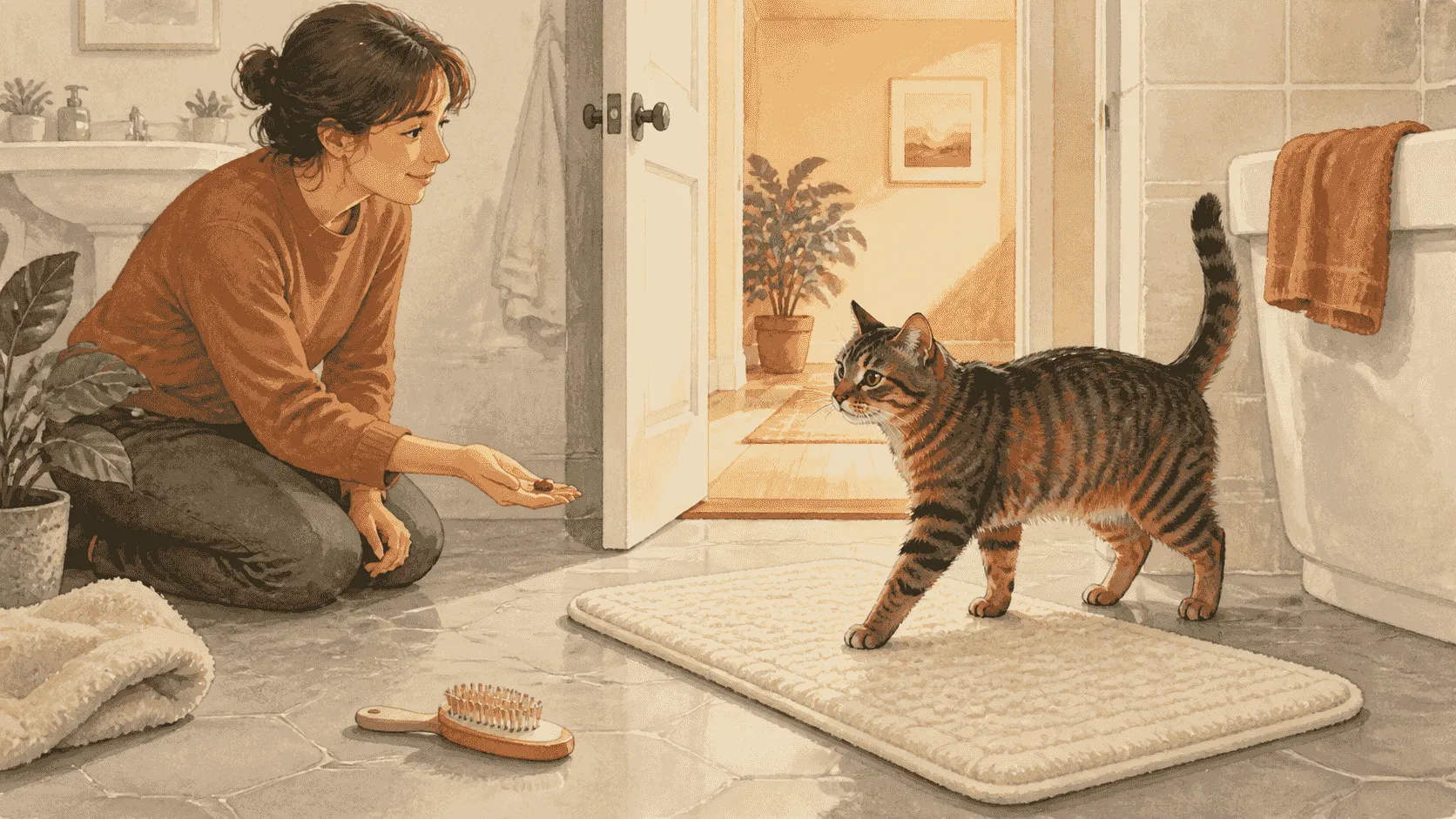
When a veterinarian has identified a care task that needs practice, start well before any water is involved. Cats Protection handling guidance begins with one second of touch in an area the relaxed cat already accepts, followed by an immediate reward and a clear exit. FelineVMA cooperative-care guidance uses the same principle: reward small voluntary steps rather than asking for the final behavior all at once.
One short session might be as small as looking at a dry non-slip mat, stepping onto it, or accepting a brief touch near the shoulder. End there if it stays easy. If the cat tenses, withdraws, hides, growls, hisses, or tries to escape, make the next attempt smaller or ask the veterinary team what safe help looks like. Do not practice through pain, illness, or fear.
When the Water Question Is Really a Veterinary Question
A sudden change in grooming, coat condition, handling tolerance, appetite, drinking, urination, or overall wellbeing belongs in a veterinary conversation. Water avoidance by itself cannot tell you whether a cat is afraid, sore, ill, or simply unwilling to have a bath. The same is true in reverse: interest in a tap is not reassurance that a health concern has resolved.
If this is sudden or severe, contact your veterinarian promptly. For a new cat, keep a small baseline of usual brushing tolerance, drinking locations, and coat condition alongside the rest of the settling routine in the first 30 days with a cat.
The takeaway is modest: respect the cat’s response, do not make immersion a test, and let a real care need—not a stereotype—decide whether bathing belongs in the plan.
Sources
Petzette's claim cards for this article point to the following scientific, veterinary, or animal-welfare sources.
- Why Many Cats Dislike Full Submersion: Cat-welfare behavior guidance
- Routine Cat Bathing Is Usually Not Needed: Vet-reviewed UK feline welfare and grooming guidance
- Cats Protection One-Second Handling Training: Animal-welfare handling guidance
- 2022 AAFP ISFM Cat Friendly Veterinary Interaction Guidelines: Peer-reviewed veterinary clinical guideline
- AAHA Cat Vet-Visit And Carrier Preparation: Veterinary association expert guidance
- FelineVMA Positive Reinforcement And Cooperative Care: Feline veterinary association caregiver guidance
- AAFP ISFM Cat Friendly Veterinary Environment Guidelines 2022: Peer-reviewed feline veterinary-environment guideline
- Cat Water Intake From Still And Flowing Sources: Peer-reviewed crossover study
Robbins MT et al. *Journal of Feline Medicine and Surgery*. 2019;21(8):683-690. doi:10.1177/1098612X18803753.
- Cat Friendly Homes: Enhancing Water Intake: Veterinary-association caregiver guidance