Health Signals24 August 2026
Why Do Cats Pant? Treat Breathing Changes as Urgent
Why do cats pant? Learn why open-mouth breathing or visible effort is an urgent veterinary question, not a pattern to diagnose at home.
TextPetzette Editorial
Read3 Min

Evidence status
Source-backed editorial
- Evidence record
- 2 claim cards linked to 1 documented source.
- Independent expert review
- Not commissioned. Petzette Editorial is responsible for the published wording.
- Source record checked
- 24 August 2026
- Scope
- General information, not an individual diagnosis or treatment plan.
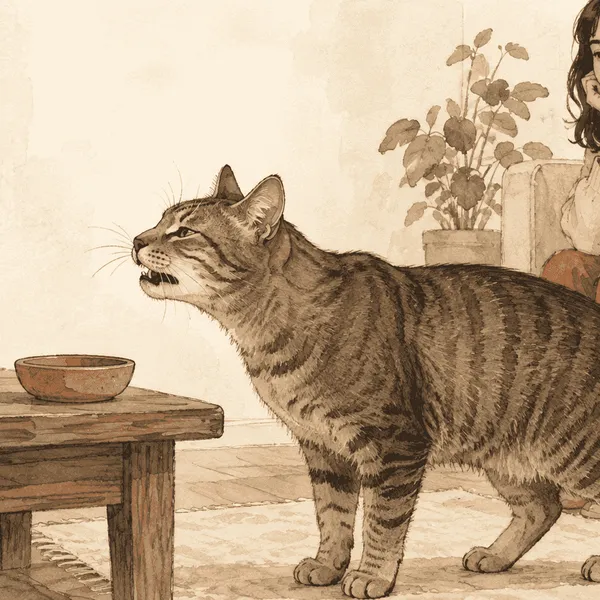
Why do cats pant? If you are asking because your cat is breathing with an open mouth or seems to be working to breathe, make the next decision urgent veterinary direction. A breathing change can be a serious clue, but the visible pattern cannot tell you at home whether the cause is respiratory, cardiac, traumatic, or something else. Do not wait to name it before calling.
Cat Panting Is a Breathing Question, Not a Behavior Label
The phrase “cat panting” can make a breathing change sound like an ordinary behavior question. The safer first move is narrower: does this cat look comfortable while breathing? Cornell Feline Health Center describes respiratory difficulty as a clinical sign rather than a disease and advises veterinary care when there is a question about comfortable breathing. Merck Veterinary Manual guidance lists breathing difficulty among concerns needing immediate treatment.
That boundary matters because a single visible pattern does not carry its own explanation. The evidence does not authorize treating panting as “just stress,” assuming that a recent activity makes it harmless, or waiting for a more complete symptom list. A cat may be quiet, frightened, purring, or otherwise hard to read while still needing professional assessment.
Open-Mouth Breathing Changes the Next Step
If your cat is breathing with its mouth open, showing visibly increased effort, or appearing unable to breathe comfortably, seek urgent veterinary direction. Cats Protection includes difficulty breathing, including open-mouth breathing or marked effort, among reasons for emergency advice or treatment. Merck also identifies open-mouth breathing as a severe sign related to oxygen loss.
If you notice cat breathing fast while purring, do not let the purr reassure you. Purring is part of the surrounding scene, not a clearance test. The same is true if the change seems brief, follows a suspected trigger, or happens without coughing. Do not wait for gum-color changes, collapse, or another sign to tell you what the breathing pattern means.

Breathing Difficulty Cannot Identify the Cause at Home
Breathing difficulty is a clue, not a label. A 2025 study in Veterinary Sciences examined 258 cats with severe emergency dyspnea at a veterinary service. The authors found that the clinical presentation did not reliably identify a specific cause before confirmatory diagnostics. That result comes from a referred emergency population; it is not a percentage calculator or a prediction for an individual cat at home.
So avoid turning a posture, sound, age, activity, or single accompanying sign into a diagnosis. You cannot safely sort asthma, heart disease, infection, trauma, poisoning, or another cause from the visible pattern alone. A normal-looking moment does not clear a cat who has appeared to struggle to breathe, and a home monitor or breath count cannot replace veterinary assessment.
Make the Call Without Turning It Into a Home Test
Use plain language when you contact your veterinarian or an emergency veterinary service. Say that your cat appears to be working to breathe, is breathing with an open mouth, or is showing a visibly changed effort. The point is to communicate the urgent observation, not to choose a cause.
While you make that contact, keep the boundary clear:
- Do not delay the call to complete a breathing checklist or wait for another symptom.
- Do not inspect the mouth, pull the tongue, count breaths to decide whether waiting is safe, or use one quiet minute as reassurance.
- Do not give food, water, medication, oxygen, steam, or a home remedy before getting professional direction.
Those limits are not a treatment plan. They prevent a caregiver from turning uncertainty into delay or an intervention that the evidence does not support.
Put This Boundary in Your First-Year Cat Plan
New owners do not need a perfect respiratory vocabulary. They do need a simple rule: visible breathing difficulty is a veterinarian question first. Save your clinic’s number and know how to ask which emergency service to contact. If this is a new kitten, the new kitten first-visit checklist can help you prepare the broader veterinary relationship; it does not replace urgent care for breathing trouble.
For ordinary sounds and social moments, context still matters. Our guide to why cats purr explains why a purr does not have one fixed meaning. But when the whole cat appears to be working to breathe, the useful next step is not interpretation. Contact a veterinarian promptly and let the clinical team decide what the sign requires.
Sources
Petzette's claim cards for this article point to the following scientific, veterinary, or animal-welfare sources.
- Feline Breathing Difficulty: Urgent Referral and Diagnostic-Uncertainty Boundary: Evidence synthesis of a peer-reviewed feline emergency cohort, veterinary-school guidance, a peer-reviewed veterinary manual, and established welfare emergency guidance. It supports a narrow recognition, no-home-diagnosis, and urgent-professional-direction boundary for apparent breathing difficulty in cats. It is not a diagnostic guide, first-aid protocol, transport plan, treatment guide, or prognosis source.
- Abboud N, Deschamps J-Y, Joubert M, Roux FA. *Emergency Dyspnea in 258 Cats: Insights from the French RAPID CAT Study.* Veterinary Sciences. 2025;12(3):242. doi:10.3390/vetsci12030242; PMID:40266956; PMCID:PMC11946846.