Behavior23 July 2026
New Cat Hissing at Me? Give Space, Then Reconnect
New cat hissing at you? Use a calm distance-and-choice plan, set up a safe base room, and know when unusual hissing needs a veterinarian.
TextPetzette Editorial
Read4 Min

Evidence status
Source-backed editorial
- Evidence record
- 6 claim cards linked to 5 documented sources.
- Independent expert review
- Not commissioned. Petzette Editorial is responsible for the published wording.
- Source record checked
- 23 July 2026
- Scope
- General guidance. Individual animals and circumstances can differ.
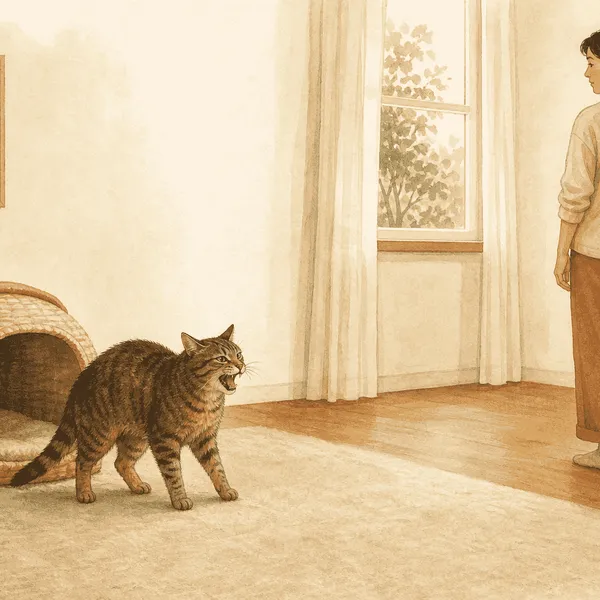
New cat hissing at me can feel like a verdict on the relationship you hoped to build. It is more useful to treat the hiss as a request for distance. Back away calmly, leave the route to a retreat open, and let the cat decide the next move. You do not need to win them over in that moment.
This arrival-specific plan is for a newly adopted cat who is facing unfamiliar people, smells, sounds, and rooms. A sudden behavior change in an established cat is a different situation and should move the veterinary check higher on your list.
What a New Cat Hissing at You Can—and Cannot—Say
Cats Protection’s 2025 hissing guidance describes the sound as a warning that a distressed cat needs space. It does not prove that the cat is aggressive, dislikes you, or will never settle. Fear, stress, uncomfortable handling, pain, and environmental pressure can overlap, so the sound alone cannot identify one cause.
Read the rest of the scene. Note where the cat is, what you were doing, whether an exit was available, and whether the body became crouched, tense, or turned away. Also check the basic routine: eating, drinking, toileting, movement, grooming, rest, and interest in the room. That whole pattern is more useful than trying to translate one hiss.
Use a 90-Second Distance-and-Choice Reset
When the hiss happens, use the same short sequence:
- Stop advancing. Make your hands still and do not reach toward the cat.
- Create distance. Turn slightly sideways and take a slow step back if the route is clear.
- Protect the exit. Do not stand between the cat and the carrier, box, perch, or doorway they may use.
- Lower the pressure. Reduce staring, handling, visitors, and noisy activity around the retreat.
- Record the trigger. Write one sentence about what happened immediately before the hiss.
Do not pet, pick up, restrain, scold, or hiss back. Forced comfort can still feel like pressure. If there is an immediate bite or scratch risk, use distance and a barrier without cornering the cat, then wait for a calmer moment.
Make the Base Room Easier to Read
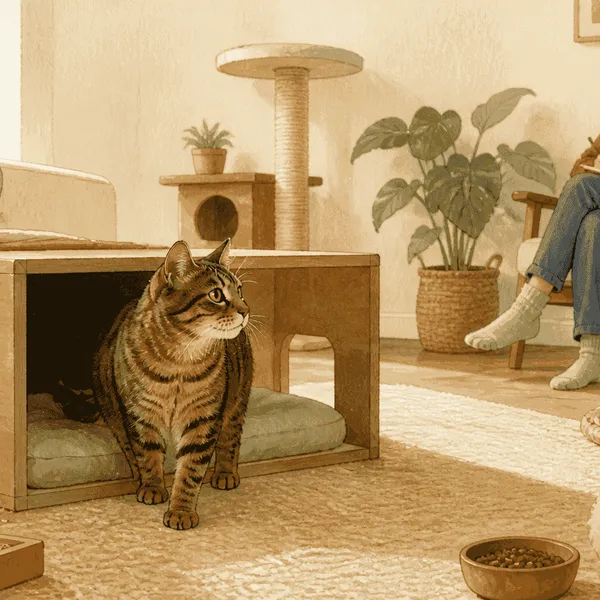
A new home can ask the cat to process too much at once. Cats Protection’s moving-home guidance recommends starting with one quiet, resource-ready room, familiar-smelling items, an open carrier, and exploration at the cat’s pace. Think base camp, not grand tour.
Provide a stable retreat, food, water, litter, rest, scratching, and play choices without packing every resource into one corner. The 2026 Feline Veterinary Medical Association caregiver guidance says a safe place should let the cat enter, leave, and avoid being cornered. Do not reach into it to force an introduction.

Our calm first-30-days cat plan covers the wider arrival routine. If the cat chooses to hide, the guide to offering a box without creating a trap explains how to preserve a usable exit.
Reconnect Without Chasing Contact
Once the cat is using the room and the immediate tension has passed, make interaction predictable. Sit at a distance, angle your body away, and let the cat approach or leave. A wand toy used away from hands may offer a low-pressure activity if the cat shows relaxed interest; silence and space are also valid choices.
AAFP/ISFM feline environmental guidance recommends positive, predictable interaction that the cat can initiate and control. A 2021 study of 100 rehoming-center cats found more affiliative behavior and less conflict-linked behavior after people learned a combined approach involving choice, attention to body language, limited touch, and pauses. It was not a magic timer or a guarantee for every cat.
If the cat approaches, offer a hand without following them. Add touch only when the body stays relaxed, then pause and see what the cat chooses next. Leaving is information, not rejection. The goal is a repeatable calm interaction, not a cuddle deadline.
When Hissing Needs Professional Help
Contact your veterinarian if the hissing is unusual for this cat, repeats when one body area is touched, or arrives with appetite, drinking, toileting, movement, grooming, or wider behavior changes. Do not press the area again to test for pain. A settling period does not rule out illness.
Seek prompt professional direction if the behavior is sudden or severe, the cat seems unwell, or anyone is at risk of being bitten or scratched. A veterinarian can assess possible health contributors; a qualified cat behavior professional can help with a safe interaction plan after health concerns are addressed.
For mild arrival-related hissing, your next step is concrete: back up, keep the exit open, simplify the base room, and record the trigger. Recheck the whole pattern rather than the speed of affection. Trust is built through predictable choices, one calm encounter at a time.
Sources
Petzette's claim cards for this article point to the following scientific, veterinary, or animal-welfare sources.
- Cats Protection Hissing Guidance: Current cat-welfare behavior guidance
- Cats Protection Moving Home Guidance: Cat-welfare home-transition guidance
- AAFP/ISFM Feline Environmental Needs Guidelines 2013: Peer-reviewed veterinary guidelines plus client-facing practice resource
- Cat Interaction Choice And Control Study 2021: Peer-reviewed controlled before/after human-training study
- FelineVMA Environmental Needs: Safe Places And Choice: Current feline-veterinary caregiver guidance