Health Signals18 September 2026
Cat Stuck in a Tree: A Safe Rescue Decision
Cat stuck in a tree? Use a quiet, low-risk plan, know when a route down is unsafe, and call the right local help before anyone climbs.
TextPetzette Editorial
Read6 Min
Evidence status
Source-backed editorial
- Evidence record
- 2 claim cards linked to 2 documented sources.
- Independent expert review
- Not commissioned. Petzette Editorial is responsible for the published wording.
- Source record checked
- 18 September 2026
- Scope
- General information, not an individual diagnosis or treatment plan.
A cat stuck in a tree creates a strong urge to do something dramatic. The safer first decision is quieter: is the cat and location stable enough for a low-risk wait, or does this need professional help now? Cats Protection explains that cats can climb up more easily than down because their claws and coordination make descent difficult, especially when the remaining jump is not safe. The Animal and Veterinary Service (AVS) likewise separates calm, low-risk steps from situations that need professional services.
This is not a climbing tutorial. Do not turn a frightened cat into a second emergency by climbing a tree, standing on an unstable ladder, or entering a dangerous location. If the cat is injured or this looks like a medical emergency, contact a veterinarian or emergency animal hospital. If the access itself is unsafe, contact a suitable local rescue, animal-welfare, or tree professional.
Start With a Safety Scan, Not a Climb
Before moving toward the tree, make a short assessment from the ground:
- Cat: Does the cat appear injured, trapped by part of the tree, or in genuine distress? Note what you can actually see without calling it a diagnosis.
- Location: Is the height, branch, access route, or surrounding area unsafe for a person? Severe weather changes the decision too.
- Duration: When did you first notice the cat, and when was it last known to be in a different place? There is no universal safe countdown.
- Attempt: Have low-risk steps already failed, or are people repeatedly approaching and making the area busier?
If injury, genuine distress, severe weather, dangerous access, or a prolonged wait is part of the picture, move toward professional help rather than escalating your own reach. AVS lists those factors as reasons to seek professional services. Cats Protection also identifies more than 24 hours stuck as a reason to contact a local tree surgeon. That reference point is not permission to wait that long when the cat or anyone nearby is at risk.
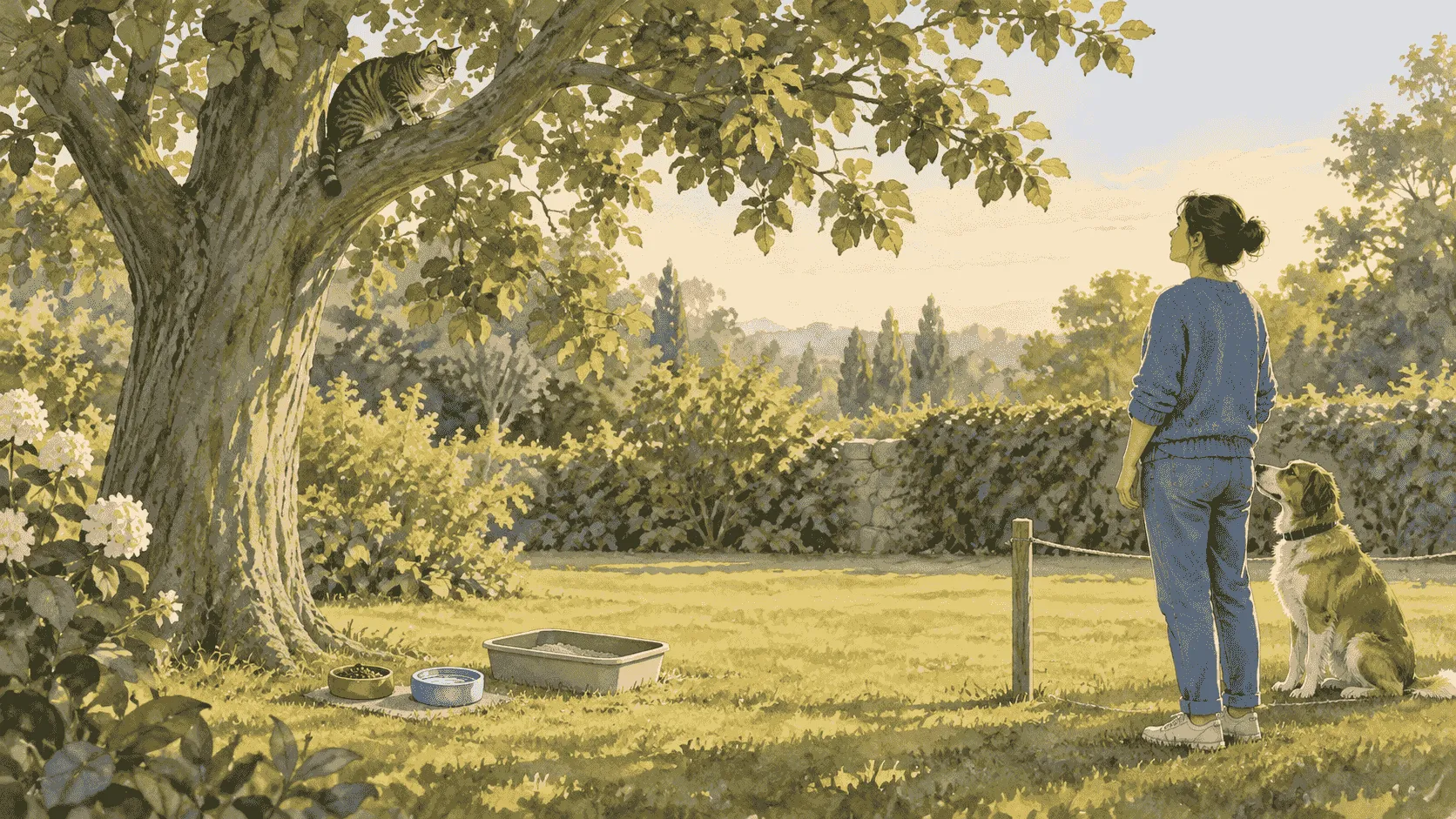
Keep people and dogs back from the base. A quiet perimeter protects the cat’s choices and keeps the situation legible: one person can observe while another makes a call if help is needed. A crowd, repeated shouting, or a person moving beneath the branch can add pressure without adding a safe route down.
If the Cat Is Stable, Make the Ground Boring
When the cat appears stable and the location is not immediately dangerous, give it time and space. Cats Protection’s guidance and AVS both support a calm, quiet setup. Stand well back, reduce movement, and avoid repeatedly calling the cat to test whether it will respond. A quiet cat is not automatically a safe cat, so continue observing for changes in position, weather, and visible condition.
If it is safe to do so from the ground, place a familiar food or water resource at the base. AVS also lists a familiar litter box as an option because a known scent may make the area more recognizable. Keep these resources away from any place that would require you to enter a hazard, and do not use them as a promise or lure that justifies getting closer.
The goal is not to win a standoff. It is to remove pressure and leave a route open if the cat decides that descending is the better choice. Do not shake the tree, chase the cat along a branch, throw objects, or send several people up to “help.” Those actions can turn a cautious pause into a fall or a human injury.
Offer a Route Down Only When It Is Already Safe
A sturdy route can sometimes help, but the route is not helpful if creating it requires a risky climb. Cats Protection discusses a stable way down as one possible aid, and AVS mentions a sturdy ladder as an alternative route while asking caregivers to assess whether reaching the cat can be done without serious risk.
Use that boundary literally. A route is worth considering only when it can be placed or made available from a secure position, without balancing, climbing, leaning over an edge, or entering an unsafe area. If you cannot create it safely, leave the route problem to a professional. Do not improvise with a loose board, a wobbly ladder, a rope, or anything that could move beneath the cat.
Do not assume that a crying cat is asking you to climb. Vocalization can tell you the situation is active; it cannot tell you that a particular rescue technique is safe. Keep the ground calm and describe the access problem clearly when calling for help.
Know When to Call for Professional Help
Call a suitable local professional when the cat has been stuck for prolonged hours, the weather is severe, the location creates a serious access risk, the cat is injured or in genuine distress, or low-risk attempts have failed. Depending on where you live, the right contact may be a tree surgeon or arborist, an animal-welfare service, a local rescue provider, or another service that handles difficult animal access. Policies and availability vary, so do not assume that one named agency will respond everywhere.
Make the call useful with four facts:
- Exact location: Give the address or landmark, tree position, approximate height, and the safest way to approach from the ground.
- Time: Say when you first noticed the cat and whether the situation is getting longer, colder, wetter, or otherwise more difficult.
- Condition: Describe visible posture, movement, vocalization, and any obvious injury or entanglement without diagnosing the cause.
- Attempts: Explain what has already been tried and whether anyone has entered a risky position.
If the cat appears injured or has a medical emergency, use a veterinarian or emergency animal hospital rather than waiting for a general rescue answer. Do not give food, medication, or a home treatment to address an injury unless a veterinary professional directs you. Your job is to preserve useful information and keep people safe while the appropriate help is arranged.
When the Cat Comes Down
Keep the same calm boundary while the cat moves. Do not turn the descent into a crowd or rush forward to grab it. If the cat is injured, remains in genuine distress, or shows a medical emergency, contact a veterinarian or emergency animal hospital even after it reaches the ground. A successful descent answers only the access problem; it does not rule out an injury or another health concern.
For broader preparation before a new cat explores, the first 30 days with a cat guide can help you think through a predictable home base and the practical details you want ready before an unexpected situation.
The Three-Line Rescue Note
Write this down before you call:
- Where: exact location, height, branch or structure, and safe ground access.
- When: first noticed, current weather, and whether the wait is becoming prolonged.
- What you see: visible condition, movement, distress, injury, and what low-risk steps have already failed.
That note keeps the decision grounded. Give a stable cat quiet space only while the location remains safe. If duration, weather, access, injury, distress, or failed attempts changes the balance, call for professional help. A rescue plan is successful when the cat gets a safe route down and the person helping does not become the next emergency.
Sources
Petzette's claim cards for this article point to the following scientific, veterinary, or animal-welfare sources.
- AVS Cat Stuck High Rescue Guidance: Singapore government animal and veterinary service public guidance on a cat stuck in a high place
- Cats Protection Cat Stuck Up A Tree Guidance: UK animal-welfare caregiver guidance on cats stuck in trees