Gear Decisions19 July 2026
Cat Teething Toys: A Soft-and-Safe Kitten Checklist
Cat teething toys should be soft, simple, supervised, and easy to inspect. Use this product-neutral checklist for safer kitten chewing.
TextPetzette Editorial
Read4 Min

Evidence status
Source-backed editorial
- Evidence record
- 6 claim cards linked to 9 documented sources.
- Independent expert review
- Not commissioned. Petzette Editorial is responsible for the published wording.
- Source record checked
- 19 July 2026
- Scope
- General guidance. Individual animals and circumstances can differ.
Cat teething toys do not need to be complicated. For a kitten changing from baby teeth to adult teeth, the useful choice is a softer, simple toy that you can supervise, inspect, and remove as soon as it starts to break down. No material or label makes a chew toy risk-free.
Begin with one easy test: can you examine the whole toy before and after your kitten uses it? If seams, fibers, or pieces are hard to see, the toy is harder to manage safely. This checklist is about how an item behaves in your home, not which brand wins a shelf comparison.
Kitten Teething Is a Window, Not a Deadline
Cats develop a deciduous set of baby teeth and then a permanent set. The MSD Veterinary Manual says permanent teeth usually begin to appear at around four to seven months. That range is context, not a home diagnosis: kittens develop on individual timelines, and chewing alone does not prove that teething is the reason.
Age is most useful when paired with what you observe. Is your kitten eating comfortably? Is the mouth behavior familiar, or has it changed suddenly? A toy can provide an acceptable chewing outlet, but it cannot confirm that the mouth is healthy or treat pain.
If you are preparing the rest of the room as well, the new-kitten first-week checklist covers litter, food, hiding places, scratching, and carrier setup without turning arrival day into a shopping marathon.
How to Choose a Kitten Teething Toy
Cats Protection advises avoiding hard wood or rigid plastic during kitten teething. Start with a toy that feels softer, stays intact under normal handling, and has no small detachable parts. Then judge the actual object rather than trusting a material name.
Use four product-neutral checks:
- Softness: Choose a softer object rather than a rigid one that offers no give.
- Simplicity: Prefer a shape with no small attachments, hard decorations, or hidden pieces that could come away.
- Visibility: You should be able to see seams, edges, and the full chewing surface.
- Condition: Skip anything already split, frayed, punctured, or shedding material.
A soft toy still needs supervision. Fabric, foam, or flexible material can become a swallowing hazard if a kitten pulls off a piece. “Soft” describes one feature; it is not a safety guarantee.
Make Supervision Part of the Toy
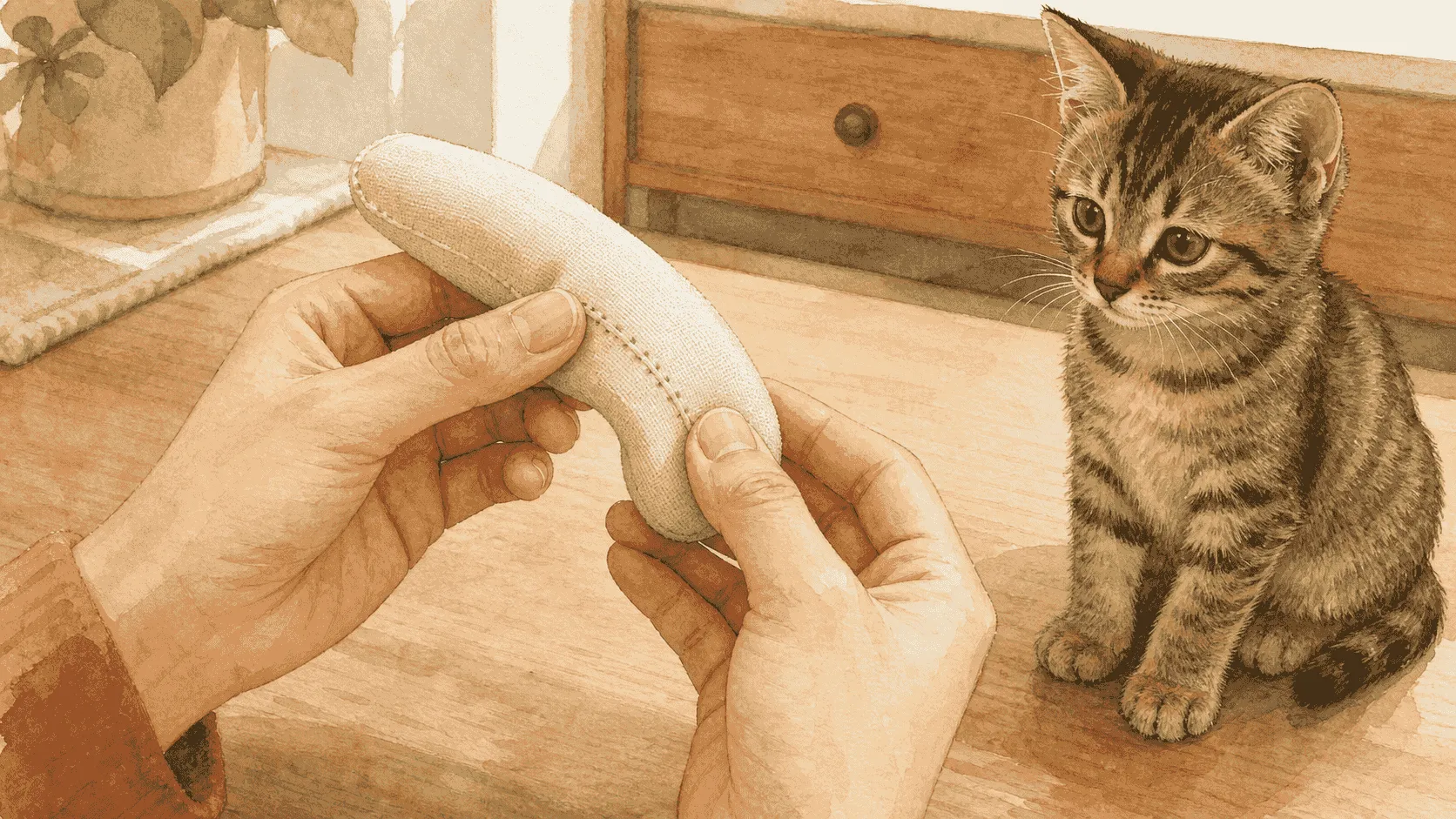
Offer the toy when you can watch the chewing. Keep the game away from fingers and toes; Cornell Feline Health Center guidance recommends giving play biting a toy target at a distance from hands rather than using skin as the play object.
When the session ends, inspect the toy again. Retire it if a seam opens, fibers pull loose, the surface splits, or any piece is missing. Put it away between sessions if your kitten could continue dismantling it without you.
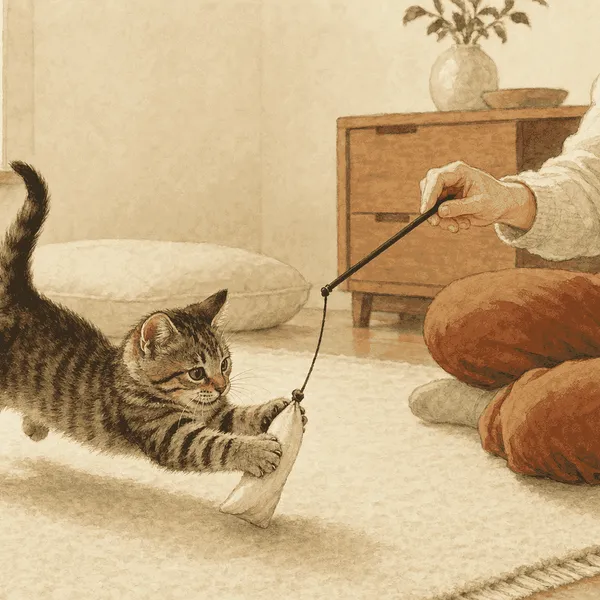
String, ribbon, yarn, and wand attachments need a stricter put-away step. Feline veterinary guidance says string-type toys and loose swallowable pieces should not remain available after play. A 2023 Journal of Feline Medicine and Surgery study documented cats needing surgery for linear and discrete foreign bodies; it does not predict what will happen in one home, but it makes prevention the sensible decision.
What a Cat Chew Toy Cannot Tell You
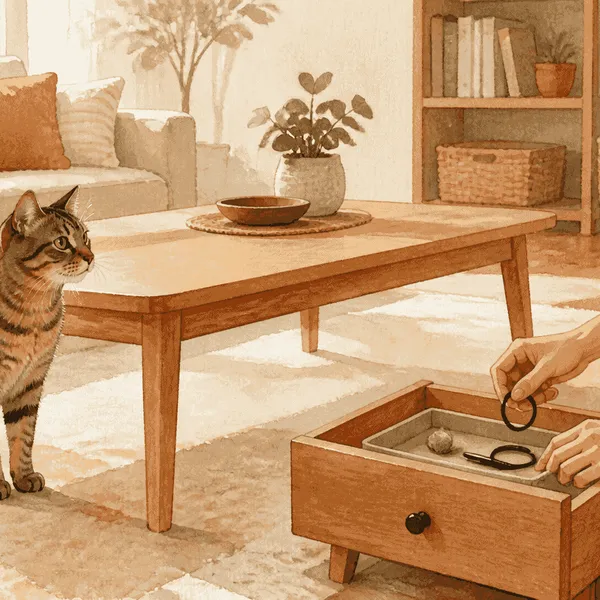
Expect uncertainty. A kitten may chew during tooth transition, play, or exploration, and one scene cannot separate those possibilities. A toy may redirect some chewing, but it may not stop interest in hair ties, rubber bands, or hands. Store those hazards rather than asking the toy to outcompete them.
Do not keep escalating hardness because a soft toy wears out. Wear is information: it tells you that the object needs removal and that your kitten’s chewing style deserves a different supervised setup. If toys repeatedly break apart, pause that type of object and ask your veterinarian about safer options for this kitten.
When to Contact Your Veterinarian
Teething should not become a reason to explain away a mouth or eating change. Contact your veterinarian if you notice abnormal chewing, drooling, repeated food dropping, reduced appetite, oral bleeding, facial swelling, difficulty eating, a damaged tooth, or behavior that suggests the mouth is uncomfortable. Do not force the mouth open to investigate.
Possible ingestion, choking, or a missing toy piece also needs prompt professional direction. Do not induce vomiting or pull visible string. Tell the clinic what the item was, what seems to be missing, and what you have observed.
The practical next step is small: choose one soft, simple toy, inspect it before use, supervise the session, inspect it again, and store or retire it. That routine matters more than a “teething” label on the packaging.
Sources
Petzette's claim cards for this article point to the following scientific, veterinary, or animal-welfare sources.
- Cats Protection: Kitten Teething Advice: Animal-welfare kitten-care guidance
- MSD Veterinary Manual: Dental Development Of Cats: Veterinary reference manual
- Surgical Gastrointestinal Foreign Bodies In Cats, 2009-2021: Peer-reviewed retrospective clinical study
Gollnick HR, et al. *Journal of Feline Medicine and Surgery*. 2023;25(6). doi:10.1177/1098612X231178140.
- Cat Friendly Homes: Playing With Your Cat: Veterinary-association caregiver guidance
- Cats Protection: Keeping Your Cat Safe In The Home: Animal-welfare household-safety guidance
- Cornell Cat Destructive Behavior, Play, And Scratching: Veterinary school feline behavior guidance
- Cornell Cat Play Aggression: Veterinary school feline behavior guidance
- AAHA Dental Care Guidelines 2019: Veterinary practice guideline
- AVMA Pet Dental Care: Veterinary association client-education brochure