Gear Guides19 July 2026
Cat Toys for Kittens: A Safer First-Year Play Guide
Choose cat toys for kittens with a product-neutral play plan: prey-like movement, catchable endings, close supervision, and simple safety checks.
TextPetzette Editorial
Read4 Min

Evidence status
Source-backed editorial
- Evidence record
- 7 claim cards linked to 9 documented sources.
- Independent expert review
- Not commissioned. Petzette Editorial is responsible for the published wording.
- Source record checked
- 19 July 2026
- Scope
- General guidance. Individual animals and circumstances can differ.
Choosing cat toys for kittens is easier when you stop looking for one perfect product. A useful first-year play setup gives a kitten something appropriate to stalk, chase, catch, and chew under supervision—then makes storage part of the routine. Start with a few simple jobs, not a crowded toy basket.
This is a product-neutral decision. The label, color, and novelty matter less than what the toy lets your kitten do, whether you can inspect it, and whether you can put it away safely. If you are preparing the whole room, begin with the new-kitten first-week setup, then add play without cluttering food, litter, rest, and hiding areas together.
Build a Small Kitten Toy Set Around Play Jobs
The 2013 AAFP/ISFM feline environmental guidelines describe play and predatory behavior as a core environmental need. Their practical direction is not to buy a particular object; it is to provide interactive opportunities that resemble prey movement and sometimes end in a catch.
A small starter set can cover three jobs:
- A supervised chase toy: Use a wand-style toy at a distance from hands so your kitten can stalk, rush, pounce, and catch the physical target.
- A simple batting toy: Choose an intact object without loose, sharp, or easily detached pieces. Its full surface should be easy to see and check.
- A softer supervised chewing option: During the kitten tooth transition, Cats Protection advises choosing softer material rather than hard wood or rigid plastic, with no small parts that can break away.
Individual preference matters. One kitten may watch before approaching; another may make several short chases and pause. Offer a choice, observe what draws relaxed engagement, and change one part of the setup at a time. A kitten ignoring a toy does not establish boredom, fear, or illness by itself.
Check Kitten Toys Before and After Play
Toy safety is a repeated check, not a permanent property. Before a session, look at seams, knots, attachments, edges, and surfaces. Afterward, check again for fraying, punctures, missing pieces, or material beginning to separate. Retire a toy when it starts to break down.
String, yarn, ribbon, and wand lines need active supervision plus a put-away step. Feline Veterinary Medical Association guidance says string-type toys and loose swallowable parts should be stored after play. A 2023 study in the Journal of Feline Medicine and Surgery documents cats requiring surgery for linear and discrete foreign bodies. It cannot predict the outcome of one swallowed object, but it supports preventing access rather than waiting to see what happens.
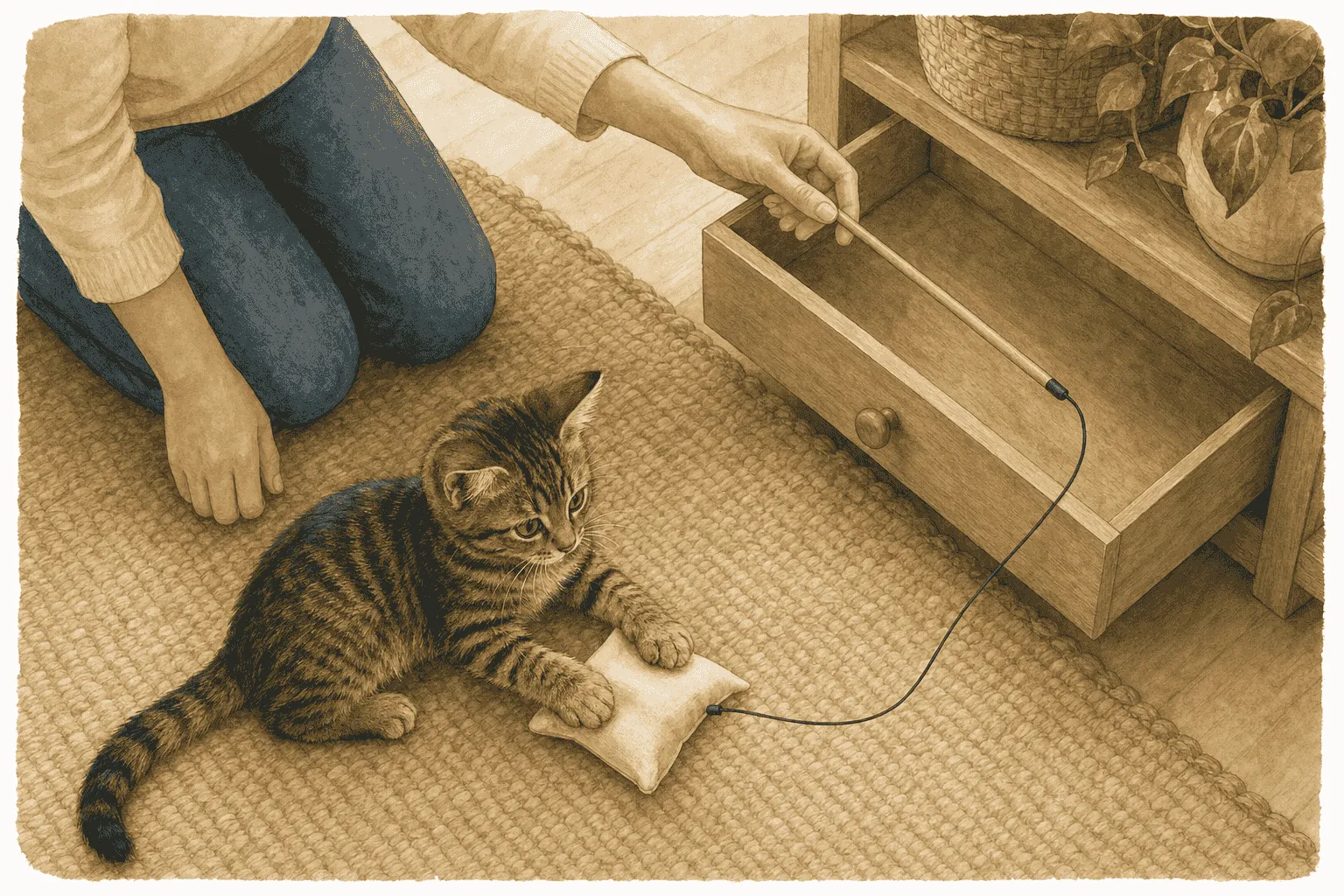
Hair ties and rubber bands are not substitute kitten toys. Cats Protection identifies them as household swallowing hazards, so keep them in a closed drawer. For a closer look at softness and wear during the tooth transition, use the kitten teething-toy checklist.
Give Every Chase a Catchable Ending
A laser dot can move like prey, but paws cannot hold it. Cats Protection’s behavior guidance warns that laser-only play can create frustration because the target cannot be caught. Prefer a physical toy your kitten can stalk, pounce on, and actually capture.
During wand play, let the lure pause, disappear behind an object, and become catchable rather than keeping it permanently out of reach. The goal is not to exhaust your kitten or manufacture nonstop excitement. It is a short, readable sequence with an ending: notice, stalk, chase, catch, then reset.
If a kitten keeps searching after the game, seems fearful, or becomes more wound up instead of settling, stop and reassess the setup. One reaction does not diagnose a behavior problem, but it is useful feedback about that session.
Let Your Kitten End the Session
The caregiver does not have to decide every play length in advance. Cat Friendly Homes guidance treats walking away as the end of that play session. Lower the toy, stop following, and let your kitten choose whether to return later.
Keep fingers, toes, and moving hands out of the role of prey. Cornell Feline Health Center guidance recommends moving the target away from skin and using appropriate toys when play biting or pouncing is the likely pattern. Do not punish, grab, or continue rough play. A single pounce cannot tell you the cause, and not all biting is play.
Know When a Toy Decision Needs Professional Help
A toy plan cannot diagnose or treat a sudden behavior or health change. Contact your veterinarian if biting or aggression is sudden, severe, or unusual, or if your kitten shows pain, reduced appetite, difficulty eating, drooling, oral bleeding, repeated food dropping, or marked withdrawal from normal activity.
Possible string or toy-piece ingestion also needs prompt veterinary direction. Do not induce vomiting or pull visible material. Tell the clinic what the item was, what may be missing, and what you have observed.
Your useful next step is modest: choose one supervised chase toy and one simple intact batting or softer chewing toy. Inspect them, run a short hunt-catch-reset session, honor your kitten’s exit, then inspect and store everything. That routine is more informative than any “must-have” list.
Sources
Petzette's claim cards for this article point to the following scientific, veterinary, or animal-welfare sources.
- AAFP/ISFM Feline Environmental Needs Guidelines 2013: Peer-reviewed veterinary guidelines plus client-facing practice resource
- Surgical Gastrointestinal Foreign Bodies In Cats, 2009-2021: Peer-reviewed retrospective clinical study
Gollnick HR, et al. *Journal of Feline Medicine and Surgery*. 2023;25(6). doi:10.1177/1098612X231178140.
- Cat Friendly Homes: Playing With Your Cat: Veterinary-association caregiver guidance
- Cats Protection: Kitten Teething Advice: Animal-welfare kitten-care guidance
- Cats Protection 2025 Behaviour Guide: Catchable Play: Animal-welfare behaviour guide
- Cat Friendly Homes: Play Ends With The Cat's Choice: Veterinary-association caregiver guidance
- Cornell Cat Destructive Behavior, Play, And Scratching: Veterinary school feline behavior guidance
- Cornell Cat Play Aggression: Veterinary school feline behavior guidance
- Cats Protection: Keeping Your Cat Safe In The Home: Animal-welfare household-safety guidance