Gear Decisions12 September 2026
DIY Cat Toys: A Safer Household Play Plan
DIY cat toys can be simple without becoming loose-part hazards. Use an open-box play plan, supervised sessions, and a repeatable safety check.
TextPetzette Editorial
Read6 Min
Evidence status
Source-backed editorial
- Evidence record
- 8 claim cards linked to 9 documented sources.
- Independent expert review
- Not commissioned. Petzette Editorial is responsible for the published wording.
- Source record checked
- 15 July 2026
- Scope
- General guidance. Individual animals and circumstances can differ.
DIY cat toys do not need to become a craft contest. For a new cat, the useful question is whether a simple household setup gives them a safe way to stalk, chase, catch, explore, or forage while leaving an easy exit. A plain cardboard box can already be a hiding, resting, and play space. The safety work is in the details: keep the route open, supervise anything with a line or loose part, and inspect the setup again when play ends.
This is a household-play plan, not a promise that one homemade cat toy will entertain every cat. Start with one simple option, watch the cat in front of you, and change one part at a time. For the wider decisions about choosing and rotating commercial or household play objects, the first-year kitten toy guide gives the larger frame.
Start With the Play Job, Not the Craft
The 2013 AAFP/ISFM feline environmental-needs guidelines place play and predatory behavior among a cat’s core environmental needs. That does not mean every cat needs the same toy or the same session. It means the home should offer opportunities for a cat to do cat-like things: notice, approach, stalk, chase, catch, and reset.
Before making anything, choose one job:
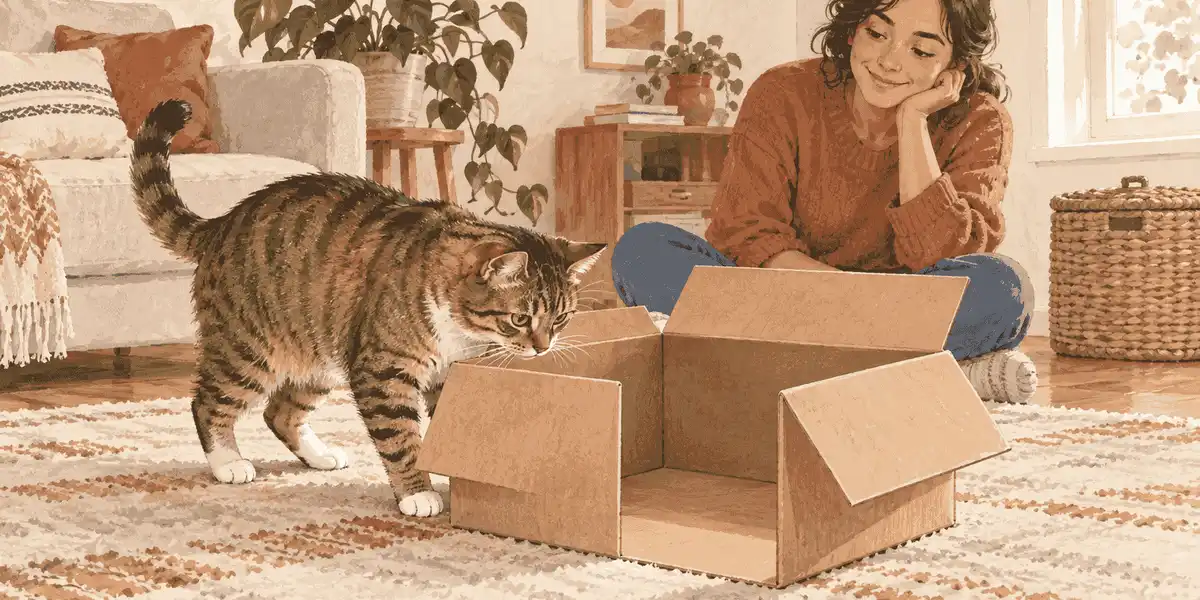
- Explore and hide: Offer an open cardboard box as a place the cat can enter, leave, watch from, or rest in.
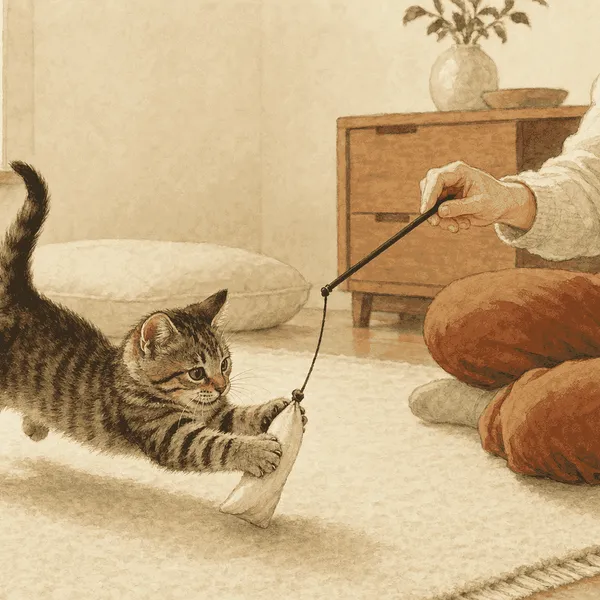
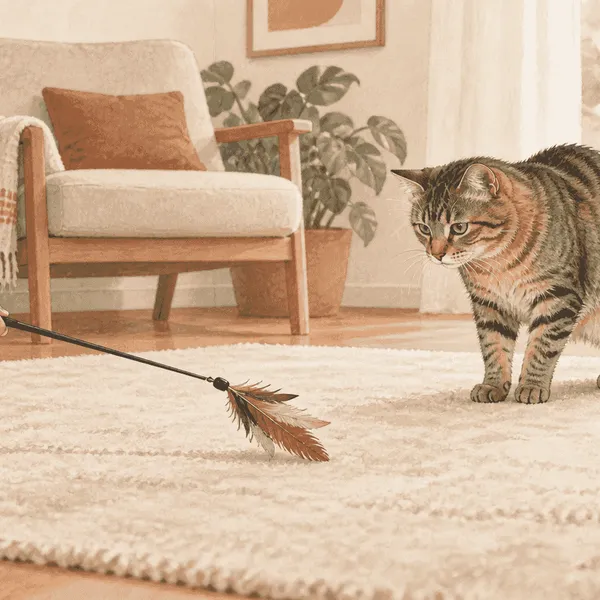
- Chase and catch: Use an interactive toy at a distance from hands, and let the cat decide whether to approach.
- Forage: If you are using a food-puzzle setup, make the first version easy enough that food is released quickly and keep the familiar feeding route available.
The job keeps a homemade cat toy from becoming a pile of random objects. If the cat ignores it, that is useful information about this option—not proof of boredom, rejection, or a health problem.
Make an Open Box the First DIY Option
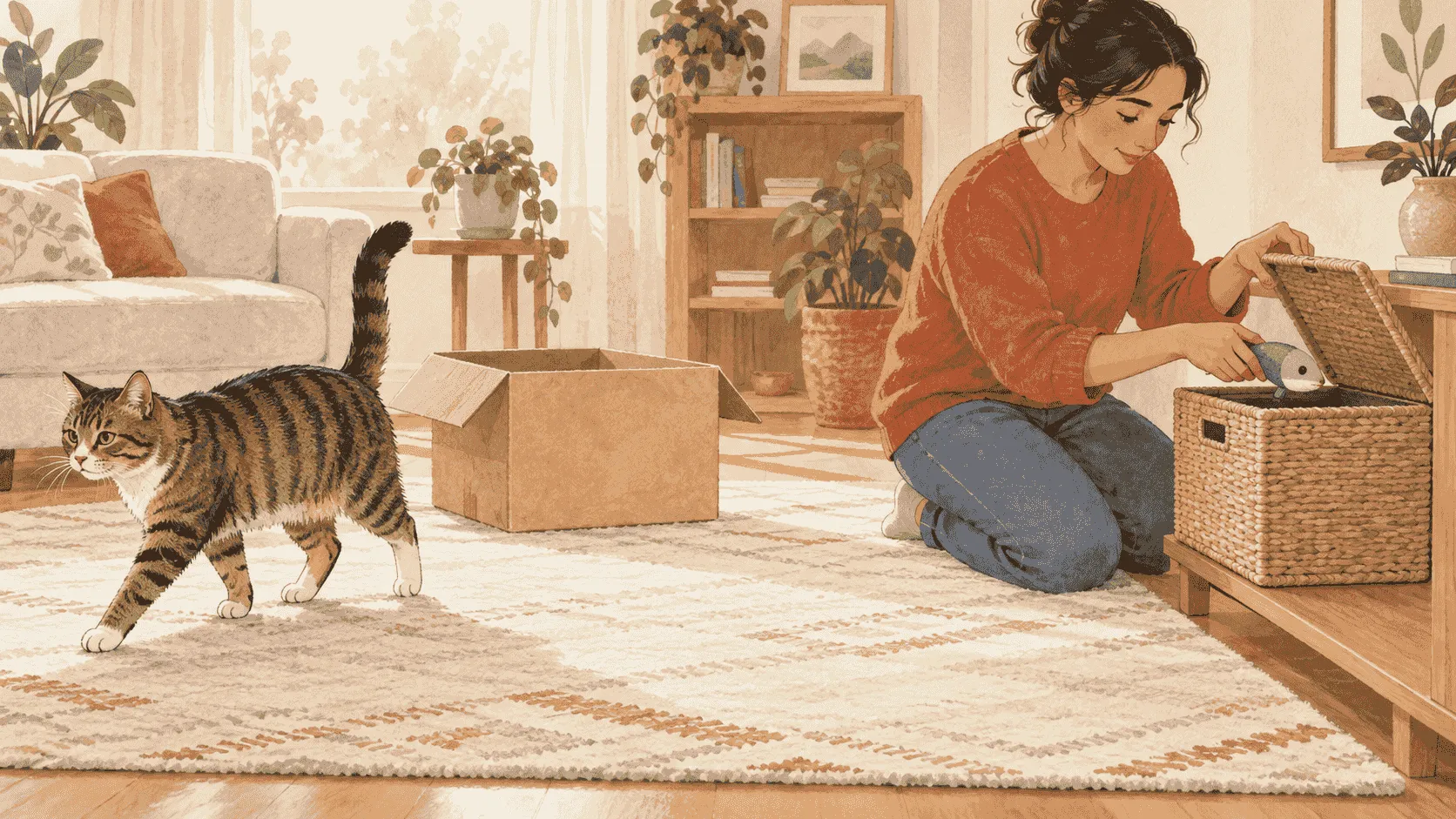
An empty box may already be a complete enrichment setup. Cats Protection guidance describes boxes as useful hiding, resting, observation, and play spaces, with one important boundary: the cat needs an easy exit.
Keep the box open and let the cat choose whether to enter. Do not turn it into a sealed prank, a forced photo opportunity, or a trap. If the box becomes part of a busy route, make room for the cat to leave rather than reaching in and pulling them out. A safe place is valuable partly because the cat controls access to it.
The same guidance supports a small but important household habit: check the box before you tape it, move it, stack it, flatten it, or put it in the bin. An “empty” box is not a reliable description if a cat has been exploring it. Increased or prolonged hiding alongside changes in eating, drinking, toileting, or general health belongs in a veterinarian conversation; the box itself cannot explain why the cat chose it.
Keep Loose Materials Out of the DIY Toy
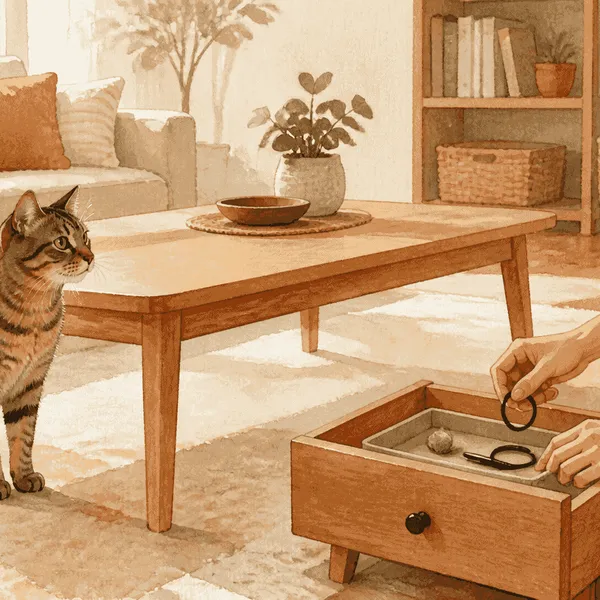
The easiest homemade cat-toy mistake is treating a small, mobile object as automatically safe. Cats Protection identifies hair ties and rubber bands as swallowing hazards, and feline veterinary guidance warns that string, yarn, ribbon, tinsel, and loose toy pieces can cause serious intestinal problems if swallowed.
Do not build a DIY toy from hair ties, rubber bands, loose yarn, ribbon, tinsel, or detachable pieces. Put those materials in closed storage instead. A cat-safe play plan needs a clear “no” list because the objects that are easiest to find are often the easiest to lose track of.
String-type play is a supervised activity, not a leave-behind toy. Cat Friendly Homes guidance recommends active play with the caregiver followed by a put-away step. Watch the line and its attachments while the game is happening, then store everything out of reach as soon as the session ends. Supervision lowers the chance that a problem is missed; it does not make swallowing impossible.
If you think a string, loop, or toy piece may have been swallowed, do not pull visible material, induce vomiting, or wait for it to pass. Contact your veterinarian promptly and describe the object, what may be missing, and what you observed.
Let the Cat Set the Pace
A homemade toy is only useful when the cat can make a choice around it. The AAFP/ISFM framework emphasizes that cats should be able to initiate and control social contact. Cat Friendly Homes guidance makes the play version concrete: when a cat walks away, the play session is over. Lower the toy, stop following, and let the cat reinitiate later if they want to.
Read the whole scene rather than grading the toy. A cat that approaches, pauses, circles back, or leaves may be making different choices in different moments. The cat body-language context guide can help you observe posture, distance, and the route out without turning one reaction into a personality label.
Do not use hands, feet, or clothing as the homemade target. Cornell University’s Feline Health Center advises keeping toy targets away from hands during likely play aggression and ending the interaction rather than using punishment. If teeth or claws reach skin, make the next play offer less personal and easier to interrupt.
If You Add Food, Start Almost Too Easy
Food puzzles are a different kind of enrichment from a chase toy. A 2016 clinical review in the Journal of Feline Medicine and Surgery describes them as a potentially biologically relevant way to let cats work for food, while emphasizing individual preference and gradual difficulty. The evidence supports “can enrich,” not “will fix behavior.”
For a first food-puzzle session, use an easy opening or reservoir so food arrives quickly. If the cat is unsettled by the change, offer the puzzle beside the familiar food container with the usual food rather than removing the known route. Keep the total food inside the cat’s normal plan, and stop if frustration, competition, or reduced intake appears.
This is where a cardboard box can be the wrong material choice: a box that tears, collapses, or hides loose pieces should not be treated as a feeding device without a way to inspect it. Keep the decision modest. An existing, intact food puzzle may be the safer answer than forcing a craft project to carry the whole meal.
Use a Before-and-After Safety Check
Run the same check each time you offer a DIY cat toy:
- Route: Can the cat leave the play or hiding space easily?
- Pieces: Are there any loops, fibers, attachments, or fragments that could be swallowed?
- Choice: Can the cat approach, pause, and walk away without being pursued?
- Condition: Does the box or object still look intact after the session?
- Storage: Have string-type toys and loose materials gone back into closed, out-of-reach storage?
That final inspection matters as much as the first one. A household object can change during chewing, batting, or climbing. Retire the setup when it no longer gives you a clear view of its condition, and check any box before moving or disposing of it.
Know When a Toy Is Not the Answer
A DIY cat toy cannot diagnose or treat a sudden behavior change. Cornell advises considering medical causes before treating aggressive behavior as a training or environment problem. Contact your veterinarian when aggression is sudden, severe, or unusual, or when play changes alongside pain, reduced appetite, marked withdrawal, or another health concern. A qualified behavior professional may also be appropriate when the interaction feels unsafe or difficult to interrupt.
The useful next step is small: put one open box in a quiet place, keep an easy exit, offer a supervised play option, and inspect everything when the session ends. Let the cat’s choice decide whether that homemade setup returns tomorrow.
Sources
Petzette's claim cards for this article point to the following scientific, veterinary, or animal-welfare sources.
- AAFP/ISFM Feline Environmental Needs Guidelines 2013: Peer-reviewed veterinary guidelines plus client-facing practice resource
- Cats Protection Hiding And Cardboard-Box Guidance: Cat-welfare behavior and home-safety guidance
- Surgical Gastrointestinal Foreign Bodies In Cats, 2009-2021: Peer-reviewed retrospective clinical study
Gollnick HR, et al. *Journal of Feline Medicine and Surgery*. 2023;25(6). doi:10.1177/1098612X231178140.
- Cat Friendly Homes: Playing With Your Cat: Veterinary-association caregiver guidance
- Cats Protection: Keeping Your Cat Safe In The Home: Animal-welfare household-safety guidance
- Cornell Cat Destructive Behavior, Play, And Scratching: Veterinary school feline behavior guidance
- Cornell Cat Play Aggression: Veterinary school feline behavior guidance
- Cat Friendly Homes: Play Ends With The Cat's Choice: Veterinary-association caregiver guidance
- Cat Food Puzzles JFMS 2016: Peer-reviewed clinical review