Behavior03 September 2026
Why Do Cats Like Being Petted? Read the Approach, Then Pause
Why do cats like being pet? Learn how to offer brief, optional contact, read the approach, and pause before touch becomes too much.
TextPetzette Editorial
Read5 Min

Evidence status
Source-backed editorial
- Evidence record
- 4 claim cards linked to 5 documented sources.
- Independent expert review
- Not commissioned. Petzette Editorial is responsible for the published wording.
- Source record checked
- 03 September 2026
- Scope
- General guidance. Individual animals and circumstances can differ.
Why do cats like being pet? If you mean petted, the safest answer is not that every cat shares one reason or wants the same kind of contact. A cat may approach, lean into a familiar hand, or return after a pause because this interaction suits them in that moment. That does not automatically mean they want longer strokes, a belly touch, or to be picked up.
The useful decision is smaller: make petting optional, keep the first contact brief, and let the cat’s next movement decide whether you continue. This is a focused contact guide. Our whole-cat body-language check covers the wider task of reading face, posture, movement, distance, and context together.
A Friendly Approach Is Not a Touch Permission Slip
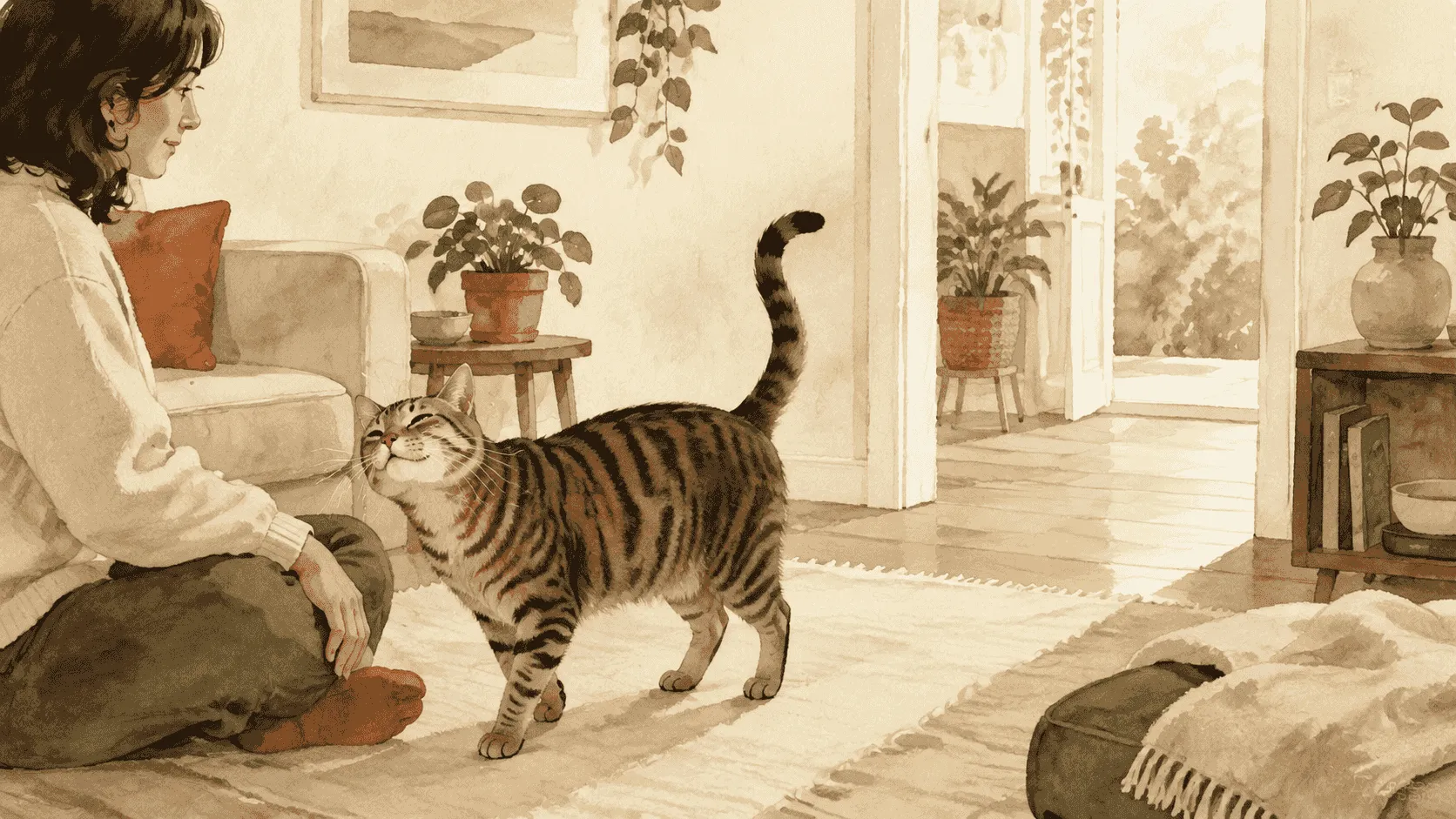
An upright tail can be part of a friendly approach, especially when the cat is walking toward a person or rubbing nearby. Deputte and colleagues’ 2021 Animals study observed tail-up and erect ears frequently in cat-to-human approaches, with rubbing often following. The study did not test whether a tail-up cat wanted petting, lifting, or holding. Its value is narrower: it shows why the approach is worth noticing, not why you should skip the pause.
Look at the sequence rather than translating the tail. Did the cat come toward you by choice? Is the body staying loose? Does the cat remain or return when your hand stops? Is there an open route away? Those details describe this interaction more honestly than a label such as “affectionate” or “in the mood.”
A cat can offer a greeting without offering every kind of handling. Keep a tail-up arrival, a cheek rub, and a decision to touch in separate boxes. The first may be a social clue; the next action still belongs to the cat.
Let the Cat Set the Start and the Stop
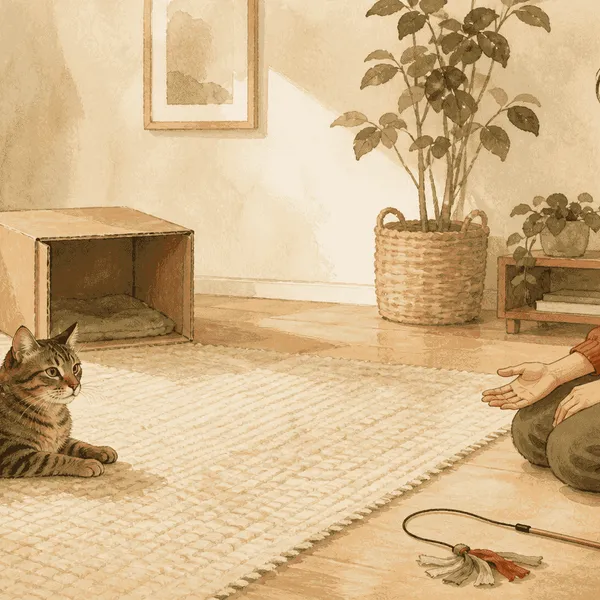
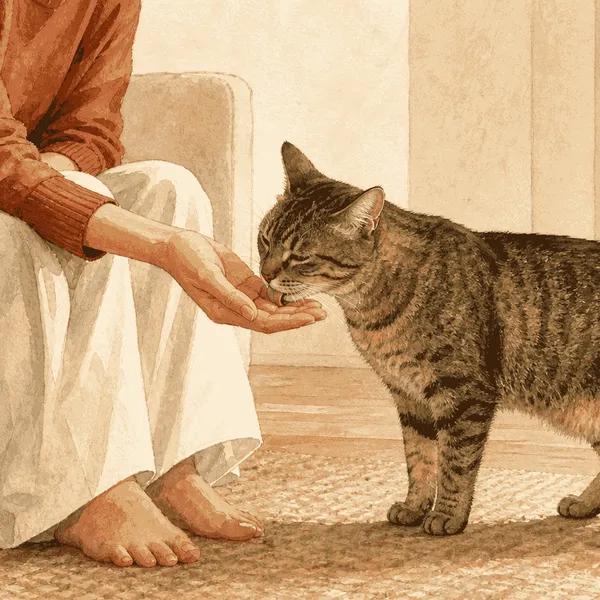
Begin with a quiet, ordinary moment when your cat is already comfortable. Sit or turn slightly sideways. Offer a still hand near a familiar cheek or shoulder area, rather than reaching over the cat or closing off the route. If the cat leans in or stays comfortably close, give a short touch and withdraw your hand. Make the pause long enough to see what the cat chooses next.
The pause is not a magic timer. In a 2021 Frontiers in Veterinary Science study, 100 well-socialized rehoming cats interacted with 120 members of the public before and after people received brief training on choice and control, body-language attention, touch location, and pausing. The post-training observations included more affiliative or positive behaviors and fewer conflict-linked behaviors. Because several parts of the interaction changed together, the study does not show that one fixed number of seconds works for every cat. It supports a broader habit: offer, pause, observe, and adjust.
Cats Protection’s handling guidance makes the same principle concrete for cooperative-care practice. When a relaxed, healthy cat is ready, one second of touch in an area they already accept can be the entire first lesson. Reward immediately, leave an exit, and add duration or a new body area only while the easier step stays easy. Tolerance during practice does not prove enjoyment, and necessary veterinary handling is a separate professional decision.
Read the Return, Not Just the First Approach
Use the next movement as your most useful update. A cat who stays loose, leans back toward a familiar touch, or returns after you stop may be choosing another brief interaction. Offer less than you think you can get away with, then pause again. A cat who turns away, becomes tense, increases distance, or uses the open route is giving you a reason to end this turn without following.
This is not a pass-or-fail consent test. The same cat may prefer cheek contact in one moment and no touch after eating, waking, traveling, or meeting a visitor. A friendly approach also does not settle whether the cat wants to be stroked along the back, touched on the paws, or lifted. Keep the choice specific to the contact you just offered.
For a newly adopted cat, repeat the same small loop in familiar conditions: still hand, brief touch, pause, then follow the return or departure. The first-year cat adoption plan can help you keep interaction alongside quiet access, hiding options, food, and litter routines rather than making petting the only measure of settling in.
Why Petting Can End in a Nip
Some cats nip or bite during petting when repeated contact becomes irritating, overstimulating, or unpleasant. ASPCA guidance describes this petting-induced aggression pattern as a cat becoming irritated and then nipping or leaving. The bite may not be random; a small change before it may have been easy to miss.
If the cat’s body changes, stop the hand before testing the moment again. Keep your hands still, make space, and let the cat leave. Do not shout, grab, hold on until the cat stops struggling, or continue stroking to find out whether the bite was “real.” Our three-context cat-bite response plan covers what to do when teeth appear, including the separate boundaries for play, hissing, and sudden changes.
Shorter contact is not a failed relationship. It is useful information about this cat, this body area, and this moment. A predictable ending can make the next interaction easier to read.
When Touch Tolerance Needs a Veterinarian
Ask your veterinarian about a sudden, persistent, painful, or otherwise concerning change in how your cat responds to touch. New hissing, hard bites, withdrawal, reduced appetite, difficulty eating, or sensitivity in one area should not be explained away as a personality shift. Severe fear or protective behavior may also need a qualified behavior professional.
Do not diagnose pain, anxiety, trust, or aggression from a tail, purr, bite, or departure. Record what changed, what kind of contact came first, what the cat did next, and whether anything else in the routine changed. That observation gives the veterinary team a clearer starting point than a fixed body-language translation.
The answer to “why do cats like being pet?” may remain partly uncertain. Your next action does not have to: offer a small choice, pause, and let the cat decide whether this particular touch continues.
Sources
Petzette's claim cards for this article point to the following scientific, veterinary, or animal-welfare sources.
- Cat Interaction Choice And Control Study 2021: Peer-reviewed controlled before/after human-training study
- Cat Tail-Up Context And Interaction-Choice Limits: Cross-source peer-reviewed feline visual-communication and human-cat-interaction evidence note. It supports one narrow public boundary: an upright tail can accompany a friendly approach, but it is not by itself a permission signal for petting, picking up, or holding a cat. It does not support a universal body-language decoder, an emotion or health diagnosis, a training prescription, a breed or personality prediction, or a named product recommendation.
- Deputte BL, Jumelet E, Gilbert C, Titeux E. *Heads and Tails: An Analysis of Visual Signals in Cats, Felis catus.* Animals (Basel). 2021;11(9):2752. doi:10.3390/ani11092752.
- AAFP/ISFM Feline Environmental Needs Guidelines 2013: Peer-reviewed veterinary guidelines plus client-facing practice resource
- Cats Protection One-Second Handling Training: Animal-welfare handling guidance
- Petting-Induced Aggression In Cats: Veterinary / animal welfare education article