Behavior14 September 2026
Dog Barking at Night: A Calm Check Before You Train
Dog barking at night can have more than one context. Learn what to record, what to change gently, and when a veterinarian should lead.
TextPetzette Editorial
Read6 Min

Evidence status
Source-backed editorial
- Evidence record
- 6 claim cards linked to 5 documented sources.
- Independent expert review
- Not commissioned. Petzette Editorial is responsible for the published wording.
- Source record checked
- 16 July 2026
- Scope
- General guidance. Individual animals and circumstances can differ.
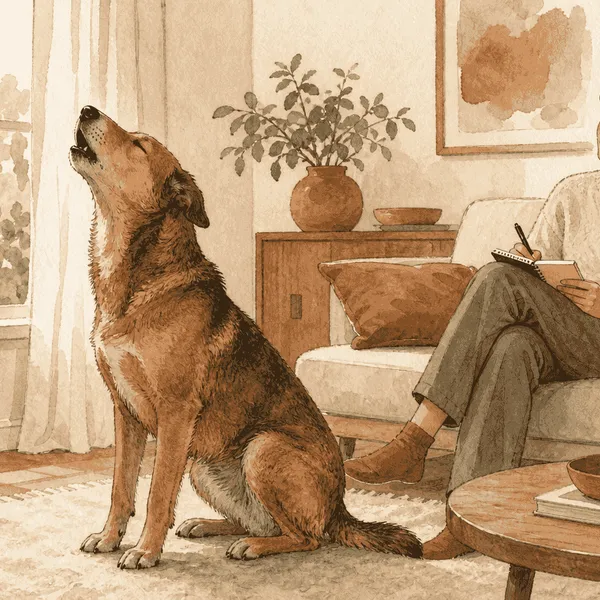
Dog barking at night can feel like a single urgent problem, especially when the house is quiet and you cannot see what started it. But the sound alone does not tell you whether your dog noticed an outside event, struggled with a change in routine, reacted after someone left, or is showing a new behavior change.
The useful first decision is smaller: what happened just before the barking, what is the whole dog doing, and what changes when you make the situation easier? A short, natural record can guide a calm home adjustment. It cannot diagnose fear, pain, separation-related distress, or another condition.
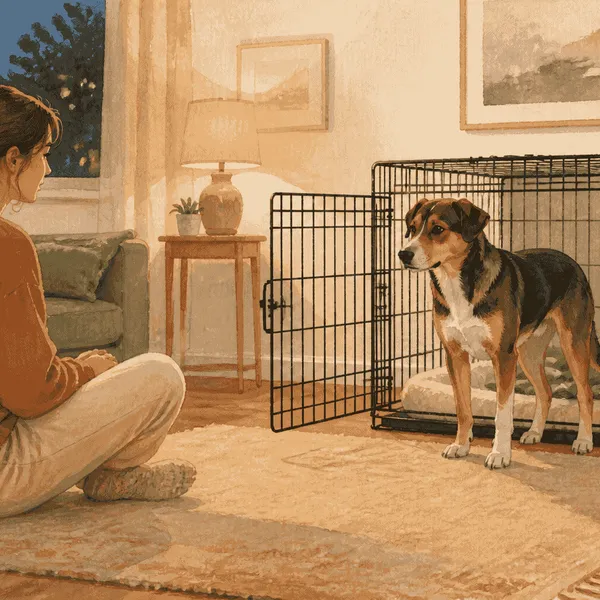
If the barking is specifically happening behind a closed crate door, use the calm crate-barking reset. This guide focuses on nighttime barking outside that narrower crate decision.
Start With a Three-Part Night Record
Dogs Trust’s barking guidance treats barking, howling, and whining as normal canine communication that can appear in several contexts. It recommends noting when and where barking happens, what surrounds it, and what the dog’s body is doing rather than assigning one meaning to the sound.
For the next naturally occurring episode, write three short lines:
- Before: What happened in the minute or two beforehand? Note lights going out, a person moving, a sound outside, a change in the evening routine, or a departure.
- During: Where is your dog looking? Is the body loose, still, tense, retreating, pacing, hiding, or trying to create distance? Can the dog move away from the window, door, person, or sound?
- After: What changed when you lowered the noise, added distance, opened a route, or returned to the room? Did the dog recover, keep scanning, or become more distressed?
If it is safe and does not require provoking the dog, a brief recording can preserve timing and context for your notes. Do not replay a sound, stage the trigger, corner the dog, or keep the episode going for better footage. The record is an observation aid, not a home test.
Check the Routine Before You Add More Activity
A nighttime plan works better when it includes the quiet parts of the day, not only exercise and entertainment. Dogs Trust’s routine guidance describes recognizable opportunities for food, toileting, activity, social time, and undisturbed rest. The exact clock can vary; the useful feature is a pattern that fits this dog and household.
Compare the barking night with an ordinary night. Was a familiar rest period crowded out? Did the household schedule shift? Was the dog settling in a place with a clear view of movement or an unfamiliar sound? You are looking for a change to describe, not a single explanation to announce.
More exercise is not a universal answer. A full calendar still needs blank space, and trying to tire a dog out until they stop making noise can hide whether the dog is comfortable. Keep the next evening readable: protect an undisturbed resting area, preserve ordinary toileting and social needs, and change one manageable part of the setup at a time.
Separate Outside Sounds From Alone-Time Distress
If barking starts after a noise outside, near a window, or when the household becomes quiet, reduce the trigger where you safely can. Close a curtain before a predictable burst of activity, move the resting spot farther from the busiest view, or invite the dog to a calmer area with a clear route. Then watch whether the dog can turn away, settle, or choose distance.
Some household sounds that seem ordinary to people can be stressful for individual dogs. A 2021 Frontiers in Veterinary Science study of owner reports from 386 dogs described barking, retreating, pacing, whining, hiding, tucked ears, shaking, panting, yawning, and lip licking around common household noises. The study had convenience-sample limits, so it cannot tell you how common any one response is. It does support a practical boundary: read the whole response and offer relief rather than replaying a reaction for amusement. Do not disable a working safety alarm to solve a barking episode.
If barking begins after you leave, look for a wider pattern such as pacing, trembling, destruction, toileting indoors, or whining. RSPCA guidance says these behaviors can reflect distress rather than revenge. One bark or one mess does not diagnose separation anxiety, however. Repeated distress, panic, escape attempts, or injury risk needs veterinary and qualified behavior support. The rescue-dog separation guide explains how to observe the first minutes of an absence without turning departure into a longer test.
Change One Thing, Then Reward the Calm Alternative
Once you have made the situation easier, choose one alternative behavior that fits the scene. Your dog might look back at you, turn away from the window, step toward a mat, or settle in the resting area. Reward that response while the dog is still able to perform it. The goal is to make the next useful move clear, not to demand silence after the dog is already overwhelmed.
Dogs Trust recommends matching management to the trigger, reducing predictable opportunities to rehearse the barking, and rewarding calm behavior. The American Veterinary Society of Animal Behavior’s 2021 position statement similarly supports reward-based training that teaches what to do rather than relying on fear, pain, intimidation, or discomfort.
Do not shout over the barking, force the dog to face a window or sound, or use a correction collar as a shortcut. Those responses can suppress noise without answering whether the dog is frightened, uncomfortable, or unable to settle. For the broader sequence of identifying triggers and building a calm alternative, see the context-first dog barking guide.

Know When Night Barking Needs a Professional Check
Treat a new pattern differently from an established one. Dogs Trust advises veterinary review when a dog starts barking after not doing so before, or when the behavior becomes notably more frequent or different. Night barking does not prove pain, cognitive change, or any other diagnosis. It does mean a marked change from this dog’s baseline is worth reporting rather than treating as a training failure.
Ask your veterinarian about barking that is sudden, persistent, paired with a sleep or settling change, or accompanied by signs that the dog is unwell or uncomfortable. Pause home experiments and seek veterinary and qualified behavior support for panic, repeated escape attempts, injury risk, significant aggression, or persistent distress.
A Five-Minute Decision for Tonight
Use the record to choose the narrowest safe next step:
- The dog is comfortable and recovers: note the trigger, reduce it if practical, and reward a calm turn-away or settling choice.
- The trigger repeats but the dog can still think: add distance or a visual barrier, protect rest, and practice only the easy alternative.
- The change is new, escalating, or distress-linked: stop trying to solve it with more repetition, preserve the timing and body-language notes, and call your veterinarian or a qualified behavior professional.
The goal is not a silent night at any cost. It is a clearer decision: observe the pattern, protect rest and choice, teach a calm alternative with rewards, and let professional assessment handle what a nighttime bark cannot settle.
Sources
Petzette's claim cards for this article point to the following scientific, veterinary, or animal-welfare sources.
- Dogs Trust Barking Causes Triggers And Support: Established animal-welfare guidance for low-risk behavior observation, management, and training boundaries
- AVSAB Humane Dog Training 2021: Veterinary behavior society position statement
- Dogs Trust Predictable Routine And Rest: Animal-welfare routine guidance
- RSPCA Dog Left Alone Training: Animal welfare organization owner guidance
- Companion Dogs And Common Household Noise: Peer-reviewed canine behavior and owner-perception paper
Grigg EK, Chou J, Parker E, et al. Stress-Related Behaviors in Companion Dogs Exposed to Common Household Noises, and Owners' Interpretations of Their Dogs' Behaviors. Frontiers in Veterinary Science. 2021;8:760845.