Behavior16 October 2026
Dog Barking at Other Dogs: Create Distance Before Training
Dog barking at other dogs needs a context-first plan: create distance, avoid forced greetings, reward calm choices, and know when to seek help.
TextPetzette Editorial
Read6 Min

Evidence status
Source-backed editorial
- Evidence record
- 4 claim cards linked to 3 documented sources.
- Independent expert review
- Not commissioned. Petzette Editorial is responsible for the published wording.
- Source record checked
- 15 August 2026
- Scope
- General guidance. Individual animals and circumstances can differ.
Dog barking at other dogs is a scene to understand, not a label to punish away. A bark, lunge, growl, or sudden retreat can happen for different reasons, and the same dog may respond differently on a lead, in a crowded place, or at night. The first useful decision is usually to create enough room for everyone to stay safe and then record what happened.
This guide is for a repeated or concerning response around other dogs. It does not diagnose aggression, fear, frustration, pain, anxiety, or a bite risk. If you are bringing a new puppy into a home with a resident dog, the new-puppy introduction plan is a separate setup decision with its own space and supervision needs.
Dog Barking at Other Dogs Is a Context Question
The word “reactive” can be useful shorthand for a visible response, but it is not a complete diagnosis. A peer-reviewed clinical review by E. Stelow explains that behavior diagnosis needs a behavioral and health history, direct observation and examination, and consideration of medical and behavioral differentials. A short clip or a difficult walk can contribute information; it cannot settle what the dog feels or why the response happened.
Start by describing the scene in plain language. Note:
- what appeared first: a dog at a distance, a close pass, a narrow path, a doorway, or a sudden approach;
- how far away the other dog was when your dog noticed it;
- whether your dog was on lead, behind a barrier, in a group, or able to move away;
- what the whole body did, including turning away, freezing, pulling, barking, lunging, or trying to create space; and
- whether the pattern is new, becoming more intense, or different in another setting.
Cornell’s veterinary behavior guidance distinguishes a reactive response from an automatic aggression conclusion and emphasizes that context changes the picture. The useful record is not “my dog hates dogs.” It is “my dog saw a dog on a narrow pavement, stiffened at this distance, and could not turn away.”
Record the Trigger Without Testing It
It is tempting to walk closer to find the distance at which barking begins, arrange a greeting, or ask another dog to stand still while you gather information. That turns observation into a test and may remove the choices that keep the scene manageable.
If you can do so without delaying your exit, make a short note after the event. Include the location, the route, the other dog’s movement, the distance that seemed workable, and what helped your dog recover. A calm observation can also include what happened after you created room: did your dog look back, sniff, keep scanning, or remain tense?
Do not approach another dog to prove that your dog can cope. Do not interpret a single bark as a stable personality statement. Dogs Trust guidance recommends recording what a dog reacts to and in which situations, while keeping overwhelming or forced contact out of the plan. Your record should help a veterinarian or qualified behavior professional understand the pattern, not become a home exam.
Create Distance Before You Train
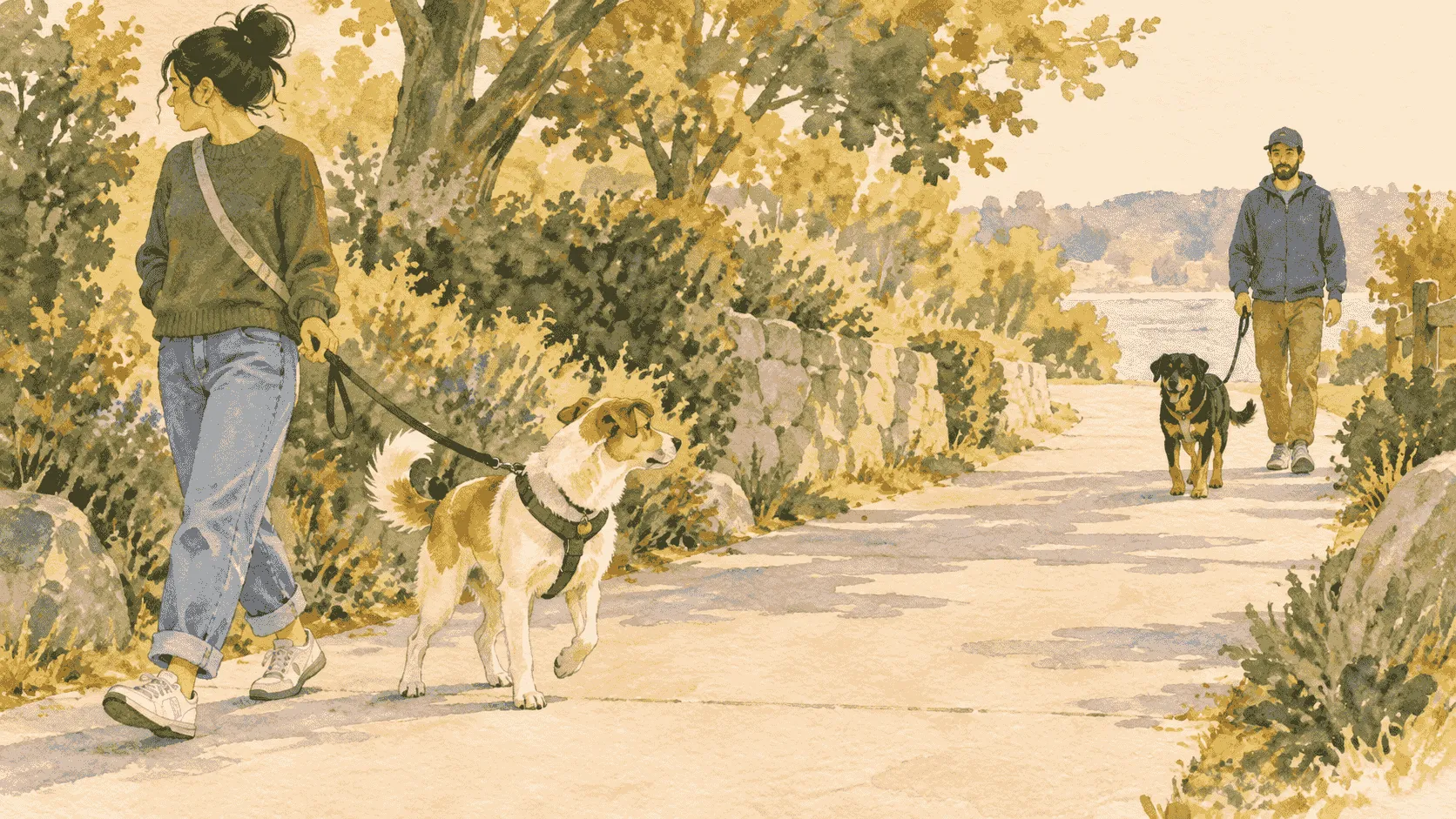
When another dog appears, make room before trying to teach a new response. Turn away early, cross the street when practical, use a wider route, or place a visual barrier between the dogs. The exact choice depends on the environment and the individual dog. The principle is to avoid a forced greeting and give your dog a chance to remain below the point where the response takes over.
Cornell recommends identifying triggers and avoiding them temporarily while an individualized plan is developed. Dogs Trust similarly advises creating a workable distance and avoiding interactions that overwhelm the dog. This is management, not a claim that avoidance alone resolves the underlying pattern. It protects the next decision while you arrange better support.
Keep the route open for the other dog as well. Do not tighten the lead and hold your dog in place while waiting for the approaching dog to pass if a safer exit is available. Do not ask two dogs to “sort it out,” and do not treat a dog park or a forced greeting as a universal socialization lesson. A new owner may need to choose a quieter time or a route with more space while the pattern is being assessed.
Reward Calm Observation at a Workable Distance
Once there is enough room for your dog to notice the other dog without escalating, reward a calm choice that your dog can actually make. That might be looking briefly and then looking back, turning with you, sniffing, or continuing along the route. Keep the moment easy enough that the dog can still respond; the goal is not to hold attention beside a trigger.
The American Veterinary Society of Animal Behavior’s humane-training position statement supports reward-based methods and environmental management. It does not create one fixed distance, cue, route, reward, or progression rate for every dog. Do not copy a timetable from another dog or keep moving closer because one repetition went well.
If barking starts, increase distance and end the practice rather than adding pressure. Shouting, leash corrections, pain, intimidation, or flooding may suppress a sound without addressing the situation, and they can make future handling harder to read. A quieter moment is useful only when the dog is also able to move, breathe, and recover with reasonable choice.
Keep Reactivity Separate From Dog-to-Dog Play
Barking at another dog on a walk is not the same decision as supervising play with a familiar or newly introduced dog. Play needs its own observation of both dogs, escape routes, pauses, and willingness to re-engage. The dog body-language guide for play with other dogs covers that different situation.
Likewise, do not use a successful greeting as proof that the walking response is solved. A dog can cope in one setting and struggle in another. Keep the trigger, distance, lead context, and recovery pattern attached to the observation instead of turning one meeting into a prediction about every future interaction.
When to Pause and Ask for Help
Ask your veterinarian about a response that is sudden, escalating, markedly different from your dog’s usual behavior, or accompanied by signs that the dog may be uncomfortable or unwell. A health and behavior history matters before a behavior-only explanation is chosen.
Seek timely help from your veterinarian and a qualified behavior professional when your dog cannot recover, repeatedly attempts to reach another dog, has injured someone or another animal, has a bite incident, or creates a safety problem that you cannot manage. Do not use this article to decide that a particular dog is safe or unsafe off lead, or to choose medication or equipment for an individual case.
If the pattern is established but manageable, bring the record to the professional who will help you plan it. Include where the dog was, what appeared, how much room you had, what your dog did, and what changed after you turned away. That is more useful than a confident story about a motive.
A Safer Walking Decision for Today
Before the next walk, choose a route with an exit, scan early for approaching dogs, and leave more room than you think you need. If your dog notices another dog, turn away while the body is still able to move and reward the calm choice. If the response begins, stop trying to train in that moment, create distance, and make a note afterward.
The goal is not to promise a silent walk or a universal dog-friendly outcome. It is to protect choices, describe the pattern accurately, and let veterinary or qualified behavior support shape the next step for this individual dog.
Sources
Petzette's claim cards for this article point to the following scientific, veterinary, or animal-welfare sources.
- Canine Reactivity: Trigger Context, Managed Distance, and Diagnostic Boundary: Cross-source evidence note combining a peer-reviewed veterinary clinical review, veterinary-school behavior guidance, a veterinary behavior society position statement, and established welfare guidance. It supports observation, managed distance, non-forced contact, and individual veterinary/behavior referral only; it is not a diagnosis, treatment, equipment, legal, or dog-park recommendation.
- Stelow E. “Diagnosing Behavior Problems: A Guide for Practitioners.” *Veterinary Clinics of North America: Small Animal Practice*. 2018;48(3):339–350. DOI: 10.1016/j.cvsm.2017.12.003; PMID: 29429600. Official NCBI E-utilities metadata and abstract were directly retrieved on 2026-08-15 after the browser-facing PubMed page presented a reCAPTCHA interstitial. The accessible abstract says clinical behavior diagnosis requires behavioral and health history, direct observation and examination, and medical and behavioral differentials.
- Dogs Trust Barking Causes Triggers And Support: Established animal-welfare guidance for low-risk behavior observation, management, and training boundaries
- AVSAB Humane Dog Training 2021: Veterinary behavior society position statement