Behavior04 September 2026
Dog Body Language With Other Dogs: Read the Play, Not One Pose
Dog body language with other dogs is a whole-scene read: use a short play break, resist rank labels, and know when to give space or ask for help.
TextPetzette Editorial
Read5 Min
Evidence status
Source-backed editorial
- Evidence record
- 3 claim cards linked to 3 documented sources.
- Independent expert review
- Not commissioned. Petzette Editorial is responsible for the published wording.
- Source record checked
- 04 September 2026
- Scope
- General guidance. Individual animals and circumstances can differ.
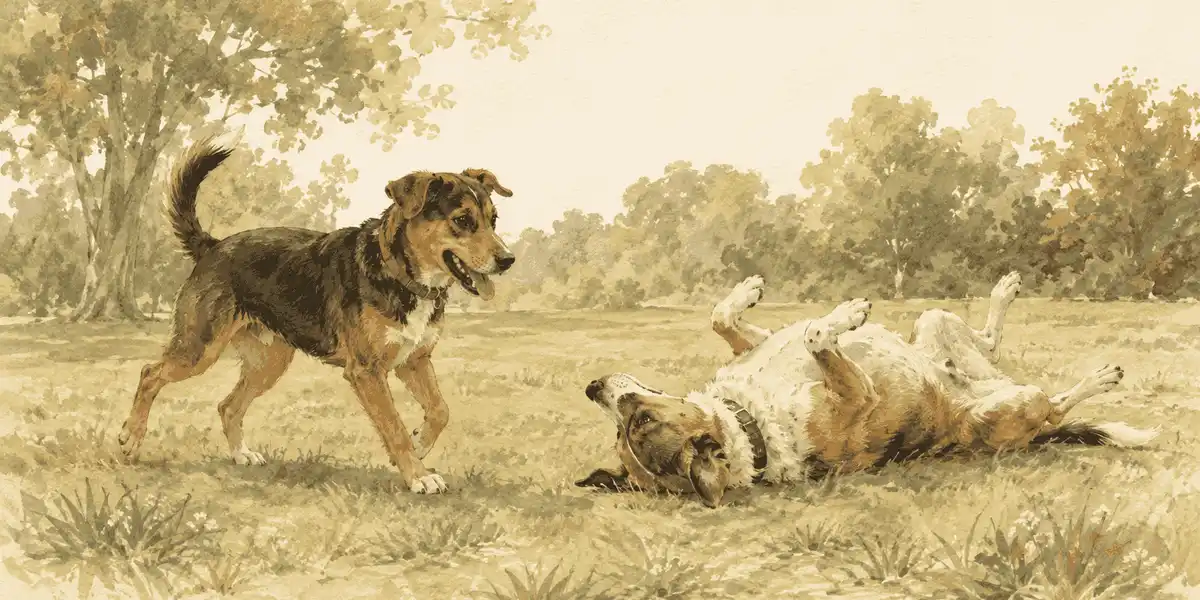
Dog body language with other dogs is easiest to read when you stop looking for a single translation. A dog rolling onto its back during play is a movement in an exchange, not a scoreboard. It does not, by itself, tell you which dog has won, which dog is lower-ranking, or whether the interaction is safe to continue.
The useful decision is smaller: read the whole exchange, pause without adding pressure, and watch what both dogs choose to do next.
A Play Rollover Is Not a Rank Label
In selected dog-to-dog play records, Norman and colleagues described back-rolling as a move that could have defensive, offensive, or solicitation functions. Their 2015 Behavioural Processes paper analyzed 248 rollovers across a staged play dataset and a separately selected public-video dataset. The study did not support treating each rollover as a submission marker.
That finding has a practical limit. The records involved selected play contexts, not every household pairing, a medical assessment, or a safety test for an unfamiliar dog. It supports one careful boundary: do not decide that the dog on the ground has “lost,” or that the dog above is the “alpha,” from a single play moment.
A separate 2015 PLOS ONE study by van der Borg and colleagues looked at repeated interactions in a formed kennel group. An individual on-back or low-on-back posture did not work as a sufficiently robust status measure on its own; the analysis depended on repeated patterns across dog pairs and other behaviors. That is a different study in a different setting, but it reinforces the same owner habit: a pose needs context and repetition before it can be interpreted at all.
Do not turn the rollover into a home hierarchy lesson. Never put a dog on its back to teach respect. That handling idea does not follow from the evidence and can remove the dog’s options when the safer goal is to lower pressure.
Read Before, During, and After the Roll
When two dogs are moving quickly, a still frame can hide the most useful information. Make a three-part observation instead.
- Before: What was the exchange doing? Look for turn-taking, pauses, approach and retreat, and whether both dogs had a clear route away. Note whether one dog was repeatedly chasing, pinning, crowding, or ignoring the other’s attempts to leave.
- During: Read the whole body rather than the back alone. Notice looseness or stiffness, weight shifts, facial tension, ears, tails, vocalizations, and whether the dog on the ground can get up and move. A wag, growl, play bow, or rollover is one clue—not permission, a diagnosis, or a verdict.
- After: Give the dogs room and watch the next choice. Does each dog shake off, sniff, move away, or return with a loose body? Does one dog use the opening to leave? The after-moment often answers more than the rollover itself.
Dogs Trust’s whole-body guidance recommends considering the individual dog, the full body, and the situation. Coat, ear shape, tail shape, and a dog’s ordinary movement can all change how a single signal looks. The whole-body dog-language pause map offers a broader way to lower pressure before you attach a feeling or rank label.
Use a Short Break as a Choice Check
The safest practical test is not a repeated challenge. It is a brief pause that gives both dogs room to answer.
Interrupt the game in a way that does not require reaching between tense dogs. Create space according to the setting, keep your voice and movement calm, and let each dog orient without being pulled into another greeting. Dogs Trust guidance describes short breaks and turn-taking as useful ways to check whether play remains mutual.
After a few seconds, use the pattern rather than a rigid rule:
- If both dogs stay loose and voluntarily return, play may continue in a lower-key burst. Keep watching rather than treating the return as a permanent pass.
- If one dog walks away, hides behind a person, turns its body out, or does not re-engage, let the break become the ending or extend it. Leaving is information, not a problem to solve by luring the dog back.
- If the bodies become stiff, one dog keeps applying pressure, or the route out closes, end the interaction and add more distance. Do not ask the dogs to “sort it out.”
This pause is an observation tool, not a guarantee that a pairing is safe. It also does not diagnose aggression or tell you what either dog feels. For a puppy meeting a resident dog, use the new-puppy introduction plan with built-in space; for a class or group setting, the safe dog-socialization checklist gives the wider setup questions.
Keep Dog Play Separate From Human Touch
A dog-to-dog rollover does not tell you what the dog wants from a person. Do not treat a back roll during a fast exchange as an invitation to reach in, rub the belly, or hold the dog in place. Dog-dog posture and human handling are different situations with different risks and choices.
The same caution applies to videos. A clip may omit what happened just before the roll, whether one dog tried to leave, or what happened after the camera stopped. Use a recording only to describe a pattern to a qualified professional, and only when making it did not require following, cornering, provoking, or physically separating the dogs.
If you are unsure, make the next moment less crowded. A calmer route, more distance, or a completed break can provide better information than a closer look. The aim is not to win an argument about dominance; it is to preserve options while you learn what the pair does over time.
Know When Observation Is Not Enough
End the interaction and create distance for repeated one-sided pressure, guarding, escalating tension, an injury, or a dog that cannot disengage. Do not physically intervene between dogs that are escalating. If there has been a bite, injury, significant aggressive behavior, or persistent concern, contact your veterinarian and seek accredited behavior support.
Ask your veterinarian about a sudden change in a dog’s comfort, movement, or behavior. A play rollover cannot identify pain, fear, illness, personality, or a relationship status. Those questions need the dog’s history and an appropriately qualified assessment.
The bottom line is simple: a rollover is a move, not a rank score. Read the exchange before and after it, pause to give both dogs room, and let their next movements—not a label—guide your decision.
Sources
Petzette's claim cards for this article point to the following scientific, veterinary, or animal-welfare sources.
- Dog Play Rollovers Are Not Status Scores: Cross-source peer-reviewed canine-play and group-status evidence note. It supports one narrow public boundary: in dog-to-dog play, a roll onto the back does not by itself establish a loser, a lower-status dog, or a safe interaction. It does not support a universal body-language decoder, an inference about emotion, health, pain, or aggression, a human-touch conclusion, a training prescription, or a hierarchy claim from one clip.
- Norman K, Pellis S, Barrett L, Henzi SP. *Down but not out: Supine postures as facilitators of play in domestic dogs.* Behavioural Processes. 2015;110:88–95. doi:10.1016/j.beproc.2014.09.001.
- Dogs Trust Play Breaks And Body-Language Check: Animal-welfare behavior guidance
- Dogs Trust Body Language Context Guidance: Welfare organization dog body-language guidance