Behavior30 September 2026
Why Do Cats Eat Plastic? Separate Chewing From Swallowing
If your cat chews plastic, separate licking, chewing, and swallowing, reduce access, and know when a veterinarian needs the full pattern.
TextPetzette Editorial
Read5 Min
Evidence status
Source-backed editorial
- Evidence record
- 2 claim cards linked to 1 documented source.
- Independent expert review
- Not commissioned. Petzette Editorial is responsible for the published wording.
- Source record checked
- 30 September 2026
- Scope
- General guidance. Individual animals and circumstances can differ.
When a cat licks, chews, or appears to eat plastic, the useful first question is not “what is the one reason?” It is “what exactly happened?” A cat may mouth a wrapper without swallowing it, while a torn or missing piece changes the safety question. Those observations need different next steps.
The safest first-year plan is simple: separate licking or chewing from suspected ingestion, remove access to the item, record the wider pattern, and involve a veterinarian if swallowing may have happened or the behavior persists, changes, or comes with illness signs.
Start by separating licking, chewing, and swallowing
Watch from a short distance if you can do so safely. Write down which of these best describes what you saw:
- Licking or mouthing: the cat contacts the plastic but you do not see biting off or swallowing a piece.
- Chewing or tearing: the cat bites, pulls, or leaves tooth marks, but you do not know whether material was swallowed.
- Possible ingestion: you saw a piece go down, a piece is missing, or the cat vomited or passed material after contact.
Do not offer plastic again as a test. Instead, keep the item or take a photo if that is safe, and note its approximate size and shape. Record when the behavior appears, what happened just before it, whether the cat was eating normally, and whether vomiting, diarrhea, reduced appetite, low energy, discomfort, or another behavior change followed. A short history is more useful than a confident explanation based on the wrapper alone.
This distinction matters because chewing and ingestion are not interchangeable research categories. The 2021 UK birth-cohort study of owner-reported pica followed 534 cats at about 6, 12, and 18 months. It included plastics among the materials cats could chew, with or without ingestion. A separate case-control study of privately owned cats found that some cats ingested particular items but only chewed others.
Neither study tells you why one individual cat is interested in one bag, wrapper, or film. The studies are observational and owner-reported. They do not show that boredom, hunger, anxiety, early weaning, a nutrient deficiency, or a compulsive disorder caused your cat’s behavior.
What the plastic-chewing research can—and cannot—say
The UK study reported pica toward at least one material at three questionnaire points in 42.9% of cats at approximately 6 months, 32.0% at approximately 12 months, and 30.9% at approximately 18 months. Those figures describe the study’s owner reports across material categories; they are not a diagnosis of plastic pica and are not a prediction for your cat.
The same paper found that targeting one material type at a time was common. That can make a household pattern look very specific, but specificity is not an explanation. A cat may repeatedly choose plastic because of its texture, smell, movement, or availability—or for a reason the available research cannot separate. The MSD Veterinary Manual’s discussion of cat behavior treats licking, chewing, sucking, and ingesting non-food materials as overlapping oral repetitive behaviors. It also says that disease processes, particularly those affecting the gastrointestinal tract, should be excluded before a medical or behavioral label is assigned.
The practical conclusion is modest: do not dismiss repeated plastic-directed behavior as a cute quirk, but do not diagnose it from a short video either. Repetition, a sudden change, or other signs of poor health are reasons to bring the whole pattern to a veterinarian.
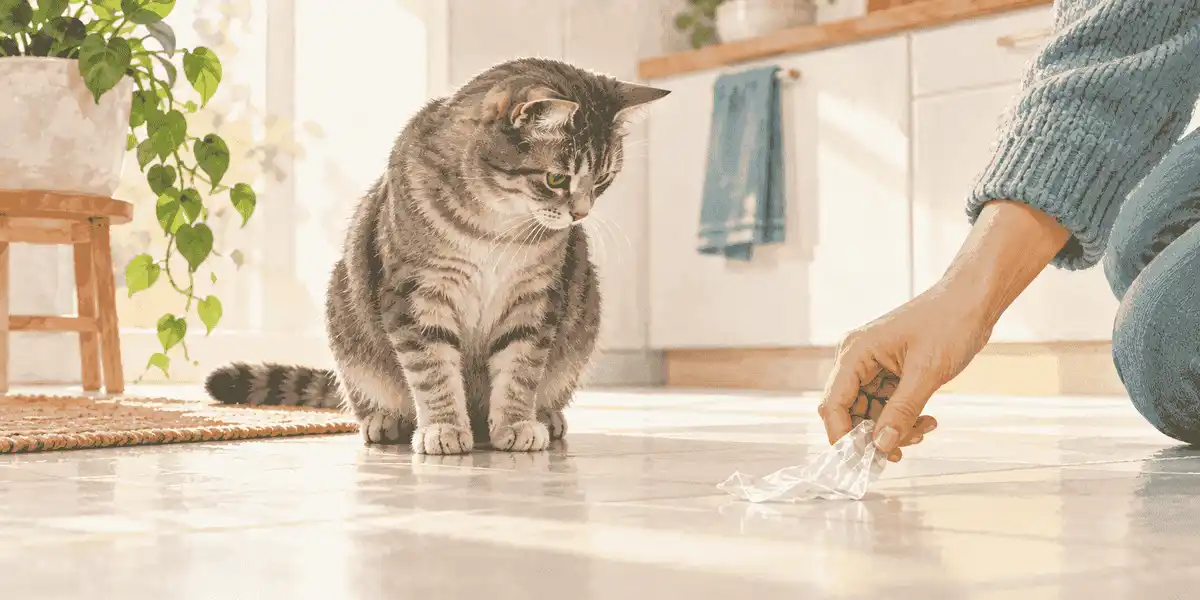
Make the home decision first: remove access without punishment
Plastic is easy to reach in a new-cat household. Clear away wrappers, thin bags, cling film, tape, packaging strips, elasticated plastic, and anything that has already attracted chewing. Use a closed bin, check the floor after unpacking, and look at the cat’s usual routes rather than only the kitchen counter. If a kitten is exploring a new room, the new-kitten first-week home setup is a useful wider checklist for access and resources.
If you see the behavior begin, use a calm interruption and move the item out of reach. Then redirect the cat to an activity that is already known to be safe and supervised. Avoid shouting, chasing, spraying, or turning the moment into a struggle. The MSD guidance supports access management, environmental needs, gentle interruption, and alternative activities; it does not support punishment as a way to discover the cause.
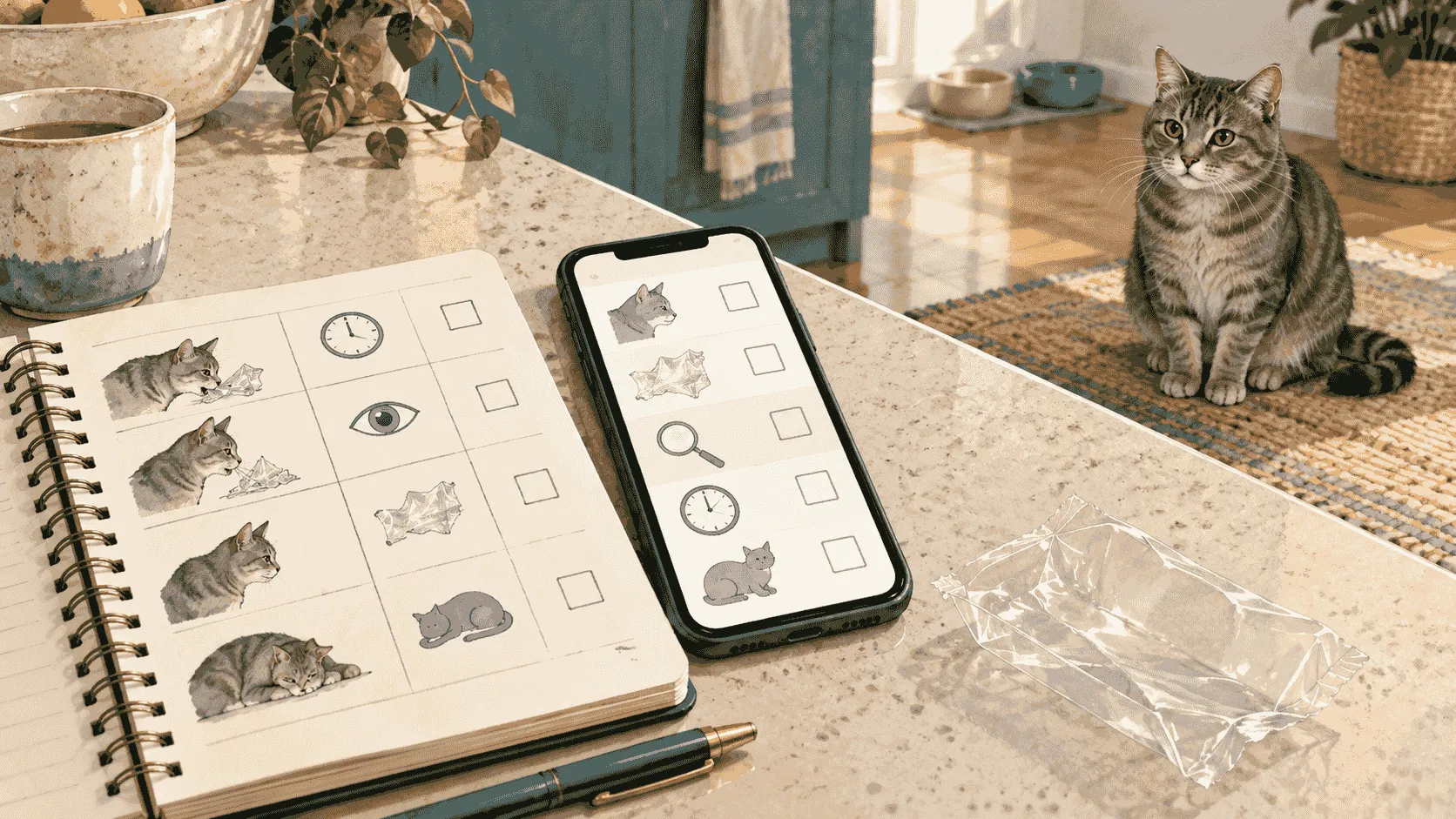
If the behavior keeps returning, log the pattern rather than repeatedly trying the same correction. Note the material, location, time, what preceded it, whether the cat actually swallowed anything, and what changed afterward. That record can help a veterinarian decide whether the next step is mainly environmental, medical, or both.
If swallowing is possible, switch to a foreign-body question
Plastic is not digested like food. The MSD Veterinary Manual’s guidance on gastrointestinal obstruction identifies plastic as a possible nondigestible foreign body and lists pica among risk factors. An obstruction can have variable signs, including appetite loss, vomiting, diarrhea, lethargy, discomfort, or shock. Those signs are not a home diagnosis, and their absence does not prove that a missing piece passed safely.
Contact a veterinarian promptly if you saw your cat swallow plastic, a meaningful piece is missing, or you cannot rule out ingestion. Contact one especially promptly if any of the health or behavior changes above appear. Tell the clinic what the item was, when contact happened, what may be missing, and what your cat has done since. A photo or intact matching piece may help explain the object.
Do not create a home treatment plan from a symptom search. Do not induce vomiting, give medication or laxatives, force food, or rely on a fixed wait time. The right response depends on the object, its shape and location, the cat’s condition, and the veterinarian’s assessment. A strip, string-like piece, or wrapper deserves particular care because cats can develop dangerous linear foreign bodies from materials that catch in the mouth or digestive tract; ask the veterinarian what to do rather than pulling at anything yourself.
Use a three-lane decision
Only licking or chewing, with no missing piece: remove access, make a note of the context, and watch for recurrence or other changes. Persistent or newly intense behavior deserves a veterinary discussion even if the cat appears well.
A piece may be missing or swallowing was witnessed: contact a veterinarian promptly with the object details. Do not wait for a symptom to prove that the material caused a problem.
Possible ingestion plus vomiting, appetite change, diarrhea, lethargy, discomfort, or marked behavior change: treat it as a professional-assessment question and seek prompt veterinary direction. Do not try to identify an obstruction at home.
Plastic chewing is a pattern to investigate, not a personality verdict. Your next step is to remove the immediate access, write down exactly what you observed, and decide whether a veterinarian needs the record now.
Sources
Petzette's claim cards for this article point to the following scientific, veterinary, or animal-welfare sources.
- Feline Plastic Chewing And Ingestion: Peer-reviewed feline pica research and veterinary foreign-body guidance
- Kinsman R, Casey R, Murray J. *Owner-Reported Pica in Domestic Cats Enrolled onto a Birth Cohort Study.* Animals. 2021;11(4):1101. doi:10.3390/ani11041101; PMID:33921455; PMCID:PMC8070519. The prospective UK cohort used owner reports at approximately 6, 12, and 18 months. Plastic was one of the target material categories, and the paper treats chewing with or without ingestion as a distinct observation from the narrower definition of ingestion.