Behavior11 August 2026
Why Do Cats Have Whiskers? A Sensory Care Guide
Why do cats have whiskers? Learn what the evidence supports about close-up sensing, grooming, bowl myths, and when to ask a veterinarian.
TextPetzette Editorial
Read4 Min
Evidence status
Source-backed editorial
- Evidence record
- 5 claim cards linked to 5 documented sources.
- Independent expert review
- Not commissioned. Petzette Editorial is responsible for the published wording.
- Source record checked
- 11 August 2026
- Scope
- General guidance. Individual animals and circumstances can differ.
Why do cats have whiskers? They are specialized sensory hairs that can add close-range information when a cat explores the room. For a new owner, that turns an anatomy fact into a few practical choices: keep routine grooming away from the whiskers, do not turn a bowl or a tight gap into a home test, and notice a sudden facial change without trying to name it yourself.
The useful answer is less magical than the myths. Whiskers are not a built-in tape measure, a one-feature emotion decoder, or a diagnosis for a cat who drops food. They are one part of the cat in front of you.
Whiskers Are Sensory Hairs, Not Decorative Fur
A 2010 PLOS ONE study of mammalian vibrissae, including preserved domestic-cat whiskers, describes these hairs as mechanical transducers: contact-related forces are passed to sensory structures at the base. That is why a cat’s whiskers deserve more care than ordinary coat hair. They can add tactile information when something is close to the face.
That does not give each whisker one simple job. The study was a mechanics and anatomy paper, not a trial of home navigation, grooming, or bowl choice. It cannot tell you that your cat can judge every space perfectly, or that one whisker movement explains a behavior. The safer interpretation is modest: treat the whiskers as sensory information and give the cat room to explore at their own pace.
A Gap Is Not a Whisker Test
It is tempting to watch a cat enter a narrow space and conclude that the whiskers measured it. A 2024 iScience at-home experiment with 30 companion cats gives a more interesting, limited picture. The cats paused and checked alternatives more at very short openings, but did not show the same advance hesitation at the narrowest tall openings.
That result does not show that cats use whiskers as rulers. It also does not promise that a cat will not get stuck. Height, width, posture, experience, motivation, and the room can all matter. Keep small passages open enough that your cat can choose an easier route, and do not stage a squeeze challenge to see what the whiskers can do.
Keep Routine Grooming Off the Whiskers
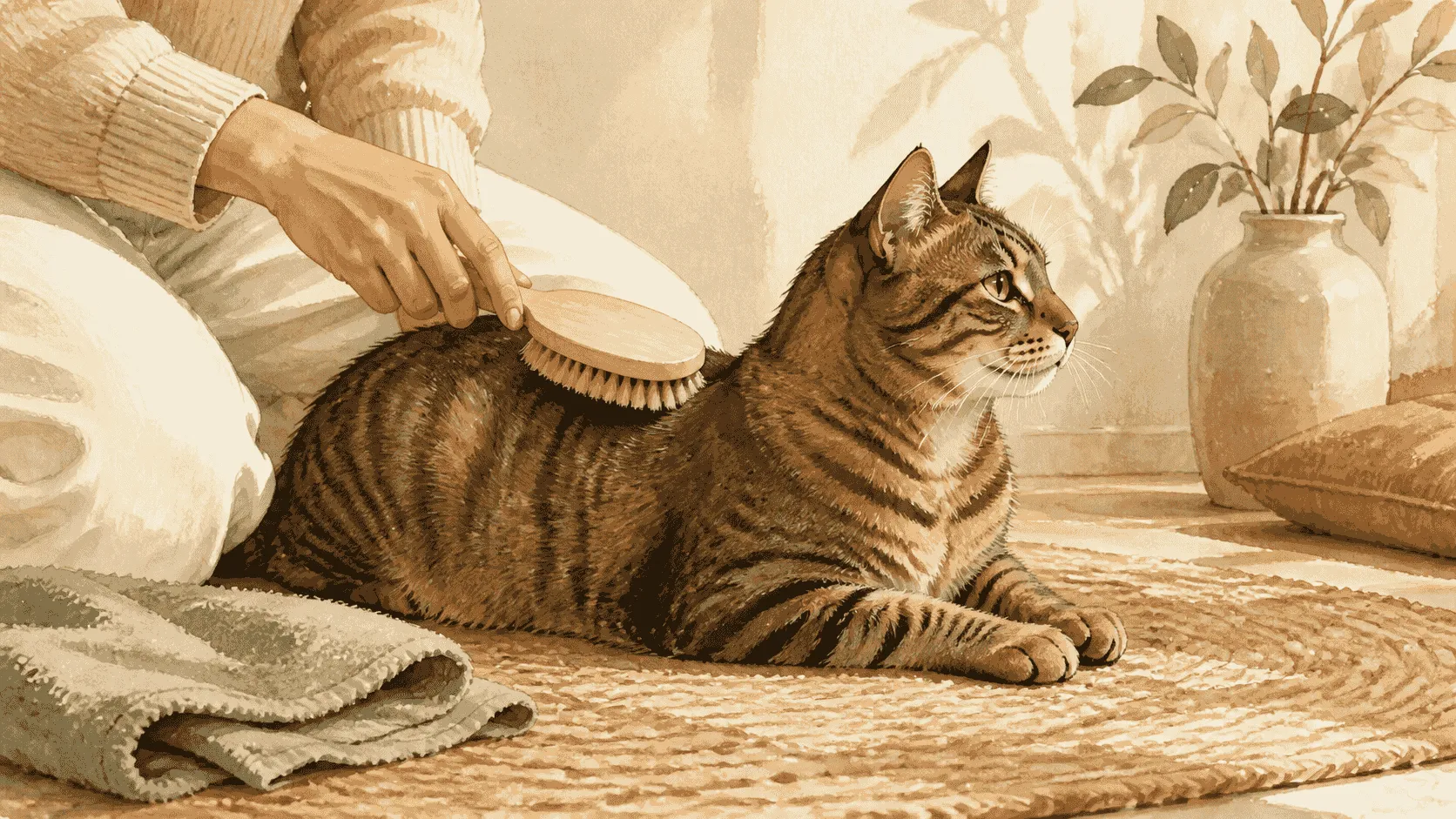
For routine grooming, keep the brush or comb on the coat and leave the whiskers untrimmed. Cats Protection guidance also advises against deliberately pulling, plucking, or cutting them. That is a precautionary care boundary, not a prediction that one trim causes the same outcome in every cat.
If many whiskers are suddenly missing, look damaged, or come with a new eye, skin, mouth, or facial concern, ask your veterinarian what to do next. Do not try to test sensitivity at home by tugging a whisker, changing several things at once, or assuming a face change has one harmless explanation.
Bowl Behavior Is a Clue, Not a Diagnosis
“Whisker fatigue” is often used to explain a cat who eats slowly, drops food, or seems fussy around a dish. A 2021 Journal of Feline Medicine and Surgery study followed 38 cats through a bowl comparison and did not find the advertised improvements in eating time, amount eaten, or dropped food. Your cat may prefer one setup, but the label is not a diagnosis or a universal shopping rule.
If you want to try a practical adjustment, change one calm, ordinary detail and watch the whole feeding pattern: access, location, other cats, the food itself, and what is actually eaten. A measured wet-food routine can make that record clearer. A sudden appetite, weight, chewing, swallowing, or feeding-behavior change belongs with your veterinarian rather than a sequence of bowl experiments.
Read Whiskers With the Whole Cat
Whiskers can move as part of a cat’s face, but they are not subtitles for an exact feeling. In a 2023 Behavioural Processes study of 53 cat-cafe cats, combinations of facial movements differed across social contexts. The useful takeaway is to add ears, eyes, mouth, posture, movement, distance, and what changed in the room before deciding how to respond.
Use the same whole-scene approach in our cat body-language guide. If the cat moves away, give space. If the cat stays or returns, keep contact brief and let the next response guide you. A single whisker position can be a clue in context; it cannot settle the story on its own.
Make the Next Choice Small
When whiskers come up, use this three-step check:
- Protect routine handling. Leave whiskers untrimmed, and avoid pulling or testing them.
- Change one thing at a time. If a feeding or access setup seems awkward, make one low-pressure adjustment and observe rather than buying a diagnosis.
- Escalate the change, not the myth. Record sudden whisker loss, facial damage, or a meaningful eating change and share that pattern with your veterinarian.
Whiskers help explain why close-up handling and thoughtful observation matter. The next step is not to decode them perfectly. It is to give your cat choice, keep the face out of routine grooming experiments, and ask for professional help when the pattern changes.
Sources
Petzette's claim cards for this article point to the following scientific, veterinary, or animal-welfare sources.
- Felid Vibrissae As Mechanical Sensory Structures: Peer-reviewed comparative biomechanics and anatomy study
Williams CM, Kramer EM. *The Advantages of a Tapered Whisker.* PLOS ONE. 2010;5(1):e8806. doi:10.1371/journal.pone.0008806.
- Cats Negotiating Narrow Versus Short Openings: Peer-reviewed at-home behavioural experiment
Pongrácz P. Cats are (almost) liquid!—Cats selectively rely on body size awareness when negotiating short openings. *iScience*. 2024;27(10):110799.
- Cats Protection Guidance On Cat Whisker Handling: Established animal-welfare organization owner guidance
Cats Protection. *Why do cats have whiskers?* Owner guidance page, published 2024. Accessed 2026-08-11.
- Evaluation Of Whisker Stress In Cats: Peer-reviewed prospective at-home feeding study
Slovak JE, Foster TE. *Journal of Feline Medicine and Surgery*. 2021;23(4):389-392. doi:10.1177/1098612X20930190.
- Cat Facial Signals In Social Interactions 2023: Peer-reviewed observational study