Behavior24 July 2026
Why Do Dogs Eat Poop? What to Do First
Why do dogs eat poop? Use a calm access, cleanup, and observation plan, learn what evidence cannot explain, and know when to call your veterinarian.
TextPetzette Editorial
Read4 Min
Evidence status
Source-backed editorial
- Evidence record
- 6 claim cards linked to 5 documented sources.
- Independent expert review
- Not commissioned. Petzette Editorial is responsible for the published wording.
- Source record checked
- 24 July 2026
- Scope
- General guidance. Individual animals and circumstances can differ.
Why do dogs eat poop? The honest answer is that the behavior alone cannot reveal one cause. Your useful first decision is simpler: prevent another opportunity, reward the dog for moving away, record the pattern, and bring a new or persistent change into a veterinary conversation.
This sequence works whether the target is the dog’s own feces, another dog’s, or cat feces. It does not require you to decide at home whether the dog is exploring, scavenging, repeating a learned pattern, or showing a health-related change.
Why Do Dogs Eat Poop? The Evidence Has Limits
A 2018 study in Veterinary Medicine and Science used two large web-based owner surveys to examine canine coprophagia—the clinical term for feces eating. In the general survey, owners reported seeing 16 percent of sampled dogs eat dog stool at least six times and 23 percent at least once. Among frequent stool eaters, the target was usually stool no more than two days old.
The surveys found no association with the dog’s age or diet, and frequent stool eaters were reported as similarly easy to housetrain as non-stool eaters. Those findings do not identify the reason for one dog’s behavior. They do challenge two tidy assumptions: that feces eating automatically reveals a nutrient deficiency or that it shows a failure of toilet training.
Merck Veterinary Manual’s 2025 behavior review leaves several contexts open, including exploration, scavenging, maternal behavior, learning through successful access, and occasional medical contributors. The observation is real; the explanation remains a question.
Use a Three-Step Plan at the Next Toilet Break
Start before the dog reaches the target:
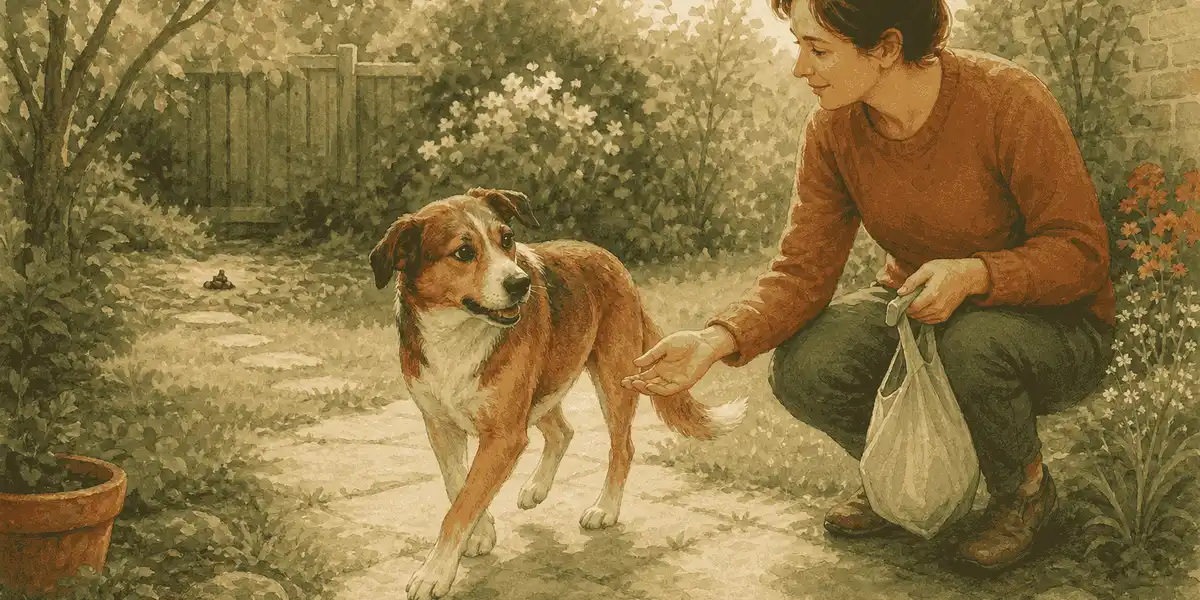
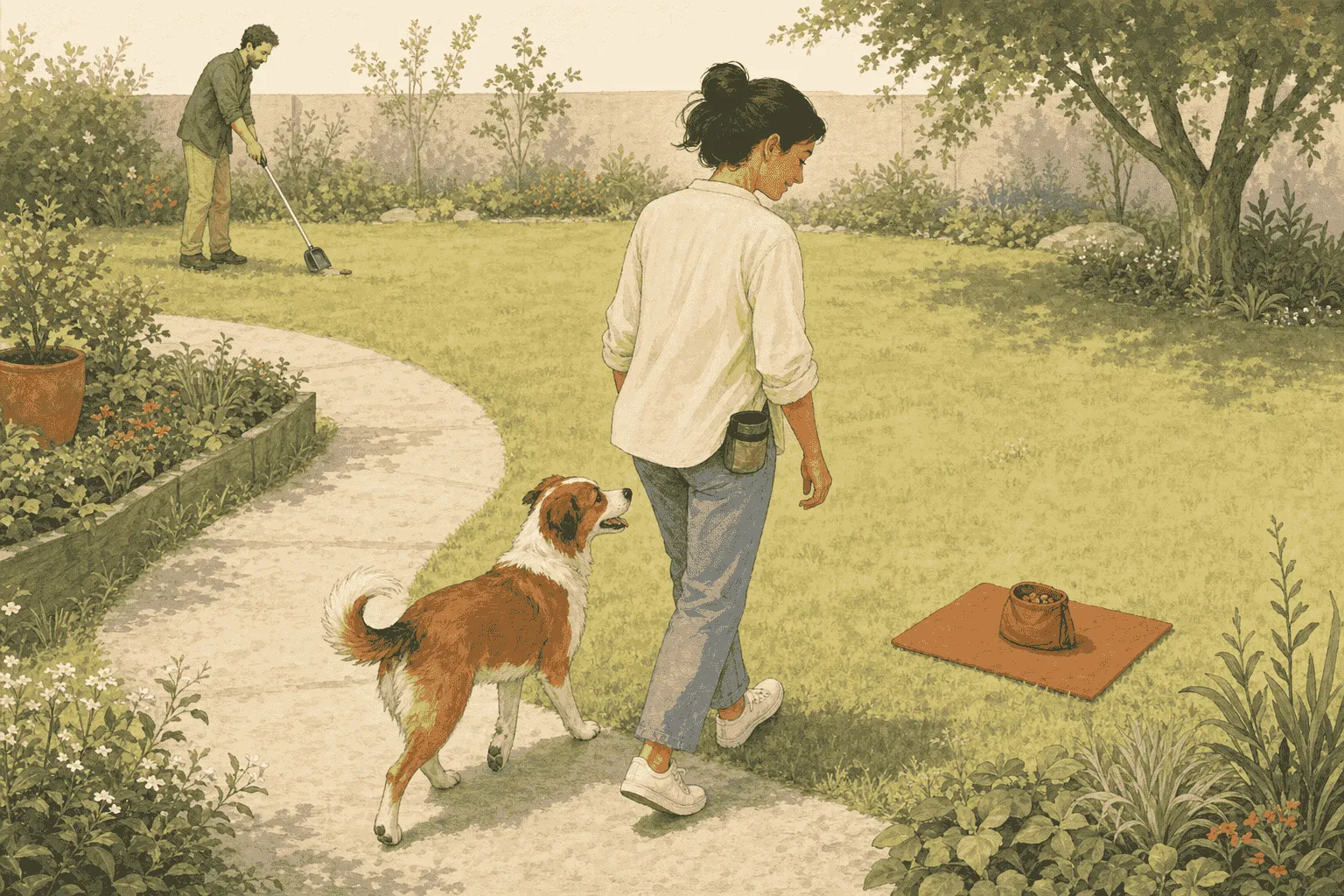
- Supervise the likely moment. Stay close enough to notice elimination and early investigation. Have a reward and cleanup supplies ready.
- Pay the move away. Ask for a simple response the dog already knows, such as coming toward you, and reward it at a comfortable distance from the stool.
- Remove access. Clean up before the dog returns. In a multi-dog home, supervise and clear shared toileting areas often enough that one dog’s feces does not become another dog’s opportunity.
Management prevents another rehearsal; it does not demonstrate that the tendency has disappeared. Build the rewarded turn-away through easy repetitions, then keep the environment doing most of the work. Petzette’s first-time dog owner plan shows how to place small reward-based skills inside a predictable first-month routine.
If Your Dog Eats Cat Poop, Protect Both Animals’ Access
The same access-first logic applies when a dog seeks cat feces. Place the litter area behind a barrier suited to the individual animals and home, while keeping the box quiet, clean, and readily reachable for the cat. A solution that blocks the dog but makes the cat’s toilet difficult to reach creates a different welfare problem.
Keep the cat’s food, rest, and litter routine steady while you change access. If the dog can still reach the box, revise the barrier rather than repeatedly testing a verbal cue beside a tempting target.
Do Not Turn Cleanup Into a Contest
Chasing, scolding, cornering, or reaching into the dog’s mouth can add conflict without explaining the behavior. Reward-based training gives the dog a clear next move; it is not permission to ignore safety.
If the dog stiffens, growls, snaps, guards the stool, or cannot be redirected safely, create distance. Do not test the response again for proof. Ask a veterinarian and a qualified reward-based behavior professional for a plan that accounts for bite risk.
Make a Coprophagia Record, Not a Diagnosis
For several days, note:
- whose feces the dog approached and whether it appeared fresh;
- the time, place, and what happened just before access;
- how often the behavior occurred and whether redirection worked;
- the dog’s current diet, appetite, thirst, weight trend, stool, vomiting, and energy; and
- any recent food, medication, routine, or health change.
This record separates “it happened again” into details a veterinary team can use. It also helps you check whether the management plan is preventing opportunities. If grass eating is happening too, keep it as a separate observation; the research on why dogs eat grass addresses a different ingestion question and safety boundary.
Skip the Miracle-Product Shortcut
In the 2018 survey, owners reported success rates of zero to two percent across 11 commercial products marketed for coprophagia. This was not a randomized treatment trial, and the researchers could not verify how each product was used. It cannot show that no product could help any individual.
It does show why a powder or tablet should not replace access management, a factual history, or veterinary assessment. Do not add supplements, change diets repeatedly, or try a treatment simply because feces eating has been framed as a deficiency online.
When Feces Eating Belongs in a Veterinary Call
Tell your veterinarian about a pattern that is new, increasing, or persistent. Mention any change in appetite, thirst, weight, stool, vomiting, energy, diet, or medication. Merck’s clinical review advises considering medical contributors before assigning a behavior-only explanation; the clinic can decide what assessment fits the individual dog.
Call sooner if the dog becomes unwell or the change is sudden or severe. A general article cannot identify a gastrointestinal, metabolic, nutritional, parasitic, or compulsive condition—and feces eating cannot identify one either.
Your next step is concrete: prepare the reward and cleanup tools before the next toilet trip, supervise the moment, pay the turn away, and start the record. Keep the cause open until the wider pattern and your veterinarian give you better evidence.
Sources
Petzette's claim cards for this article point to the following scientific, veterinary, or animal-welfare sources.
- Merck Dog Behavior And Coprophagia Review 2025: Peer-reviewed veterinary manual clinical review
- Canine Conspecific Coprophagy Survey 2018: Peer-reviewed owner-survey study
- AVSAB Humane Dog Training 2021: Veterinary behavior society position statement
- AAFP ISFM House Soiling Guidelines 2014: Veterinary guideline summary
- Cornell Cat House Soiling: Veterinary school owner education