Behavior24 August 2026
Why Do Dogs Scratch Their Beds? Read the Settling Pattern
Why do dogs scratch their beds? Learn how to read a brief settling ritual, protect the resting spot, and know when a change needs your veterinarian.
TextPetzette Editorial
Read4 Min
Evidence status
Source-backed editorial
- Evidence record
- 5 claim cards linked to 4 documented sources.
- Independent expert review
- Not commissioned. Petzette Editorial is responsible for the published wording.
- Source record checked
- 24 August 2026
- Scope
- General guidance. Individual animals and circumstances can differ.
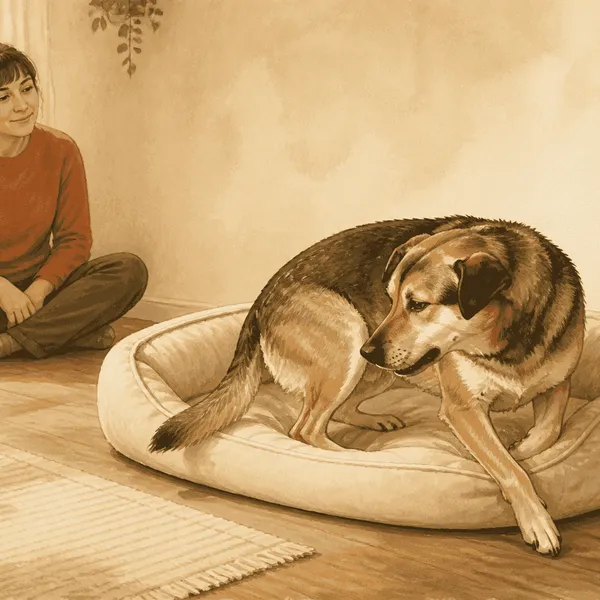
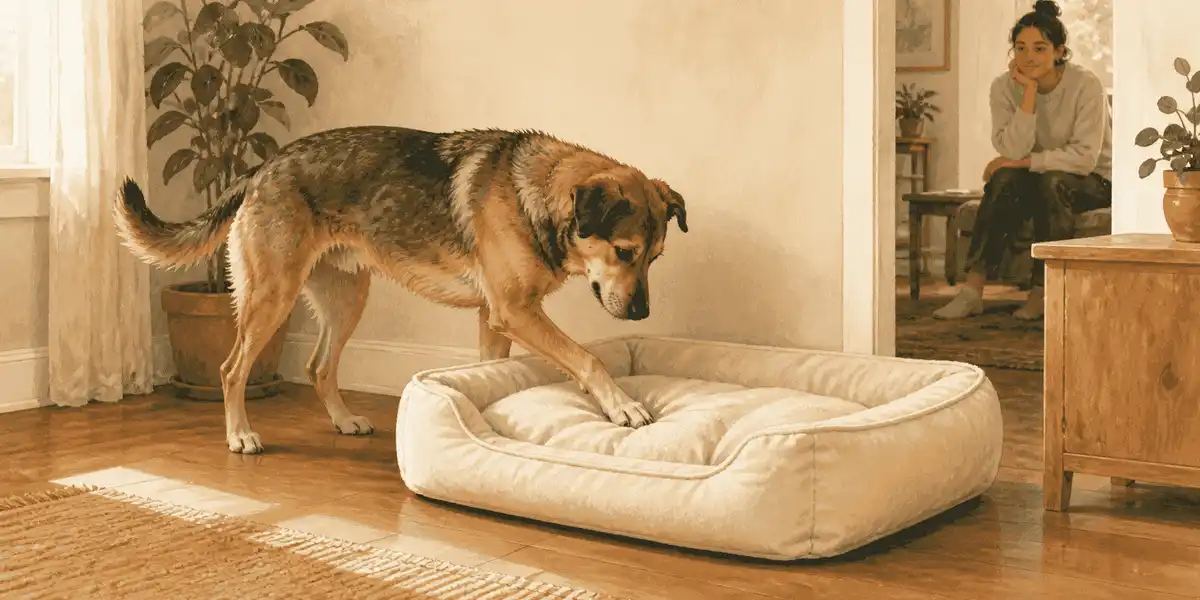
Why do dogs scratch their beds? For a new owner, the useful decision is not to identify a hidden motive. It is to decide whether a short pre-rest routine ends in easy settling or whether a changed pattern deserves a record and professional help. A dog may paw, dig, turn, or rearrange a blanket, but the scratching alone does not explain the individual dog.
This guide focuses on pawing at bedding before rest. It is not a decoder for every movement or a test for pain. Watch what happens after the scratch, compare it with your dog’s ordinary pattern, and keep the next step small.
Why Do Dogs Scratch Their Beds Before Sleeping?
Veterinary sources describe turning before lying down as a common bedtime behavior, and the American Kennel Club notes that some dogs scratch fabric before they lie down. That makes a brief scratch-and-settle sequence a reasonable observation, not an automatic problem.
There are several possible contexts. A dog may be arranging a resting place, following a familiar routine, responding to the feel of the surface, or using behavior connected with scent or nesting. The Merck Veterinary Manual describes scent as part of canine social communication and notes that hormonal changes can be associated with nesting behavior. Those points do not translate one episode into “your dog means this.”
The simplest first check is the landing. If your dog paws briefly, lies down, and rests or chooses another comfortable place, protect the quiet moment and keep observing. If the question is really about turning before lying down, the guide to reading a dog’s circle and landing owns that narrower movement pattern.
Is Bed Scratching Ordinary? Watch the Next 30 Seconds
“Normal” is not a stopwatch result. Read the whole dog, the resting place, and the moment. Notice:
- whether the dog settles after a short bout or starts over several times;
- whether the body looks loose and able to rest or unusually tense, restless, or guarded;
- whether this is familiar for this dog or new on this surface, after a household change, or across several resting attempts;
- whether the dog can leave the bed, choose another place, and return without pressure.
One body part is not the whole dog dictionary. Dogs Trust guidance recommends considering the individual dog, the whole body, and the context because the same behavior can carry different meanings in different situations. A scratch before a relaxed nap is a different scene from scratching that never reaches rest.

Make the Resting Spot Easy to Use
A bed works as a resting place when the dog can approach, settle, and leave by choice. Dogs Trust guidance describes a useful safe space as comfortable, away from heavy traffic where possible, and free from people following the dog in or dragging the dog out. That rule matters during scratching too: do not turn a brief settling routine into a struggle over the bed.
Keep a clear route in and out, and give the dog a quiet period without repeated cues or handling. A predictable daily rhythm still needs undisturbed rest; more activity is not a substitute for the quiet part of the calendar. The dog-bed setup guide covers access, location, and the household do-not-disturb rule without turning a bed choice into a behavior diagnosis.
If scratching is tearing the bedding, catching a paw, or making the resting place difficult to use, supervise the setup and change the situation when the dog is safely elsewhere. The goal is not to punish pawing. It is to keep the resting area usable while you find out whether the pattern is brief and familiar or becoming harder for the dog.
When Dog Bed Scratching Needs a Veterinarian
Move from casual observation to a professional conversation when the scratching is new, prolonged, repeatedly interrupted, or paired with difficulty getting comfortable. A change in movement, posture, rest, appetite, activity, or general behavior also matters. St. Vital Veterinary Hospital places excessive or damaging bed scratching, pacing, pain, and discomfort in the veterinarian-discussion lane; AAHA and Merck similarly treat changed comfort and movement patterns as observations to check, not diagnoses to make at home.
If the change is sudden, severe, worsening, or accompanied by another concerning sign, ask your veterinarian for prompt direction. Do not decide that scratching proves pain, anxiety, boredom, pregnancy, or a compulsive problem. Do not force the dog to lie down, pull at the body, or give a home pain remedy. If the pattern is persistent, distressing, destructive, or unsafe, a qualified behavior professional may also help alongside veterinary guidance.
Use a Two-Episode Bed-Scratching Note
Do not manufacture a scratching episode. Instead, record the next natural one, then compare it with a later episode if the behavior repeats:
- Before: where the dog was, what happened just before, and which resting place they chose.
- During: how long the pawing lasted, whether it repeated, and whether the dog began to lie down and stopped.
- After: whether the dog rested, moved away, chose another surface, or returned to scratch.
- Baseline: what is different from the dog’s ordinary movement, posture, rest, appetite, or behavior.
That note answers the first-year owner’s real question: can this dog settle in this place today? A brief, familiar scratch followed by rest can stay in the observation lane. A failed landing or wider change is a reason to share the record with your veterinarian rather than guess at the motive.
Sources
Petzette's claim cards for this article point to the following scientific, veterinary, or animal-welfare sources.
- Veterinary And Welfare Guidance On Dog Bed Scratching Before Rest: Veterinary behavior and pain-observation guidance. This note supports a narrow owner decision: how to read brief scratching or pawing at bedding before rest and when a changed pattern belongs in a veterinary conversation. It does not diagnose pain, identify a single motive, set a normal scratching duration, or provide treatment.
- Dogs Trust Safe Space For Dogs: Animal-welfare home-environment guidance
- Dogs Trust Body Language Context Guidance: Welfare organization dog body-language guidance
- Dogs Trust Predictable Routine And Rest: Animal-welfare routine guidance